


From 30 December 2026 the EU Deforestation Regulation applies to large and medium operators, and a container of teak root accent and bedside tables that cannot be traced to a mapped plot of land will not clear customs. That is roughly eight weeks away. The paperwork is now the critical path in a guest-room order, not the sawmill.
Summary: Made in Jepara, Indonesia. FOB Semarang, one 20ft container with mixed models. Freight also moves more than duty ever will: the Drewry World Container Index stood at USD 4,429 per 40-foot container on 29 October 2026, down 3% in a week, with Shanghai–Rotterdam at USD 3,686 and Shanghai–Los Angeles at USD 7,514.

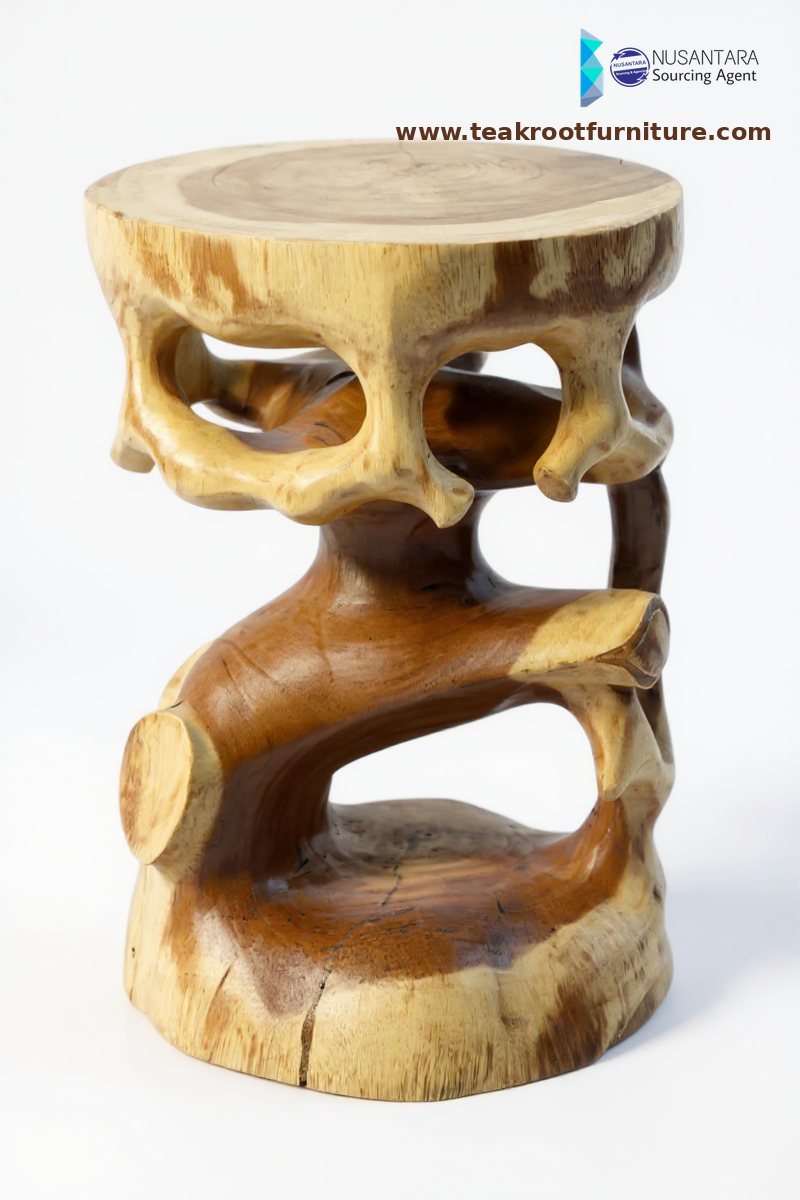
The small pieces are where that bites first. A 200-room hotel orders 400 bedside tables before it orders a single dining table, and a buyer who prices them per unit without pricing the compliance file is the one who discovers the gap in the week the vessel sails. Three things decide whether an order of teak root accent tables and bedside tables makes money in 2026: how many fit in a box, what they cost landed, and what has to be in the file before the container moves.
For the console and side table range with prices and CBM, see the teak root console and side table guide.
Why the small pieces decide whether a container works
Accent tables and bedside tables are the volume line in any hospitality programme, bought in hundreds rather than dozens. Two bedside tables per guest room is the standard, plus a lamp table in suites and accent tables in lounges and corridors. A 120-key property therefore needs around 240 bedside tables before it furnishes a single restaurant.
At roughly 0.12 cubic metres per carton, those 240 pieces are about 29 cubic metres of cargo — one 20-foot container filled by the bedroom alone. Add the lobby, the bar and the meeting rooms and a mid-size refurbishment becomes a two-container order quickly.
The pipeline behind those numbers is not shrinking. Europe's hotel construction pipeline stood at 1,736 projects and 255,976 rooms at the close of Q2 2026, with 773 projects and 116,172 rooms already under construction (Lodging Econometrics, Q2 2026). The largest country pipelines are the United Kingdom at 263 projects, Turkey at 156, Germany at 146, France at 117 and Portugal at 115.
The figure that matters more to a furniture supplier never makes the headline: renovations and brand conversions across Europe total 640 projects and 82,841 rooms (Lodging Econometrics, Q2 2026). A conversion replaces case goods on a fixed brand schedule, in one compressed window. In the United States the same category stands at 2,041 projects and 251,909 rooms against a total pipeline of 5,901 projects and 692,999 rooms (Lodging Econometrics, Q3 2026).
Retail is moving the same way: the 2026 interiors cycle has favoured aged woods, visible grain and hand-finished surfaces over lacquered uniformity (Vogue, July 2026) — the material story a small root table tells at an entry price point.
What contract buyers are specifying in 2026
Specifications have converged, largely because hotel brands now write them into brand standards instead of leaving them to the designer.
- Height. Bedside tables sit at 45–55 cm, with the top within about 5 cm of the mattress surface. Above 58 cm the piece reads as a desk at mock-up stage.
- Footprint and weight. 40–50 cm square. Housekeeping moves the piece one-handed to vacuum, so 12–25 kg is the practical ceiling for solid root.
- Top thickness. 3–5 cm of solid root, flat and stable. Thin slices cup as they dry, which is why the drying schedule matters more than the sanding.
- Finish. Low-sheen hardwax oil or matte PU that can be repaired on site. High gloss survives retail, rarely hotels: one glass ring takes a room out of service.
- Pair matching. No two root sections are identical, so a pair is matched to within about 1 cm in height and 2 cm in top diameter. Write the tolerance into the PO, or you receive two correct pieces that do not belong together.
- Test evidence. European contract buyers ask for EN 15372 reports, the non-domestic table standard, before approving a piece for a public area. In our experience the request has been routine since 2024, especially from UK and German specifiers.
Moisture content is the specification that gets left out and causes the most claims. Teak root is dense and dries slowly; we kiln-dry to 8–12% and hold the pieces before finishing. A supplier shipping at 18% ships a table that will open a seam in a heated room in February. Ask for the meter reading on the batch.
The loading maths: what actually fits in the box
Buyers new to the category estimate volume from product dimensions and are surprised when the container holds 15% fewer pieces. Cartons, corner protection and the stack plan take space, and root furniture cannot be nested like a flat-pack chair. These figures come from our 2025–2026 load plans.
| Item | Carton, approx. | CBM per unit | Units per 20'FCL | Units per 40'HC |
|---|---|---|---|---|
| Teak root bedside table, 45×40×55 cm | 50×45×60 cm | 0.12 | 200–210 | 510–530 |
| Teak root accent table, 45×45×50 cm | 50×50×55 cm | 0.10 | 240–255 | 610–640 |
| Nesting accent set of two | 55×50×58 cm | 0.16 | 150–160 | 390–410 |
| Teak root stool, 35×35×45 cm | 40×40×50 cm | 0.055 | 440–470 | 1,050–1,150 |
| Teak root console, 120×40×80 cm | 125×45×85 cm | 0.48 | 50–54 | 130–138 |
The counts assume 25–27 usable cubic metres in a 20-foot container and 65–68 in a 40-foot high cube. Nominal capacity is larger; the gap is the air around cartons and the pallet-free stacking that root furniture requires.
This is why a mixed container is the sensible first order: 80 bedside tables, 80 accent tables, 40 stools and a few consoles still give a complete story in a mock-up room, and nobody bets a full container on one SKU.
Ready to price a container? Send us your item list and quantities, and we will confirm what fits in one load, the FOB Semarang price and a realistic lead time.
Send your item list for a quote →
Landed cost from Semarang to Rotterdam, line by line
Duty is the line buyers ask about and the one that matters least: wooden furniture under 9403 60 10 enters the EU at 0% in the 2026 Combined Nomenclature. The cost sits in freight, handling and the cash flow of VAT. The example uses 210 bedside tables at an illustrative FOB of USD 55 — substitute your own quote before deciding anything.
| Cost line | Basis | USD |
|---|---|---|
| Goods, FOB Semarang | 210 × 55 | 11,550 |
| Ocean freight, 20'FCL to Rotterdam | forwarder quote, Nov 2026 | 2,400 |
| Marine insurance | 0.4% of CIF | 56 |
| Import duty | 9403 60 10, 0% | 0 |
| Terminal handling and clearance | Rotterdam, per container | 460 |
| Inland delivery | port to warehouse | 300 |
| Landed, before VAT | per unit ≈ 70.30 | 14,766 |
| Import VAT, Netherlands | 21%, recoverable | 3,101 cash |
Two things are worth noticing. VAT is a cash-flow item, not a cost, for a VAT-registered importer — but it is real money for six to ten weeks, and on a two-container order that decides whether the quarter is comfortable. Freight also moves more than duty ever will: the Drewry World Container Index stood at USD 4,429 per 40-foot container on 29 October 2026, down 3% in a week, with Shanghai–Rotterdam at USD 3,686 and Shanghai–Los Angeles at USD 7,514. A Semarang booking is not a Shanghai booking, but the direction is the same, and a rate quoted in June is not a rate in November.
That is why we quote FOB Semarang: two suppliers quoting FOB compare line by line; two quoting CIF to different ports do not.
The compliance file that has to be closed before 30 December 2026
European buyers now spend more time on the wood file than on the finish. Under the EUDR the operator placing goods on the EU market files a Due Diligence Statement resting on plot-level geolocation and a check against the 31 December 2020 cut-off. Indonesia is standard risk: no simplified due diligence, and at least 3% of operators checked. Penalties start at 4% of EU-wide turnover.
Indonesia has a head start here, and it is worth understanding precisely. Its timber legality system, SVLK, underpins the FLEGT Voluntary Partnership Agreement with the EU, and FLEGT-licensed timber is accepted as meeting the EUDR legality requirement — a position the EU reaffirmed in August 2026. But a FLEGT licence does not replace the Due Diligence Statement and does not prove the land was unfelled in 2020. Legality and deforestation-free status are two different tests, and suppliers who treat the licence as the whole answer are the ones whose containers sit at the terminal.
| Requirement | European Union | United States |
|---|---|---|
| Base duty | 0% (9403 60 10, 2026 CN) | Free (9403.60.80, HTSUS) |
| Added layers | Import VAT by member state, 19–23% | 19% reciprocal rate (US–Indonesia agreement, Feb 2026); 10% forced-labour action reported Oct 2026 |
| Wood legality | SVLK / FLEGT licence, accepted for legality | Lacey declaration: genus, species, harvest country, quantity, HTS, MID |
| Deforestation proof | Plot geolocation plus DDS in TRACES | Not required; legality of harvest is |
| Filing | EU system, by the importer of record | Electronic only since 1 Jan 2026; paper PPQ 505 ended |
| First deadline | 30 Dec 2026, large and medium operators | In force for 9403.60 under Lacey Phase VII |
The American side tightened quietly. APHIS Phase VII pulled most remaining Chapter 94 codes, 9403.60 among them, into the Lacey declaration net, and since 1 January 2026 those declarations must be filed through ACE or LAWGS. Teak has its own statistical line — 9403.60.80.89, "Of teak (Tectona spp.)" — which turns the species declaration into a documented fact. The importer of record carries the liability, whoever files it, so harvest country and species must come from the factory before the vessel loads.
On tariffs, treat headlines with care. The reciprocal agreement signed on 19 February 2026 caps the US rate on Indonesian goods at 19%, and October 2026 reporting described a further 10% forced-labour action. Whether those layers stack depends on the Chapter 99 provisions in force on the entry date — ask your broker, and plan the margin on the higher figure.
Where these pieces come from
The root sections are a by-product of plantation teak in Central Java. When a tree is felled, the stump and root mass come out with it; for decades that material was burned or left to rot. Turning it into a table is a drying problem before it is a design problem — a root section is dense, irregular and full of tension.
Our workshop is in Jepara, on Java's north coast, a town that has carved teak for centuries and still trains cabinetmakers through family workshops. Root sections are pressure-washed, trimmed and stacked to air-dry, then kiln-dried for three to four weeks. Then come the slower steps: filling, sanding through several grits and finishing, which for matte oil means several coats with a day between each. A single accent table can occupy a bench for two weeks.
That rhythm explains the lead time: about 12 weeks from confirmed PO to loading on a first order, 50% deposit and the balance before shipment. Capacity is 4×40'FCL per month, and we have shipped more than 300 containers since 2016, mostly to importers and project buyers in Europe and North America. A hotel order rarely stops at bedside tables — it needs a console in the corridor, a coffee table with a glass top in the suite, stools at the bar, a planter at the entrance, all in one finish. Four suppliers produce four oils and four lead times.
Five checks before you sign the purchase order
Most failures we see were visible before the deposit was paid.
- Ask for the moisture reading, not the certificate. A number from a meter on the actual batch, taken in front of the inspector, tells you more than any document about the kiln.
- Approve a pair, not a photo of a pair. Approve the tolerance in writing — height within 1 cm, diameter within 2 cm — and ask for the matched pair to be photographed before packing.
- Confirm the carton, not just the product. Single-face carton with corner protection is standard; if your warehouse receives palletised loads, say so before production, because it changes the stack plan and the freight.
- Get the load plan before the vessel books. Carton counts, CBM and weights are what your broker needs to file and what you check the arrival against.
- Start the compliance file at PO stage. Species, harvest country, mill identification and, for Europe, plot geolocation should be in your hands weeks before shipment, not after the arrival notice.
Frequently Asked Questions
Does an SVLK or FLEGT licence make teak root tables EUDR-compliant on its own?
No. A FLEGT licence is accepted as evidence of legal harvest, but the EUDR adds a second test: the land must not have been deforested or degraded after 31 December 2020, shown with plot-level geolocation attached to the importer's Due Diligence Statement. Treat the licence as half the file and ask for the geolocation data too.
Can accent tables and bedside tables travel in the same 20-foot container?
Yes, and for a first order it is the sensible way to buy. The minimum is one 20-foot container, mixed. As a working example, 80 bedside tables at 0.12 CBM, 80 accent tables at 0.10 CBM and 40 stools at 0.055 CBM come to about 20 cubic metres, leaving room for a few consoles without exceeding a practical load.
What height should a hotel bedside table be?
Aim for 45–55 cm, with the top within about 5 cm of the mattress surface. Above 58 cm the piece reads as a desk; below 42 cm guests reach down for a phone in the dark. If you specify from a brand standard, send the drawing — we build to the drawing, not to a catalogue size.
How long does a first order take from purchase order to loading?
Around 12 weeks, including sample approval, production, finishing and packing, with 50% deposit on order and the balance before shipment. Repeat orders are shorter because nothing has to be re-approved, but we confirm against the actual quantity at PO stage rather than quoting a standard number.
Talk to us about your project
If you are pricing a guest-room package or a retail range, send the item list with sizes, quantities, finish and destination port. We will reply with what fits in one container, the FOB Semarang price per line and a schedule your team can work to. Buyers are welcome to inspect production before the deposit is paid.
Send your item list for a quote →
Packing, loading and shipping
Container loading in Jepara — packed, checked against the packing list and staged before dispatch.
Each piece is wrapped, corner-guarded and packed in a single-face carton, then stacked to a load plan that keeps heavy root sections at the floor and lighter accent tables on top. The packing list is checked piece by piece before the doors close, and we send the load plan, weights and CBM to your broker in advance so the entry is prepared before the vessel arrives.
Where does the container actually leave from?
Loading happens at our yard in Jepara, on Java's north coast. The truck run to Semarang takes about two hours; the container is checked against the packing list at the yard, moved to the terminal, and loaded on a vessel booked out of Semarang as the port of loading. FOB Semarang is the standard term on every quotation we issue.
Our office and factory stand at the same address on every document we issue: Jl. RA Rukmini KM.02 Pekalongan RT.02/V, Tahunan, Jepara 59428, Central Java, Indonesia.
MOQ 1×20'FCL mixed · 4×40'FCL per month · 300+ containers shipped since 2016 · export@teakrootfurniture.com
Written by
Mr. August Praymunor — Overseas Marketing Director
CV. Nusantara Sourcing Agent · manufacturer and exporter of teak root furniture in Jepara, Central Java, Indonesia. We have shipped over 300 containers since 2016, loading 4×40’FCL per month for importers, hotel groups and interior contractors in Europe and North America. Every figure in this article comes from the sources noted in the text or from our own shipping records.
export@teakrootfurniture.com · WhatsApp +62 852 0600 7878 · LinkedIn · Jl. RA Rukmini KM.02 Pekalongan RT.02/V, Tahunan, Jepara 59428, Central Java, Indonesia
If your project also needs a matching set of tops rather than one-off pieces, we produce suar wood dining tables, stools and planters on the same container.
See also
- Teak Root Console and Side Tables for Importers
- Teak Root Coffee Tables with Glass Tops
- Teak Root Furniture Wholesale for US Importers and Designers
- Our teak root furniture range
Modellseiten — Preis, CBM und Containerladung
Eine Seite pro Modell: Größe, Packvolumen, FOB-Preis Semarang und wie viele in einen 20-Fuß-Container passen.
- Console 200 cm — USD 215 · 0.61 CBM
- Console 180 cm — USD 185 · 0.55 CBM
0 comments:
Post a Comment