


Ask a South African importer what surprised them about their first furniture container from Indonesia and the answer is rarely the product. It is the duty. Finished wooden furniture entering South Africa carries a 20% general customs duty (SARS Schedule 1, HS 9403.60) on top of 15% VAT. That is the opposite of the European picture, where the same lines mostly clear at around 0% duty. In South Africa the duty line, not the ocean freight, is what reshapes the landed cost — and the gap between a planned order and a casual one runs into tens of thousands of rand per load.
Summary: Made in Jepara, Indonesia. FOB Semarang, one 20ft container with mixed models. It is indicative, built on a US$12,000 FOB container; your freight and clearing rates will differ, so treat it as a worked method rather than a fixed price.

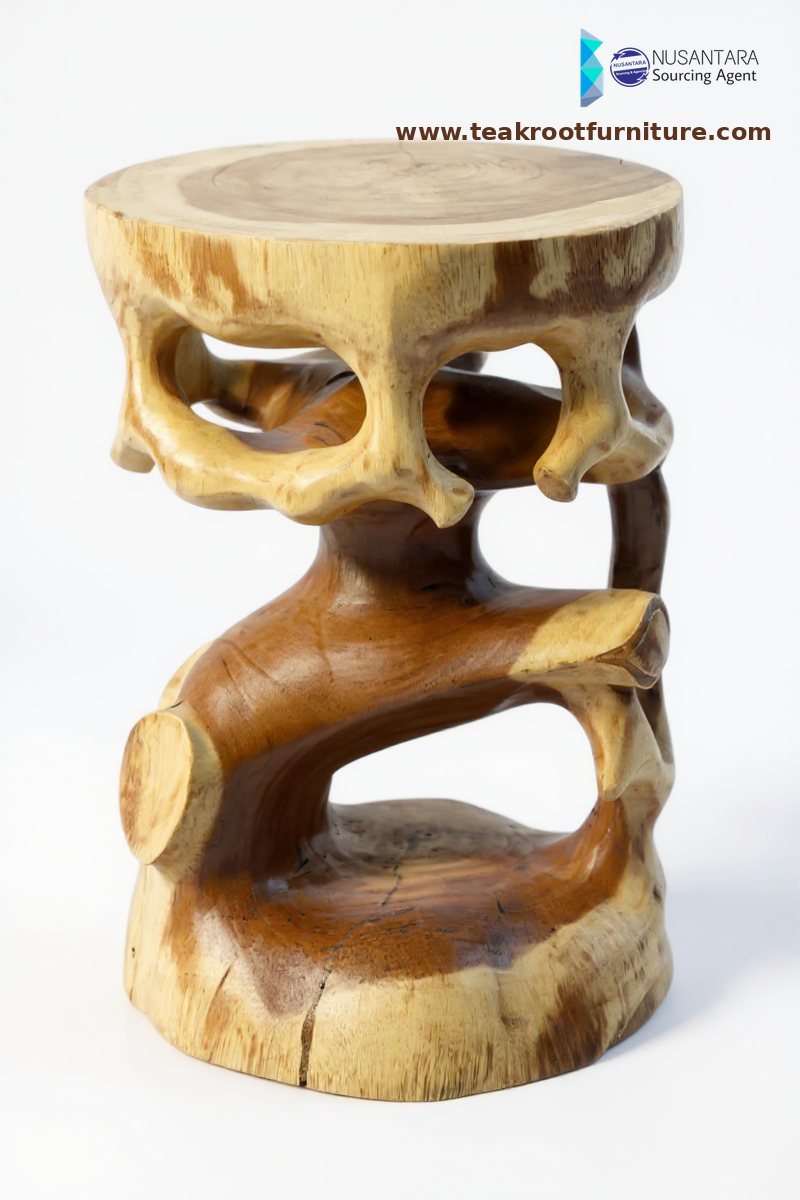
Finished wooden furniture entering South Africa carries a 20% general customs duty under SARS Schedule 1 on top of 15% VAT. That is the opposite of the European picture, where the same lines mostly clear at 0% duty. In South Africa the duty line, not the ocean freight, is what reshapes the landed cost, and the gap between a planned and a casual order runs into tens of thousands of rand per load.
So this is not an article about how lovely the wood is. It is about three things a buyer actually has to solve: where demand is coming from in 2026, how the 20% duty works through a real quotation, and what slows a container down at the port. Get those three right and teak root furniture becomes a straightforward South African business.
What South Africa is specifying right now
The demand signal is unambiguous, and it starts with tourism. South Africa closed 2025 with a record 10.5 million international arrivals, and the recovery has kept climbing since. The Department of Tourism reported 6,576,169 international visitors between January and July 2026, up 12.4% on the same period in 2025. July alone brought 991,696 visitors, a 12.5% year-on-year rise. Hotels, lodges and restaurants are, in plain terms, busier than they have ever been.
That traffic is feeding a construction pipeline. W Hospitality Group’s 2026 survey — the standard industry count — put the African hotel development pipeline at a record 123,846 rooms across 675 hotels and resorts, up 18.6% year-on-year. South Africa is not the fastest-growing part of that pipeline — East and North Africa lead on raw numbers — but it is the continent’s largest and most import-ready furniture market: organised retail chains, a mature contract-furniture and interior-design industry, and the best importer credit quality in Africa. For a supplier, that matters more than a headline room count, because it means an order can actually be financed and cleared.
What specifiers are buying is specific. Cape Town boutique hotels and the Cape Winelands estates want statement pieces in natural, organic forms — a single sculptural root console in a reception, a root coffee table with a glass top in a lounge, a run of root stools along a bar. Safari lodges lean toward heavier, textured pieces that survive outdoor-adjacent use. Johannesburg commercial and residential projects are buying dining tables and consoles in volume. In all of them, the common thread in 2026 is a visible move away from uniform, machine-made finishes toward pieces with a recognisable grain, an irregular edge, and a provenance story.
The 20% duty that changes every quotation
Here is why South African importers cannot simply copy a European landed-cost model. Under the EU Common External Tariff the finished wooden-furniture line sits near zero. Under South Africa’s schedule the same goods attract the 20% general rate, and there is no Indonesia–SACU free-trade agreement to escape it. The SADC and AfCFTA preferential schedules help other African origins, not Indonesian ones. So the general rate applies, cleanly.
Added to that, VAT is charged at 15% on the duty-paid value, not on the FOB price. A VAT-registered importer recovers that VAT, but it still has to be financed at the moment of clearing. And two further flags sit on the customs side: certain furniture lines require an ITAC import permit, and some categories are subject to anti-dumping duties. Those do not touch every product, but they touch enough that the first job on any quotation is confirming the exact eight-digit tariff line, not the six-digit heading.
The table below shows how this works on a representative mixed load. It is indicative, built on a US$12,000 FOB container; your freight and clearing rates will differ, so treat it as a worked method rather than a fixed price.
| Line | Amount (USD) |
|---|---|
| FOB Semarang value — 1×20’FCL, mixed items | 12,000 |
| Ocean freight and marine insurance (approximate) | 2,000 |
| CIF value at South African port | 14,000 |
| Customs duty — 20% of CIF | 2,800 |
| Duty-paid value | 16,800 |
| VAT — 15% of duty-paid value (recoverable if VAT-registered) | 2,520 |
| Clearing, terminal handling and inland delivery (indicative) | 700 |
| Approximate landed cost, excluding recoverable VAT | 17,500 |
Method only. Confirm the exact tariff line, permit requirements and current rates with your SARS-accredited clearing agent before you commit.
The practical takeaway for a buyer is this: negotiate the FOB price, but decide the order on the landed number. A supplier who is 8% cheaper at FOB can be more expensive once freight density, packing volume and the duty base are added in. Which is why the next question — what fits in a container — usually saves more money than haggling over the unit price.
Ready to price a container for South Africa? Send us your item list and quantities, and we will confirm what fits in one 20’FCL, the FOB Semarang price and a realistic lead time — duty and freight worked separately so you can compare landed cost properly.
Request FOB prices and a load planBuild a container load →
What actually keeps a South African container moving
Customs in South Africa is document-driven, and most delays are paperwork, not product. Every commercial shipment needs the standard set — a commercial invoice, a detailed packing list, a bill of lading, and a certificate of origin — and your clearing agent files the customs declaration (the SAD 500) on SARS’s system. On top of that, solid-wood packaging such as pallets and crates must be ISPM 15 heat-treated and stamped, and phytosanitary or fumigation certification may be requested for wood products.
The two South Africa-specific traps are permits and proof of legality. First: if the tariff line on your goods requires an ITAC import permit, no permit means no release, however well-packed the container. Confirm the permit position on the exact eight-digit code before production starts — not after the vessel is already at sea. Second: buyers increasingly want documented legal origin, and Indonesia makes this easy. The SVLK / V-Legal system assures the timber’s legality and is recognised internationally, so chain-of-custody paperwork travels with the load from the workshop onward.
Then there is the port. Durban is South Africa’s busiest container gateway and, in 2026, its most congested. In August 2026, operational problems at the Durban Gateway Terminal pushed vessel waiting times toward 10 to 20 days, with Pier 2 materially constrained — a period that coincided with terminal operator ICTSI’s takeover of operations and a change of IT system. Carriers including MSC and Maersk warned shippers directly. For an importer, that translates into three planning rules: build port time into your delivery date rather than assuming a clean berth; keep demurrage and detention exposure in view; and consider Cape Town or Coega (Ngqura) where routing and cost allow. A supplier who can tell you honestly how long the port is running is worth more than one who only quotes a sailing date.
DATA SHEET - FROM OUR FOB 2026 PRICE LIST
Models that leave the factory most often (FOB Semarang, delivery to Durban / Cape Town)
| Model | CBM/pc | FOB | Max pcs in one 20ft |
|---|---|---|---|
| Cabak Dining Table dia 100 cm | 0.75 | USD 195 | ~32 pcs |
| Cabak Dining Table dia 120 cm | 1.08 | USD 265 | ~22 pcs |
| Cabak Dining Table dia 150 cm | 1.8 | USD 340 | ~13 pcs |
| Mawar Dining Table dia 120 cm | 1.08 | USD 265 | ~22 pcs |
| Mawar Dining Table dia 150 cm | 1.69 | USD 340 | ~14 pcs |
| Mawar Dining Table dia 200 cm | 2.43 | USD 650 | ~9 pcs |
Max pcs = if the container carries that model only, using 24 CBM of usable space.
A worked mixed load - 24 pieces, 22.78 CBM, FOB USD 5,310
| Item | Qty | CBM | FOB |
|---|---|---|---|
| Cabak Dining 120 cm | 8 | 8.64 | USD 2,120 |
| Mawar Dining 150 cm | 6 | 10.14 | USD 2,040 |
| Izpo Coffee Table 100 cm | 10 | 4.00 | USD 1,150 |
Border cost for this load into South Africa
| Goods, FOB Semarang | USD 5,310 |
| Ocean freight (example rate) | USD 1,900 |
| Insurance 0.5% | USD 36 |
| CIF value | USD 7,246 |
| Duty: per your tariff line (confirm with your broker) | not included |
| VAT 15% | USD 1,087 |
| Landed, before duty, broker and port fees | USD 8,333 |
Freight is an example rate, quoted per sailing. VAT is the standard rate and is recoverable if you are registered. Duty depends on your tariff line and on the origin certificate; confirm both with your broker. Broker and port charges are set at destination and are not included. Product figures come from our FOB 2026 price list.
Making the first order safe
The first order is where most risk sits, and it is easy to design it out. Start with a mixed 20-foot container — the minimum order — rather than a full 40-foot load. A mixed box lets a buyer test several lines at once: a run of teak root dining tables for a restaurant, a couple of root coffee tables with glass tops for a lounge, root consoles and stools for public areas, and a few root planters or sculptures to see how they land with clients. It also keeps the duty exposure low while you learn how the pieces perform in a South African climate.
The commercial terms are deliberately boring, which is how they should be. The order runs on 50% deposit with the balance before shipment, and a first order’s lead time is about 12 weeks in production. Buyers are welcome to inspect the factory in Jepara in person, or to appoint a third-party inspector, before the container is sealed. That is the point at which any doubt about packing, finish or quantity gets settled — while it is still in our yard rather than on your dockside.
For a hotel or lodge project, the useful planning fact is scale. A 40-room boutique property typically needs on the order of 40 to 60 dining or side tables, 60 to 100 stools and benches, and 10 to 20 consoles and accent pieces once public areas are included. That comfortably fits a single 20-foot container on a mixed load, with room left for a few statement pieces. Deciding the mix early — rather than ordering line by line — is what keeps a refurbishment on schedule.
Where these pieces come from
Jepara, on the north coast of Central Java, has been Indonesia’s carving and furniture town for centuries, and teak is the reason. Teak root is a by-product: when plantation teak is harvested for timber, the dense, twisted root mass underneath is left over, and the workshops here have spent generations turning it into furniture instead of waste. Each root is different, so no two tables are identical — which is exactly why designers specify them.
The work is slower than people expect. Roots are washed of soil and grit, then dried for weeks; the monsoon season, roughly November to March, stretches drying times and is the single biggest reason a factory can slip a schedule. Carvers shape each piece by hand, and the finishing — sanding, treating, and fitting glass or stone tops — is skilled, steady work that cannot be rushed. Our own workshop has shipped over 300 containers since 2016 and loads about 4×40’FCL per month, which is only possible because the drying and finishing capacity is planned a season ahead. When a South African buyer asks why the lead time is 12 weeks, that is the honest answer: it is the time the wood needs, not a queue we invented.
Frequently Asked Questions
What duty and VAT apply to teak furniture imported into South Africa?
The general rate on the finished wooden-furniture line (HS 9403.60) is 20% customs duty, charged on the CIF value, plus 15% VAT on the duty-paid value. VAT is recoverable by a VAT-registered business. Indonesia has no free-trade agreement with SACU, so the general rate applies. Confirm the exact eight-digit line with your clearing agent — it drives both the rate and the permit question.
Do I need an ITAC import permit, and is there anti-dumping risk?
It depends on the line. Some furniture categories require an ITAC import permit, and a few are subject to anti-dumping duties. These do not cover every teak root product, but they cover enough that the permit position should be checked before production begins. Ask us for the exact HS code per item and take it to an ITAC-registered agent early.
Which ports do you ship to, and what Incoterm do you quote?
We quote FOB Semarang, and buyers clear through Durban, Cape Town or Coega. FOB lets you compare factories on identical terms and control your own freight and clearing. Note that Durban Gateway Terminal ran waiting times of roughly 10 to 20 days in August 2026, so build port time into your delivery date and keep demurrage in view.
Can a single lodge or boutique hotel order just one container?
Yes. The minimum is one 20-foot container, mixed items. A single property can combine teak root dining tables, a root coffee table with a glass top, root consoles, stools and benches in one load — often with room for a statement piece. A first order runs about 12 weeks in production, on 50% deposit with the balance before shipment.
Talk to us about your project
Send us your item list, quantities and destination city in South Africa. We will confirm what fits in one container, the FOB Semarang price, and a realistic timeline — with duty and freight shown separately, so the landed cost is clear before you commit.
Send your item list for a quote →
Or write directly to export@teakrootfurniture.com · WhatsApp +62 852 0600 7878 · Mr. August Praymunor (10:00–16:00 Jakarta time, GMT+7)
Packing, loading and shipping
Every order is packed with protective wrapping, stacked to a load plan and staged before it leaves the factory. We list each piece so that what arrives matches what was ordered, and we can supply a container load plan for your customs broker.
Where does the container actually leave from?
The container leaves from Semarang. Our address in Jepara is where the loading, counting and final photos happen — about two hours’ drive from the quay.
We have handled this route repeatedly for South African buyers, so the paperwork and timings are routine for us.
Our office and factory stand at the same address on every document we issue: Jl. RA Rukmini KM.02 Pekalongan RT.02/V, Tahunan, Jepara 59428, Central Java, Indonesia.
MOQ 1×20'FCL mixed · 4×40'FCL per month · 300+ containers shipped since 2016 · export@teakrootfurniture.com
Written by
Mr. August Praymunor — Overseas Marketing Director
CV. Nusantara Sourcing Agent · manufacturer and exporter of teak root furniture in Jepara, Central Java, Indonesia. We have shipped over 300 containers since 2016, loading 4×40’FCL per month for importers, hotel groups and interior contractors in Europe and North America. Every figure in this article comes from the sources noted in the text or from our own shipping records.
export@teakrootfurniture.com · WhatsApp +62 852 0600 7878 · LinkedIn · Jl. RA Rukmini KM.02 Pekalongan RT.02/V, Tahunan, Jepara 59428, Central Java, Indonesia
See also
- Teak Roots for Egypt's 185 New Hotels
- Sourcing Teak Root Furniture for Kenya's Safari Lodges and Coastal Resorts
- From Order to Loading: What Happens in the 12 Weeks Before Your Container Ships
- Our teak root furniture range
- Teak Root Furniture for Maldives Resorts and Villas
- Teakholz Möbel — Hersteller & Exporteur in Jepara
- Teak Root Tables for Oman: Import Duty & Buyer Guide
- Teak Root Furniture Wholesale for US Importers and Designers
- Teak Root Coffee Tables & Consoles for Norway | Bulk
- Teakholz Esstische & Couchtische für die Schweiz | Direkt vom Werk
Model pages — price, CBM and container load
One page per model: size, packed volume, FOB Semarang price and how many fit in a 20ft container.
- Mawar Dining Table dia 200 cm — USD 650 · 2.43 CBM
- Oval root dining table 200 cm — USD 365 · 1.50 CBM
- Cabak Dining Table dia 150 cm — USD 340 · 1.80 CBM
Where to go next
Do you provide sourcing-agent services or factory visits?
We manufacture and export our own furniture from Jepara. We do not run a sourcing-agency service — no daily fee, no commission and no multi-supplier factory tours. Buyers are welcome to visit our workshop. For products outside our lines, we can consolidate with other suppliers into one shipment.
FAQ: Sourcing Agent & Factory Visits
Do you provide sourcing-agent services or factory visits?
We manufacture and export our own furniture from Jepara, Indonesia. We do not run a sourcing-agency service (no daily fee, no commission, no multi-supplier tours). Buyers/importers are welcome to visit our workshop; for products outside our lines we can consolidate and cooperate with other suppliers.
0 comments:
Post a Comment