


Kenya moved the duty on imported furniture from 35% to 45% on 1 July 2026 (Finance Act 2026; HKTDC, July 2026). On a US$12,000 container that is about US$1,350 more duty and US$1,570 more landed cost, because 16% VAT is charged on the duty-paid value. Every FF&E budget approved in the first half of 2026 is now understated by roughly 7%.
Summary: Made in Jepara, Indonesia. FOB Semarang, one 20ft container with mixed models. Add the 10% excise and the same container lands at US$25,758, 17.6% above the pre-July figure.

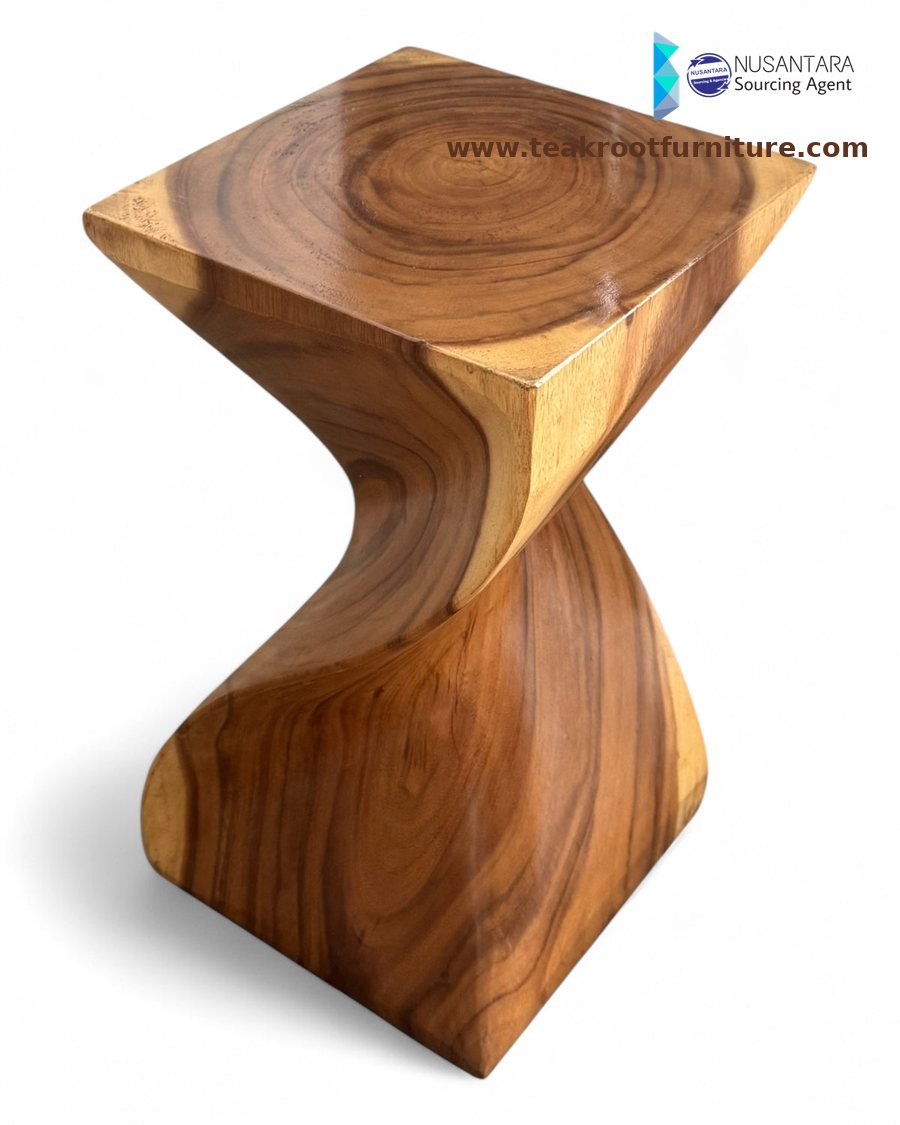
The same act added 10% excise on a schedule of specified imported goods that includes wood products, and 30% on imported plywood and timber (EY, Kenya enacts Finance Act 2026). Read together, the two measures say plainly that Kenya intends to make furniture in Kenya. That does not block a teak root dining table, which no Nairobi workshop can grow. It changes what the table has to be worth.
Then there is a date. The 2027 Africa Cup of Nations opens in Nairobi on 19 June and closes on 17 July, across ten venues in seven host cities shared with Uganda and Tanzania (CAF, 2026). Kenya's chain pipeline is 26 projects and 4,344 rooms, about 63% already under construction (W Hospitality Group, Hotel Chain Development Pipelines in Africa 2026). Rooms on site order furniture within eighteen months, not five years.
What changed on 1 July 2026 — and why freight is no longer the argument
Kenya has used country-specific stays under the East African Community Common External Tariff for years to protect local manufacturing. The general ceiling of that tariff is 35% (PwC, Kenya: Other taxes), so 45% is not a rounding error but a deliberate step above the regional band. Only one of the consequences is about price.
- The rate follows the tariff line, not the catalogue. A dining table, a console and a bar stool can fall under different eight-digit subheadings inside HS 9403.60. Get the classification in writing from a licensed Mombasa agent before you approve production, and ask for the excise position in the same ruling.
- VAT multiplies the duty. VAT at 16% is charged on CIF plus duty plus levies, so a ten-point duty rise lifts the VAT base too. The landed increase is about 7%, not ten — which is why a sheet built on the old rate still looks survivable when it is not.
- The local argument got stronger. At 45% the gap against Kenyan-made furniture narrows sharply. The import case now rests on form, size and provenance — a forty-year-old root ball cannot be replicated — not on being the cheaper chair.
The landed-cost sheet to rebuild before you negotiate
Same load, same freight, three duty positions. Freight is indicative and moves weekly, so read the structure rather than the number.
| Cost element | Basis | At 35% (US$) | At 45% (US$) | 45% + 10% excise (US$) |
|---|---|---|---|---|
| Goods, FOB Semarang | Negotiated price | 12,000 | 12,000 | 12,000 |
| Ocean freight to Mombasa | Indicative 20'FCL | 1,500 | 1,500 | 1,500 |
| Marine insurance | about 0.3% of goods | 40 | 40 | 40 |
| CIF value | FOB + freight + insurance | 13,540 | 13,540 | 13,540 |
| Import duty | 35% or 45% of CIF | 4,739 | 6,093 | 6,093 |
| Excise, where scheduled | 10% of CIF + duty | — | — | 1,963 |
| IDF and RDL | about 4.5% of CIF | 609 | 609 | 609 |
| VAT, 16% | on CIF + duty + levies | 3,022 | 3,239 | 3,553 |
| Landed at Mombasa | Before clearance and inland | 21,910 | 23,481 | 25,758 |
Indicative only. VAT is recoverable if you are VAT-registered; duty, excise, IDF and RDL are not. KRA guidance has quoted the Import Declaration Fee between 2.5% and 3.5% of customs value in different versions, with the Railway Development Levy at 2%. Confirm both with your agent.
Read the bottom line, not the middle. Duty rose by about US$1,350 between the first two columns, but landed cost rose by US$1,570, because VAT was charged on the higher duty: a 7.2% increase caused entirely by policy, with no freight rate moving. Add the 10% excise and the same container lands at US$25,758, 17.6% above the pre-July figure. A sheet still built on 35% understates the bill by roughly US$2,700 on this load.
Ready to price a container? Send us your item list and quantities, and we will confirm what fits in one load, the FOB Semarang price and a realistic lead time — duty and freight kept separate, so your landed sheet stays yours.
Send your item list for a quote →
Seven months to kick-off: where the rooms are actually being built
Kenya closed the 2025/26 financial year with 2.76 million international arrivals and KSh 564 billion in tourism earnings, both records (Kenya Tourism Board, August 2026), against a target of 5.5 million arrivals by 2028. Arrivals do not buy furniture. They underwrite the refurbishment cycle that does.
The pipeline is the better number, and smaller than the headlines suggest. Kenya's 4,344 rooms sit across 26 chain projects — real volume, but not the "80% under construction" figure that circulates regionally; that belongs to Ethiopia, at 79.5% (W Hospitality Group, 2026). Kenya's 63% still means roughly 2,700 rooms are on site now, fitting out between 2027 and 2028.
The camp market moves faster. Kinara, a 21-suite tented camp above a bend in the Mara River, opened in September 2026 as a Marriott Luxury Collection property, rebuilt on the footprint of an existing lodge (The Opening List; Marriott, 2026). "Rebuilt from an existing lodge" is the phrase to hear twice: a rebuild keeps the shell and replaces nearly everything inside. That is a two-container order, not one statement table.
A root console at reception is the first piece a guest touches — and the one a lodge will not replace with a local copy.
Each segment buys differently, which decides the load plan. Camps in the Mara, Amboseli and Laikipia order fewer pieces at higher value: a teak root dining table seating ten, a teak root console at reception, benches at the firepit. Coastal properties in Diani, Watamu and Kilifi refit between seasons and need salt-tolerant finishes: a teak root coffee table with a glass top, root stools along a beach bar, root planters at the pool. Nairobi buyers order against a handover date and care most about repeatable finish across forty identical rooms — the hardest thing to buy from a workshop that makes one-off pieces.
Documents that decide whether the box clears Mombasa
Most Kenyan delays are documentary. The goods are fine; the file is not. Three changes in 2026 moved the goalposts, and all three sit with the importer.
- The Certificate of Conformity, and who issues it. KEBS's PVoC contracts for general goods expired on 8 February 2026, and consignments dispatched from 9 February without a valid CoC go to destination inspection on arrival (KEBS public notice, February 2026). Replacements were signed within days: Intertek on 11 February and SGS on 9 February (company announcements, 2026). The certificate is issued in Indonesia before the container sails, so confirm which body holds the Indonesian zone before production ends.
- What a missing CoC costs. Destination inspection is charged as a percentage of approved customs value with a floor and ceiling; the USDA Foreign Agricultural Service put it around 0.6% of value, floor about US$300, ceiling about US$3,500 (March 2026). The fee is survivable. The dwell time is not — a container parked at Mombasa still accrues rent.
- The export declaration you now keep. Since 1 September 2026, Section 23B of the Tax Procedures Act requires importers to obtain and retain an export declaration or equivalent customs document from the country of export, for five years (KRA, 2026). We issue the Indonesian export declaration with every shipment. If a supplier cannot produce one, you will find out at audit, not at the port.
Two items complete the file: the Import Declaration Form, lodged before cargo lands, and the customs entry, filed by a licensed agent. Finished furniture has generally not needed a Kenya Forest Service permit under the Forest Conservation and Management Act 2016, but the rules are being redrafted — check before you ship, and carry SVLK chain-of-custody documents regardless.
What a 20-key camp actually fits in one container
Kenyan buyers rarely open with price. They ask how much of their list goes in one box. Volume is the constraint: a 20-foot container runs out of cubic metres long before it runs out of tonnes. These figures come from our own load plans in Jepara, Central Java, Indonesia; finish and packing move them 10–15%.
| Item | Qty | CBM each | CBM total |
|---|---|---|---|
| Teak root dining table, 220 × 100 cm | 10 | 1.55 | 15.50 |
| Root coffee table with glass top, 120 × 70 cm | 8 | 0.65 | 5.20 |
| Root console, 160 × 40 cm | 6 | 0.38 | 2.28 |
| Root stool, 40 cm | 12 | 0.16 | 1.92 |
| Root bench, 180 cm | 6 | 0.72 | 4.32 |
| Root planter, 60 cm | 8 | 0.30 | 2.40 |
| Total | 31.62 |
A 20-foot container holds around 28 CBM usable once cartons are loaded; a 40-foot high-cube holds around 58 CBM. Volumes vary with specification, and glass tops pack separately.
At 31.6 CBM the list will not fit a 20-footer and wastes half a 40-foot high-cube. Trim two dining tables and four benches, and it drops to about 26 CBM, inside a 20-foot load. Better to have that conversation before the pro forma than to leave two tables standing in Jepara. A 40-key camp also needing 40 bedside tables is two containers, and the second should wait until the owner has lived with the first.
The leg nobody quotes: Mombasa to the site
Suppliers quote FOB. Forwarders quote port to port. Nobody quotes the part where a container waits. Transit from Indonesia to Mombasa runs about 30–35 days port to port (Sinalda transit tables, 2026), usually via Singapore or Colombo — but the leg that breaks handover dates is dwell time and the road inland, not the sailing.
| Leg | Mode | Typical | What goes wrong |
|---|---|---|---|
| Berth to release, Mombasa | Port, KEBS, KRA | 3–7 days | A missing CoC can stretch this to three weeks |
| Mombasa to Nairobi ICD, Embakasi | SGR freight | 1 day, plus slot | Space booked late in peak season |
| Mombasa to Nairobi | Road | 2 days | Axle-load checks and weighbridges |
| Nairobi to Nanyuki, Laikipia | Road | 4–6 hours | Last stretch turns to mud in the long rains |
| Nairobi to Mara gate | Road | 5–6 hours | Gravel sections; oversize tops may need a low-bed |
| Mombasa to Diani or Kilifi | Road | 1.5–3 hours | Likoni ferry queues on the south coast |
Indicative, from our own shipments and forwarders' schedules — confirm with your transporter before you fix a handover date.
Since late October 2026 there is one more option on that corridor: CMA CGM launched a dedicated weekly freight train between Mombasa and the Nairobi-Embakasi inland container depot (company announcement, October 2026). For a group taking delivery in Nairobi, a fixed weekly rail slot is easier to plan around than a truck you book after the container is released.
Building a first order that survives its own mistakes
First orders fail when they are structured as a bet. Our minimum is one 20-foot container, mixed items, so a property can put a dining table, a coffee table with a glass top, consoles, stools and benches in one load and see the whole range on site together.
Four things are worth doing on order one. Settle the finish on a sample, because grain and colour are what photographs cannot promise. Spread the risk across products instead of betting the container on one untried item. Inspect the factory if the order justifies the flight — two hours from Semarang airport, and it answers capacity questions faster than any document. And use terms you can plan around: about 12 weeks in production, 50% deposit with the balance before shipment, single-face carton packing.
Then work backwards from the date the furniture must be on site. Production is the long pole, not the sailing.
- Week 0 — item list, quantities and finish agreed; pro forma signed; deposit paid; tariff line and excise position confirmed in writing.
- Weeks 1–12 — production, moisture checks, finishing, pre-shipment photographs against the packing list.
- Week 13 — loading in Jepara, PVoC inspection, CoC issued before the container leaves the yard.
- Weeks 14–19 — sea freight to Mombasa, usually via Singapore or Colombo.
- Weeks 19–21 — clearance, duty, excise and VAT paid, then rail or road to site.
For a property furnished before 19 June 2027, that puts a comfortable order date in November 2026 and a tight one in February 2027. Leave furniture to the month before handover, and you are not buying furniture; you are buying whatever is on a Nairobi showroom floor.
Where these roots come from
Teak root furniture starts as what most people would call waste. When plantation teak is harvested, the stump and root ball stay in the ground — irregular, heavy, useless to a sawmill. In Jepara, on Java's north coast, workshops clean, dry and stabilise those roots into table bases, consoles and stools. No two are alike, which is either the reason to buy or the reason to walk away.
Jepara has been Indonesia's carving town for centuries, and that depth of skill is why we build there. It is also why the calendar matters. In the rainy season, roughly November to March, roots take longer to dry, and rushing that step produces a base that splits eighteen months later in an air-conditioned Nairobi apartment. Anyone importing teak root furniture from Indonesia should ask for moisture content at loading, and expect a number rather than an assurance.
Our record is unglamorous and checkable: more than 300 containers since 2016, a steady 4×40'FCL a month for buyers in Europe and North America, now increasingly East Africa. What that buys is not a promise about quality but a packing plan and an export file that have been through Mombasa before. The duty, the CoC and the inland leg stay your risk, and no supplier should pretend otherwise.
DATA SHEET - FROM OUR FOB 2026 PRICE LIST
Models that leave the factory most often (FOB Semarang, delivery to Mombasa)
| Model | CBM/pc | FOB | Max pcs in one 20ft |
|---|---|---|---|
| Cabak Dining Table dia 100 cm | 0.75 | USD 195 | ~32 pcs |
| Cabak Dining Table dia 120 cm | 1.08 | USD 265 | ~22 pcs |
| Cabak Dining Table dia 150 cm | 1.8 | USD 340 | ~13 pcs |
| Mawar Dining Table dia 120 cm | 1.08 | USD 265 | ~22 pcs |
| Mawar Dining Table dia 150 cm | 1.69 | USD 340 | ~14 pcs |
| Mawar Dining Table dia 200 cm | 2.43 | USD 650 | ~9 pcs |
Max pcs = if the container carries that model only, using 24 CBM of usable space.
A worked mixed load - 24 pieces, 22.78 CBM, FOB USD 5,310
| Item | Qty | CBM | FOB |
|---|---|---|---|
| Cabak Dining 120 cm | 8 | 8.64 | USD 2,120 |
| Mawar Dining 150 cm | 6 | 10.14 | USD 2,040 |
| Izpo Coffee Table 100 cm | 10 | 4.00 | USD 1,150 |
Border cost for this load into Kenya
| Goods, FOB Semarang | USD 5,310 |
| Ocean freight (example rate) | USD 1,700 |
| Insurance 0.5% | USD 35 |
| CIF value | USD 7,045 |
| Duty: per your tariff line (confirm with your broker) | not included |
| VAT 16% | USD 1,127 |
| Landed, before duty, broker and port fees | USD 8,172 |
Freight is an example rate, quoted per sailing. VAT is the standard rate and is recoverable if you are registered. Duty depends on your tariff line and on the origin certificate; confirm both with your broker. Broker and port charges are set at destination and are not included. Product figures come from our FOB 2026 price list.
Frequently Asked Questions
Is furniture duty in Kenya really 45% now, and does it apply to teak root tables?
For specified furniture lines, yes: 35% to 45% from 1 July 2026 under the Finance Act 2026 (HKTDC, July 2026). Wooden dining tables normally sit under HS 9403.60, but the rate follows the eight-digit line and how the piece is built. Have a licensed Mombasa agent confirm your item list in writing before production, and ask for the excise position in the same ruling.
Does the 10% excise duty cover finished wooden furniture, or only timber and plywood?
It applies to a schedule of specified imported goods that includes wood products, with 30% on imported plywood and timber (EY, 2026). Finished furniture is not automatically inside the 10% list — it depends on the tariff line and the schedule wording. This is the figure most often assumed rather than checked; if it applies, rebuild the sheet, because excise sits inside the VAT base too.
Will a Certificate of Conformity issued before February 2026 still be accepted?
Only if it was valid for that shipment and dispatch date. KEBS's PVoC contracts expired on 8 February 2026, and consignments dispatched from 9 February without a valid CoC go to destination inspection. Replacements are in place, with Intertek appointed in February and SGS confirming its mandate on 9 February. Book the inspection before production ends; the certificate is issued in Indonesia, not at Mombasa.
Can we split a first order between two lodges, or start smaller than a container?
One 20-foot container is the minimum, but it can be mixed, and two properties under the same ownership can split one load — the packing list keeps the deliveries apart at site. What we would not recommend is dividing a container between unrelated buyers: duty, the CoC and the customs entry are per consignment, and one disputed line stops the whole box.
Talk to us about your project
Send your item list, quantities and destination — Nairobi, Mombasa, Diani, Nanyuki or a safari circuit — and we will come back with what fits in one container, the FOB Semarang price and a realistic timeline, normally within one working day. Duty, excise and freight stay separate, so your landed figure remains yours to verify. If you are building to a June 2027 opening, send the handover date, and we will work the schedule backwards from it.
Send your item list for a quote →
Or write directly to export@teakrootfurniture.com · WhatsApp +62 852 0600 7878 · Mr. August Praymunor (10:00–16:00 Jakarta time, GMT+7)
Packing, loading and shipping
Every order is packed with protective wrapping, stacked to a load plan and staged before it leaves the factory. Tops travel upright or on edge, never flat under load; bases are braced, so weight runs through the structure rather than the joints. We photograph the load against the packing list and send the plan to your broker before the vessel berths.
Where does the container actually leave from?
It is loaded here in Jepara, on Java's north coast, about two hours' drive from the port of Semarang. Goods are counted against the packing list as they go in, then trucked to the quay. FOB Semarang is our standard term, so every quotation separates the factory price from whatever happens after the container leaves the yard.
Our office and factory stand at the same address on every document we issue: Jl. RA Rukmini KM.02 Pekalongan RT.02/V, Tahunan, Jepara 59428, Central Java, Indonesia.
MOQ 1×20'FCL mixed · 4×40'FCL per month · 300+ containers shipped since 2016 · export@teakrootfurniture.com
Written by
Mr. August Praymunor — Overseas Marketing Director
CV. Nusantara Sourcing Agent · manufacturer and exporter of teak root furniture in Jepara, Central Java, Indonesia. We have shipped over 300 containers since 2016, loading 4×40'FCL per month for importers, hotel groups and interior contractors in Europe and North America. Every figure here comes from the source named beside it.
export@teakrootfurniture.com · WhatsApp +62 852 0600 7878 · LinkedIn · Jl. RA Rukmini KM.02 Pekalongan RT.02/V, Tahunan, Jepara 59428, Central Java, Indonesia
See also
- Teak Roots for South Africa’s Hotel Build-Out
- Teak Roots for Egypt’s 185 New Hotels
- Teak Root Dining Tables & Consoles for Gulf Hotels
- Our teak root furniture range
Model pages — price, CBM and container load
One page per model: size, packed volume, FOB Semarang price and how many fit in a 20ft container.
- Mawar Dining Table dia 200 cm — USD 650 · 2.43 CBM
- Oval root dining table 200 cm — USD 365 · 1.50 CBM
- Cabak Dining Table dia 150 cm — USD 340 · 1.80 CBM
0 comments:
Post a Comment