


The Middle East hotel pipeline stood at 724 projects and 178,003 rooms at Q2 2026, with 387 projects in Saudi Arabia alone (Lodging Econometrics). Every opening date carries a fit-out window that closes months earlier, so the container has to be booked against that window. We ship teak root tables, consoles and seating from Jepara: one 20-foot container mixed, FOB Semarang, about 12 weeks from deposit, every piece photographed and measured for approval before loading.
Summary: Made in Jepara, Indonesia. FOB Semarang, one 20ft container with mixed models. Qatar is investing USD 45 billion under its National Tourism Sector Strategy 2030 and holds the GCC Tourism Capital title for 2026 (Leading Hoteliers, April 2026), with a pipeline skewed heavily toward luxury inventory.

The Middle East hotel construction pipeline closed Q2 2026 at an all-time high of 724 projects and 178,003 rooms, roughly 11 percent more projects than a year earlier (Lodging Econometrics, Q2 2026). Saudi Arabia alone accounts for 387 of those projects. For a furniture importer, that is not a statistic — it is a set of opening dates, and every opening date carries a fit-out window that closes months before the doors actually open.
This article is written for the procurement managers, interior contractors and importers who have to fill those rooms. It covers what Gulf projects are specifying right now, what duty, VAT and conformity rules will meet the container at the port, which ports to quote from, and how to structure a first order that does not put the opening schedule at risk.
The pipeline that actually matters right now
The regional pipeline is concentrated in a handful of markets, and the timing matters more than the headline number.
- Saudi Arabia anchors a regional hotel pipeline valued at around USD 90 billion. Roughly 88,000 rooms are already under construction across the GCC and North Africa, with a further 25,000 in final planning (Arabian Business, September 2026). Development is spread across Riyadh, Makkah, Madinah, Diriyah, NEOM, the Red Sea and AMAALA.
- The United Arab Emirates has a shorter, nearer-term pipeline: around 26,000 rooms are expected to come online from 2026 onward (Hotel and Catering News, December 2025). Dubai welcomed 19.59 million international overnight visitors in 2025, up 5 percent year on year (Dubai Department of Economy and Tourism).
- Qatar is investing USD 45 billion under its National Tourism Sector Strategy 2030 and holds the GCC Tourism Capital title for 2026 (Leading Hoteliers, April 2026), with a pipeline skewed heavily toward luxury inventory.
Lodging Econometrics forecasts 91 new hotels and 17,995 rooms to open across the Middle East in 2026, followed by a further 98 hotels and 20,372 rooms in 2027. The practical consequence is a booking window. A property scheduled to open in late 2027 will be placing its furniture orders during 2026 and early 2027. Sea freight from Indonesia runs three to five weeks, and first orders on custom pieces run longer, so the order date — not the delivery date — is the deadline that gets missed.
What Gulf specifiers are asking for
The briefs we see from Gulf hospitality projects share one theme: solid, tactile, natural materials rather than high-gloss veneer. Designers ask for lobby consoles that read as objects rather than cabinets, restaurant tables whose bases are visibly individual, and terrace seating that survives heat and humidity without looking synthetic. This is a design direction, not a claim of ours — but it is the direction that keeps arriving in our inbox.
That description fits teak root almost exactly. Each piece is cut from the root system of the teak tree, so grain, colour and silhouette are one of a kind. For a residence that is the point. For a 300-room hotel, procurement sees the same uniqueness as a problem: how do you specify dozens of pieces that must sit together in one restaurant and still look like a matched set?
Our answer is to separate the part that has to repeat from the part that can stay unique. The working surface repeats; the base does not. A teak root dining table for a hotel restaurant keeps the same top size, height and finish across the whole batch, while the root base beneath each one stays individual. The same logic applies to a root coffee table with a glass top: the glass is cut to a fixed dimension and the root below it is the variable. A root console in a corridor gets a fixed length and depth so it lines up with the joinery, on a base that is never twice the same.
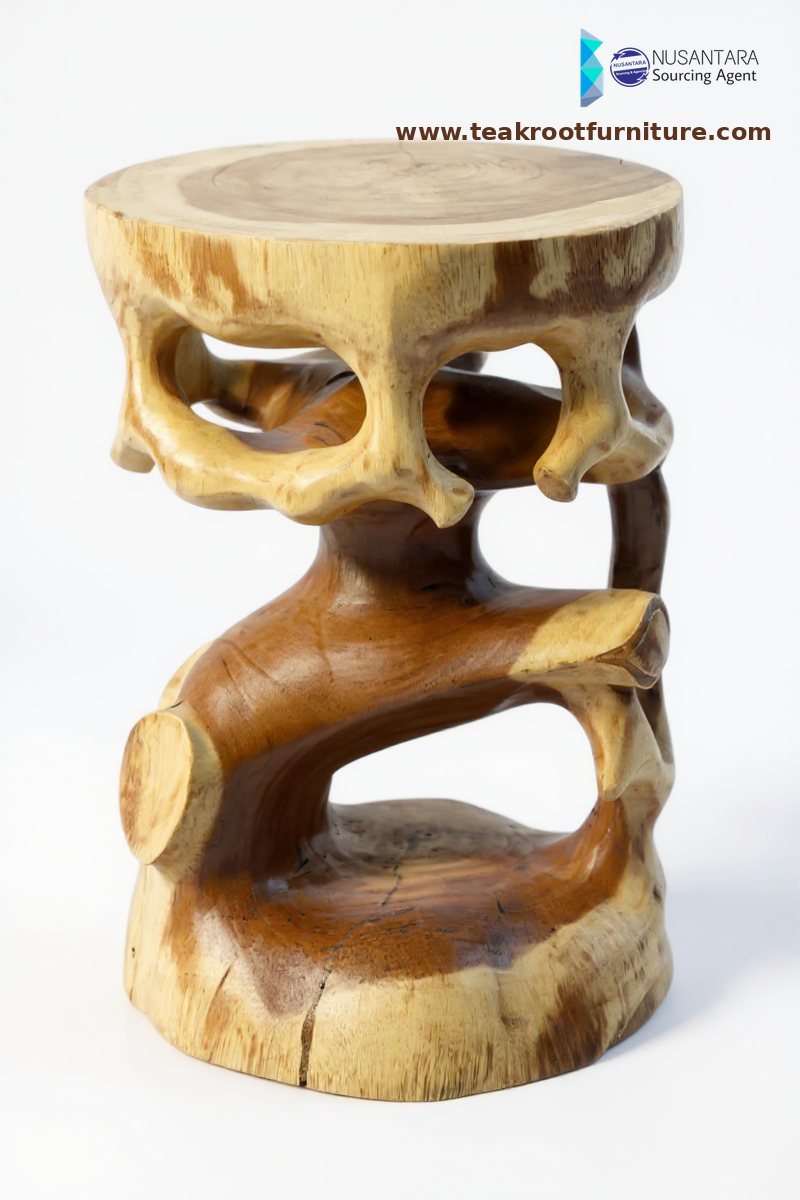
The range we ship for contract work covers teak root dining tables, root coffee tables with glass or stone tops, root consoles, root stools and benches, root table bases supplied on their own for stone or glass tops, root planters and root sculpture for public areas. Custom sizes and finishes are routine; the specification is fixed in writing before production starts.
As a rough planning figure — confirm it against your own schedule rather than treating it as a quotation — a 40-room boutique property fitting a restaurant and a lobby might need somewhere between 30 and 35 dining tables, 60 to 80 stools and benches, 10 to 15 consoles, and a handful of planters and sculptures for the public areas. In our experience that mix fits inside a single 20-foot container, which is why we quote a mixed 20’FCL as the minimum order instead of forcing buyers into one product line.
Turning a room count into a container
The 40-room figure above is a planning estimate, not a quotation. The same mix becomes a freight decision once you put packed volume against it, so here is the arithmetic using the per-piece volumes we publish for every model. It is the calculation that decides whether a project is a 20ft conversation or a 40ft one.
| Item group | Pieces (40-room property) | Packed CBM each | Packed CBM, total |
|---|---|---|---|
| Dining bases, 120–150 cm tops | 30–35 | 0.35–0.55 | 10.5–19.3 |
| Console and side bases | 10–15 | 0.20–0.40 | 2.0–6.0 |
| Bases and consoles together | 12.5–25.3 CBM | ||
| Stools, benches, planters | 60–80 plus | packed around the bases | use the voids, not a separate pallet |
Against the roughly 28 CBM usable in a 20ft container, the base-and-console load lands between 12.5 and 25.3 CBM before the loose pieces go in. Two practical consequences follow. A 40-room fit-out genuinely fits one 20ft container, which is why we quote a mixed 20’FCL as the minimum rather than forcing a single product line. And the top of that range is close to the ceiling: for a larger property, divide the packed volume by 28 before you accept a single FOB figure, or send us the room count and we will confirm the split against real model volumes.
Ready to price a container? Send us your item list and quantities, and we will confirm what fits in one load, the FOB Semarang price and a realistic lead time.
Send your item list for a quote →
Duty, VAT and conformity: what actually stops a container
Furniture entering the Gulf rarely fails on freight. It fails on paperwork. Duty is the easy part: most goods, including furniture, attract customs duty of around 5 percent under the GCC common external tariff. VAT is where the markets diverge, and where a landed-cost estimate copied from another country will quietly be wrong.
| Market | Customs duty (indicative) | VAT (2026) | Conformity step to plan for |
|---|---|---|---|
| Saudi Arabia | around 5% | 15% | SABER: PCoC before shipment, SCoC per consignment |
| United Arab Emirates | around 5% | 5% | ECAS where the product is regulated |
| Qatar | around 5% | 0% (VAT not yet enacted) | Standard import permit |
| Kuwait | around 5% | 0% (VAT not yet enacted) | Standard import permit |
| Oman | around 5% | 5% | Standard import permit |
| Bahrain | around 5% | 10% | Standard import permit |
Treat those duty figures as indicative, not final: the exact rate depends on the HS code your broker uses and can move with trade policy. The VAT rates, though, are the ones in force in 2026 (GCC VAT comparison data, 2026), and the spread is wide enough to change a project budget — a shipment into Saudi Arabia at 15 percent carries three times the tax of the same shipment into the UAE at 5 percent, and Qatar and Kuwait currently levy none.
Saudi Arabia is the one Gulf market where conformity is a hard gate rather than a formality. SABER is mandatory for regulated products including furniture: the importer registers the product and secures a Product Certificate of Conformity (PCoC) before the goods ship, then a Shipment Certificate of Conformity (SCoC) for each consignment (SASO, 2026). Certificates get rejected when the technical file does not match the commercial invoice, when the HS code is wrong, or when the container lands before the SCoC has been issued. Our advice to buyers is blunt: open the SABER file the day you place the order, not the week the vessel sails.
Ports, transit and the papers that clear faster
We load at Semarang on the north coast of Central Java. From there, Gulf-bound containers normally call at one of a small set of ports, and the port you choose affects both transit time and which paperwork the destination will demand.
| Port of discharge | Market served | Typical transit from Semarang |
|---|---|---|
| Jebel Ali | UAE (and onward re-export) | roughly three to four weeks |
| Dammam / Jeddah | Saudi Arabia | roughly four to five weeks |
| Hamad | Qatar | roughly three to four weeks |
| Shuwaikh | Kuwait | roughly four weeks |
| Sohar / Salalah | Oman | roughly four to five weeks |
| Khalifa Bin Salman | Bahrain | roughly four weeks |
Transit ranges are indicative and shift with routing, transhipment and carrier schedules — ask your forwarder for the sailing you intend to book. What does not change is the document set we prepare for every Gulf shipment: commercial invoice, packing list, bill of lading and certificate of origin. Where the destination requires fumigation or a phytosanitary certificate for the wood packaging, we arrange it before the container is sealed. The part we cannot fix is a certificate issued after the vessel has sailed, so destination requirements need to be confirmed before booking, not after arrival.
Where these pieces come from
Jepara, on the north coast of Central Java, is Indonesia’s carving town. Teak root furniture is a by-product of plantation management: when mature teak is harvested, the roots are left in the ground, and instead of being burned or left to rot they are dug, graded and turned into furniture. We buy from legally documented, SVLK-certified supply, because Gulf and European buyers increasingly ask for the legality paper trail, and it is easier to hold that discipline from the start than to reconstruct it later.
In the workshop, a root is cleaned of soil and embedded stone, split and shaped, then kiln-dried to a moisture content low enough to survive air-conditioned interiors and Gulf humidity, before it is sanded and finished. Drying is the slowest and least forgiving step. In the rainy season, which runs roughly from November into March, green material sits in the kiln far longer before it is stable, and rushing that step is the most common cause of a root piece that cracks after it has crossed the ocean. It is one reason we quote about 12 weeks for a first order rather than promising a faster date we cannot hold.
CV. Nusantara Sourcing Agent has loaded more than 300 containers since 2016 and runs at about four 40-foot containers a month, mostly for importers, hotel groups and interior contractors in Europe and North America, with Gulf projects a growing share. First orders typically ship as a mixed 20’FCL, which lets a buyer test the quality and the paperwork without committing to a full production run.
Frequently Asked Questions
Which Gulf market is easiest for a first container?
If the priority is the lightest paperwork, Qatar or Kuwait are the simplest destinations today because neither currently levies VAT, so the landed cost is close to duty plus freight. Saudi Arabia is the largest market but the most document-heavy, because SABER is mandatory, and a rejected certificate stops the container at the port. Match the first order to how much paperwork your team can actually manage.
Does SABER apply to every teak root order going into Saudi Arabia?
SABER applies to regulated products that include furniture, so budget for it on essentially every order. The importer registers the product and obtains a PCoC before shipment, then an SCoC for each consignment. Allow two to four weeks for the PCoC in your schedule, and make sure the technical file, the HS code and the commercial invoice all describe the same goods.
Can one container serve several Gulf markets?
Physically, yes — the goods are the same. In practice, customs and VAT are charged per destination, so a container cleared in Jebel Ali and then moved on to Saudi Arabia needs the correct documentation and an SABER certificate at each stage. For a first order, it is cheaper to ship to a single market and clear once.
How long does a hotel fit-out order take from placement to delivery?
In our experience a first order runs about 12 weeks in production, plus three to five weeks of transit and clearance — so roughly four months to the door. Repeat orders and standard sizes move faster. For a fixed opening date, work backwards from the fit-out window and let us confirm the date before you commit it to the project schedule.
Talk to us about your project
Send your item list with sizes, finishes and quantities — or a room count and a rough brief if the specification is still open. We will come back within one working day with what fits in a container, the FOB Semarang price and a realistic lead time. Samples are available for first orders, and buyers are welcome to inspect the factory in Jepara before committing.
Send your item list for a quote →
Or write directly to export@teakrootfurniture.com · WhatsApp +62 852 0600 7878 · Mr. August Praymunor (10:00–16:00 Jakarta time, GMT+7)
Packing, loading and shipping
Every piece is wrapped and corner-protected, then packed in single-face carton so that stacked items do not rub against each other in transit. We build a stack plan for the root bases and a separate plan for glass and stone tops, and we prepare a detailed packing list and a load plan that your freight forwarder can work from before the truck arrives.
Where does the container actually leave from?
Semarang again — that is the port we have shipped through since 2016. The cargo is staged and checked in Jepara, roughly two road-hours inland, then moved to the terminal for loading onto the vessel.
We have handled this route repeatedly for Gulf buyers, so the paperwork and timings are routine for us.
Our office and factory stand at the same address on every document we issue: Jl. RA Rukmini KM.02 Pekalongan RT.02/V, Tahunan, Jepara 59428, Central Java, Indonesia.
Container loading in Jepara — MOQ 1×20’FCL mixed · 4×40’FCL per month · 300+ containers shipped since 2016 · export@teakrootfurniture.com
Written by
Mr. August Praymunor — Overseas Marketing Director
CV. Nusantara Sourcing Agent · manufacturer and exporter of teak root furniture in Jepara, Central Java, Indonesia. We have shipped over 300 containers since 2016, loading 4×40’FCL per month for importers, hotel groups and interior contractors in Europe and North America. Every figure in this article comes from the sources noted in the text or from our own shipping records.
export@teakrootfurniture.com · WhatsApp +62 852 0600 7878 · LinkedIn · Jl. RA Rukmini KM.02 Pekalongan RT.02/V, Tahunan, Jepara 59428, Central Java, Indonesia
Further reading: Oman: import duty and buyer guide.
See also
- Teak Root Bar Tables and Bistro Sets for Hospitality and Retail
- Teak Root Stools and Seating: Wholesale Supply for Furniture Buyers
- Outfitting Qatar's Hotels and Retail Spaces with Teak Root Furniture
- Our teak root furniture range
Model pages — price, CBM and container load
One page per model: size, packed volume, FOB Semarang price and how many fit in a 20ft container.
- Mawar Dining Table dia 200 cm — USD 650 · 2.43 CBM
- Oval root dining table 200 cm — USD 365 · 1.50 CBM
- Cabak Dining Table dia 150 cm — USD 340 · 1.80 CBM
0 comments:
Post a Comment