FACTORY DIRECTOEM & CUSTOMEXPORT READYMIXED CONTAINER
300+Containers Shipped Since 2016
4 x 40'FCLMonthly Capacity
1 x 20'FCLMinimum Mixed Container
12 WeeksTypical Lead Time
Manufacturer & Exporter of Teak Root Furniture · Established 2016 · Jepara, Indonesia · Shipping Worldwide
Teak Root Furniture Manufacturer for European Importers

Teak Root Furniture Manufacturer for European Importers

Handcrafted teak root furniture from Jepara, Indonesia. Indoor and outdoor collections for wholesale and export buyers.

Sculptural Teak Root Dining Tables

Sculptural Teak Root Dining Tables

Solid teak root and glass-top dining tables, produced to order and prepared for container shipment.

Organic Coffee and Side Tables

Organic Coffee and Side Tables

Natural root-base coffee and side tables — statement pieces for retail and interior projects.

Wholesale and Custom Production

Wholesale and Custom Production

Custom and OEM production for importers, retailers and hospitality projects worldwide.

Request Our Catalogue and Price List

Request Our Catalogue and Price List

Send us your target items and quantities — our team will prepare a quotation for you.

Sunday, October 25, 2026

Muebles de raíz de teak para Perú — Lima y la costa

Perú cobra 6% de ad valorem a los muebles de madera de la partida 9403.60 y 18% de IGV sobre el valor CIF. Y desde noviembre de 2024 el contenedor que los trae puede desembarcar en un puerto que no existía cuando se cerró el contrato anterior. Chancay, 75 km al norte de Lima, se inauguró el 14 de noviembre de 2024 con cuatro muelles y una inversión inicial de USD 1.300 millones (Cosco Shipping Ports Chancay, 2024). La Cámara de Comercio de Lima proyecta que cerrará 2026 con más de 422.000 contenedores, 82,5% más que en 2025 (CCL, octubre de 2026).

Quick answer: Perú cobra 6% de ad valorem a los muebles de madera de la partida 9403.60 y 18% de IGV sobre el valor CIF.

Para quien importa mesas de raíz de teak eso significa dos cosas: hay una segunda puerta de entrada, y el costo final ya no se decide solo en la negociación con el taller sino en la suma de flete, ad valorem e IGV.

En resumen: fabricamos y exportamos muebles de raíz de teak y madera de suar desde Jepara, Indonesia, para importadores, tiendas y proyectos en Perú. Pedido mínimo: un contenedor de 20 pies, mixto, sin mínimo por modelo. Precios FOB Semarang de USD 28 a 215 por pieza. Primer pedido: unas 12 semanas de producción, más el tránsito marítimo.
Mesa de comedor de raíz de teak con base escultórica y tapa de vidrio, acabado natural, Jepara, Indonesia

Lo que Lima está especificando en 2026

La demanda peruana de mobiliario de madera no viene del consumidor final: viene de camas hoteleras nuevas, de restaurantes que abren y de casas de playa que se amueblan una vez al año. Los tres canales compran distinto y pagan distinto.

El primero mueve volumen. Las cadenas hoteleras que operan en Lima prevén invertir USD 495 millones hasta 2028 (El Comercio, agosto de 2026), y el Estado busca atraer otros USD 347 millones para 43 proyectos hoteleros (Infobae, marzo de 2026). Un hotel no compra muebles cuando inaugura: compra entre seis y doce meses antes, cuando el proyecto de interiores ya está aprobado. Estas cifras se convierten en pedidos con dieciocho meses de retraso.

El segundo canal es más pequeño y más rápido. La lista de los 16 restaurantes que marcaron la escena limeña en 2026 (Premios Somos, El Comercio, setiembre de 2026) es, en la práctica, una lista de compradores de taburetes, mesas altas y consolas de bar. Un local de 80 m² se amuebla con 30 piezas: no necesita un contenedor, pero sí un proveedor que despache en noventa días.

El tercero sostiene el ticket alto: casas y departamentos en Asia, Punta Hermosa y Barranco, amoblados por estudios que no compran catálogo sino medidas. Ahí una mesa de comedor de raíz con vidrio resuelve el ambiente sin competir con la piedra ni el cemento pulido que dominan la paleta limeña.

El turismo explica el resto, aunque hay que leerlo con cuidado. El Perú recibió 4.157.469 visitantes internacionales en 2025 (Mincetur, citado por El Peruano, 15 de enero de 2026); otras mediciones hablan de 3,4 millones de turistas (La República, febrero de 2026). La diferencia no es un error: "visitante" incluye a quien no pernocta, y para un hotel cuenta el segundo número. El gasto promedio fue de USD 1.232 por turista en 2025 (Forbes Perú, agosto de 2026).

2026 viene más flojo: entre enero y julio llegaron 1,95 millones de visitantes internacionales (Mincetur, citado por Forbes Perú, 3 de setiembre de 2026). Un año débil no cancela proyectos, pero cambia el pedido: menos unidades, más piezas que cargan solas el ambiente. Es la diferencia entre veinte mesas auxiliares iguales o seis piezas de raíz que el huésped recuerda.

Mesa de centro de raíz de teak con tapa de vidrio en un living, acabado natural, Jepara, Indonesia
IndicadorCifraFuente y fechaQué significa para su pedido
Visitantes internacionales 20254.157.469Mincetur, enero 2026Base de ocupación hotelera
Visitantes enero–julio 20261,95 millonesMincetur, setiembre 2026Año flojo: pedidos selectivos
Gasto promedio por turista 2025USD 1.232Forbes Perú, agosto 2026Presupuesto de interiores
Inversión hotelera en Lima hasta 2028USD 495 millonesEl Comercio, agosto 2026FF&E 6–12 meses antes de abrir
Cartera de proyectos hoteleros43 / USD 347 millonesInfobae, marzo 2026Espacio para proveedores con muestra
Chancay, proyección 2026+422.000 TEU (+82,5%)CCL, octubre 2026Segunda opción real de descarga

¿Quiere saber qué cabe en una carga? Envíe su lista de ambientes y cantidades: le confirmamos qué entra en un contenedor de 20 pies, el precio FOB Semarang por pieza y un plazo que se pueda cumplir.

Enviar mi lista para cotización →

La aritmética del costo puesto en almacén en Lima

La aduana peruana no cobra sobre el precio que usted negoció con el taller: cobra sobre el valor CIF, es decir FOB más flete más seguro. Ese detalle explica por qué dos importadores con el mismo precio FOB terminan con costos distintos, y por qué el flete barato a veces no lo es.

El ad valorem de la partida 9403.60 es 6%, con una sola línea arancelaria y sin escalones (Banco Mundial, WITS/UNCTAD TRAINS, dato 2023). El IGV es 18% y alcanza a la gran mayoría de las importaciones: 93%, según el Country Commercial Guide de Perú (Departamento de Comercio de EE. UU., 30 de junio de 2026). Perú e Indonesia no tienen acuerdo comercial, así que no hay certificado de origen que rebaje ese 6%.

Con un CIF de USD 12.000 —un 20 pies con 150 piezas de FOB promedio USD 70, más flete y seguro— la cuenta queda así:

ConceptoBase de cálculoUSD
Valor CIF en aduanaFOB + flete + seguro12.000
Ad-valorem 6%6% × 12.000720
Base del IGVCIF + ad valorem12.720
IGV 18%18% × 12.7202.289,60
Total tributos25,1% del CIF3.009,60
Despacho, agente, almacenaje y trasladoSegún cotización localno incluido

Hay una diferencia que casi nadie explica al importador nuevo: el ad valorem es costo y el IGV es caja. Con RUC y ventas gravadas, ese 18% se recupera como crédito fiscal; el 6% no se recupera nunca. Por eso el número que debe comparar no es el FOB sino el FOB más ad valorem más eficiencia de carga: un contenedor que entra con 24 m³ útiles en lugar de 28 encarece cada pieza cerca de 15%, y eso se come cualquier descuento.

Dos advertencias. La subpartida manda: una pieza con estructura metálica puede clasificar en otra partida, y un error en la DAM se corrige con multa. Y si su agente aplica percepción del IGV, súmela al desembolso aunque después la recupere: es caja que sale el día del levante.

Chancay o Callao: la decisión que cambia el despacho

Chancay creció más rápido de lo que anticipaban las proyecciones de 2024. En el tercer trimestre de 2026 movilizó 24,9% más contenedores que un año antes (Asociación Peruana de Agentes Marítimos, noviembre de 2026) y ya desplazó a Paita del segundo lugar nacional (Gestión, octubre de 2026). La segunda fase, con USD 3.500 millones previstos, debería completarse en 2032; el proyecto atribuye a la ruta asiática 10 a 12 días menos de tránsito y cerca de 15% menos de costo logístico.

Callao no se quedó quieto. DP World Callao registró en octubre de 2026 su mejor mes histórico, con 200.000 TEU (Gestión, 3 de noviembre de 2026), y el movimiento total del puerto creció 8,1% en 2025 (PortalPortuario, febrero de 2026). Sigue siendo el nodo con más servicios directos, más agentes y más almacenes cerca de los distritos donde están los clientes.

La elección no la hace solo el importador: la hace la naviera que cotiza. Pero estas preguntas cambian el resultado:

  • ¿Cuántas escalas tiene cada ruta? Un transbordo en Busan o Shanghái puede sumar una semana.
  • ¿El flete es hasta el puerto o hasta puerta? Ahí se pierden los presupuestos.
  • ¿Quién paga el vacío, cuántos días libres hay antes de demora y qué pasa si el buque adelanta la ventana?

Documentos y aduana: qué decide el despacho en Callao

La lista oficial es corta: DAM, factura comercial, conocimiento de embarque o guía aérea, lista de empaque y carta de seguro (Country Commercial Guide de Perú, 30 de junio de 2026). Lo que retrasa un contenedor no es la lista: es la inconsistencia entre los papeles.

Los tres errores que vemos con más frecuencia:

  • Descripción vaga en la factura. "Artículos de madera decorativos" no dice lo mismo que "mesa de comedor de raíz de teak, 220 × 100 × 76 cm". Si el inspector no puede conciliar papel y carga, hay aforo físico y días de almacenaje.
  • Flete subdeclarado. SUNAT ajusta el CIF cuando el flete no es razonable para la ruta, y el ajuste llega con IGV e intereses.
  • Carta de seguro tardía. Es el documento que más veces falta y el que menos se recuerda.

Sobre la madera hay un debate local que conviene conocer: en Casacor Perú 2026 —31ª edición, Jockey Club, mayo— el Serfor promovió el uso de madera legal y certificada (Agencia Andina, mayo de 2026). Es la dirección del especificador peruano: procedencia documentada. Nuestra posición es explícita: no reclamamos FSC ni SVLK; el proceso está en curso y, a pedido, mostramos la documentación de origen y el avance del trámite. Preferimos decirlo antes que poner un sello que no podemos sostener.

El primer 20 pies para un proyecto en Lima

Un contenedor de 20 pies lleva unos 28 m³ de mueble embalado; uno de 40 pies high cube unos 65 m³. El error del primer pedido no es el tamaño: es la mezcla. Quien llena el contenedor con una sola familia de producto se queda sin surtido para la tienda y sin argumento para el segundo pedido.

Una mezcla que funciona para un hotel boutique de 40 habitaciones, con volumen real:

  • 14 mesas de comedor de raíz de teak, 0,85 m³ cada una: 11,9 m³.
  • 6 mesas de centro de raíz con tapa de vidrio, 0,4 m³: 2,4 m³.
  • 8 consolas o mesas de apoyo, 0,32 m³: 2,56 m³.
  • 24 taburetes y bancos, 0,13 m³: 3,12 m³.
  • 10 esculturas de raíz y maceteros, 0,2 m³: 2,0 m³.

Total: alrededor de 22 m³. Quedan seis metros cúbicos libres: espacio para un segundo destino o para reponer cuando una pieza no pasa el control de calidad.

Las condiciones no cambian por volumen: mínimo un contenedor de 20 pies mixto, sin mínimo por modelo; 50% de depósito y saldo antes del embarque; y unas 12 semanas de producción en el primer pedido, porque las primeras piezas se aprueban con muestra física. La inspección en fábrica, en Jepara, está abierta: el comprador o su agente puede revisar pieza por pieza antes del embarque.

Calendario: temporada alta de obra en Lima

Perú compra por temporada, aunque no lo parezca. Entre enero y marzo, Lima se vuelca a las playas del sur y las casas de Asia y Punta Hermosa se amueblan; quien no tiene las piezas instaladas en diciembre las vende el verano siguiente. Los hoteles de la costa siguen el mismo ritmo: la temporada alta manda el cronograma de apertura. Casacor, en mayo, marca el otro extremo: allí los estudios muestran lo que van a especificar, y las compras de proyectos que arrancan en el segundo semestre se deciden entre junio y agosto.

Del lado de la producción hay un calendario que el comprador no ve. En Jepara, la temporada de lluvias va de noviembre a marzo: la madera seca más lento y el acabado al aceite necesita más días de curado. No es una excusa, es una restricción física que se traduce en semanas.

La cuenta hacia atrás que usamos: 12 semanas de producción, cinco de tránsito marítimo y una o dos de despacho. Trece a quince semanas entre la orden de compra y la puerta del almacén. Si su proyecto abre en enero, la orden debería estar firmada en agosto o setiembre.

Cómo verificar la calidad antes de que el contenedor salga

La raíz de teak no se inspecciona como un mueble de línea: no hay dos piezas iguales, así que la revisión es pieza por pieza y con criterios escritos. Lo que exigimos a nuestros propios equipos, y lo que un comprador debería pedir a cualquier proveedor:

  • Ficha por pieza. Foto con cinta métrica sobre la mesa, no foto de catálogo. Largo, ancho, alto y peso real.
  • Humedad por lote. Tres lecturas por pieza. En nuestra experiencia, por encima de 15% el riesgo de fisuras en el clima seco de Lima sube de forma visible en los primeros seis meses.
  • Reporte de grietas y rellenos. La raíz tiene grietas naturales: la pregunta es si están estabilizadas y si el relleno está pigmentado igual que la veta.
  • Prueba de estabilidad. Empuje lateral sobre la mesa armada. Una base de raíz mal nivelada se mueve, y el vidrio encima no perdona.
  • Plan de carga contra CBM medido. Cada pieza con su volumen real, compartido antes de estibar.

De Jepara a Callao: el recorrido de cada pieza

Jepara es un pueblo de la costa norte de Java Central, Indonesia, con más de un siglo de talla en madera. No aparece en los mapas de logística global, y eso desconcierta: el taller está a 65–70 km del puerto de Semarang, unas dos horas por carretera.

La materia prima tiene una particularidad que conviene entender. La raíz de teak no viene de talar árboles para hacer muebles: viene de los tocones que quedan cuando se renueva una plantación. Son piezas irregulares, pesadas, con arena y piedra incrustadas, que hay que limpiar, secar y estabilizar durante meses. Por eso cada mesa de raíz es distinta y el mismo modelo no se repite al centímetro. Para las medidas que sí deben repetirse —taburetes, consolas, bases— trabajamos con madera de suar.

El taller produce alrededor de 4×40'FCL por mes y ha embarcado más de 300 contenedores desde 2016. Esa capacidad salió de años de aprender qué se rompe en el tránsito y qué acabado aguanta el sol de una terraza.

La humedad de Lima y el acabado que la resiste

Lima pasa buena parte del año entre 70% y 90% de humedad relativa, con garúa entre mayo y noviembre. La madera no se hincha de un día para otro, pero un acabado mal sellado sí muestra manchas y juntas abiertas en la primera temporada.

Para proyectos en Lima y la costa usamos mate de poro cerrado y dejamos la pieza 72 horas en el clima del taller antes de embalar. Si el destino es sierra o selva, el mismo mueble lleva otra mezcla: lo decidimos con la altura y la humedad de la plaza, no con el catálogo.

Preguntas frecuentes

¿Cuánto termino pagando de impuestos al importar muebles de madera a Perú?

6% de ad valorem sobre el valor CIF y 18% de IGV sobre el CIF más el ad valorem. Sobre un CIF de USD 12.000 son USD 3.009,60. El IGV se recupera como crédito fiscal si su empresa tiene RUC y vende con IGV; el ad valorem no.

¿Conviene descargar en Chancay o en Callao?

Depende de la naviera que cotice. Chancay creció 82,5% en 2026 y ya es el segundo puerto del país, pero tiene menos servicios directos y más transbordos posibles. Callao sigue concentrando agentes, almacenes y servicios. Pida las dos cotizaciones y compare el costo hasta el almacén, no el flete por contenedor.

¿Qué documento retrasa más un despacho de muebles en el Callao?

Casi siempre la factura comercial: descripciones vagas, medidas que no coinciden con la carga o flete subdeclarado. Le siguen la carta de seguro emitida tarde y una subpartida mal asignada. El problema nunca es la cantidad de papeles, sino su coherencia.

¿Puedo mezclar modelos en el primer pedido y cuánto tarda?

Sí. El mínimo es un contenedor de 20 pies mixto, sin mínimo por modelo, y el mix de 22 m³ descrito arriba entra completo. Cuente 12 semanas de producción para el primer pedido, más cinco de tránsito y una o dos de despacho.

Hablemos de su proyecto

Si está armando el FF&E de un hotel, la carta de una tienda en Miraflores o una casa de playa, empiece por la lista de ambientes y las medidas. Con eso devolvemos qué modelos se acercan, cuánto volumen ocupan y qué tendría que venir de un taller asociado: un día hábil, con precios FOB Semarang y una fecha de embarque realista.

Pedir precios FOB para su proyecto →

Embalaje, carga y embarque

Carga de contenedor de 40 pies con muebles de raíz de teak embalados en cartón single-face, Jepara, Indonesia

Cada pieza se envuelve en cartón single-face, con esquinas protegidas y film exterior; las cubiertas de vidrio viajan en caja separada y acuñada. El plan de carga se arma por volumen medido y se comparte con el agente antes de estibar. La lista de empaque detalla pieza, medida, peso y CBM: lo que su agente necesita para la DAM y el seguro.

¿De dónde sale realmente el contenedor? Se llena en nuestro almacén de Jepara, en la costa norte de Java Central, Indonesia. De ahí sale por carretera 65–70 km hasta el puerto de Semarang —unas dos horas—, donde cada bulto se contrasta contra la lista de empaque antes de entrar al terminal. El término estándar es FOB Semarang: usted controla el flete y el seguro, y nosotros respondemos hasta que la carga está a bordo.

Nuestra oficina y nuestra fábrica están en la misma dirección que aparece en cada documento que emitimos: Jl. RA Rukmini KM.02 Pekalongan RT.02/V, Tahunan, Jepara 59428, Central Java, Indonesia. Las visitas se coordinan con una semana de anticipación, con su agente o con un inspector de tercero.

MOQ 1×20'FCL mixto · capacidad 4×40'FCL por mes · más de 300 contenedores embarcados desde 2016 · export@teakrootfurniture.com

Escrito por

Mr. August Praymunor — Director de Marketing Internacional

CV. Nusantara Sourcing Agent · fabricante y exportador de muebles de raíz de teak y madera de suar en Jepara, Java Central, Indonesia. Más de 300 contenedores enviados desde 2016, con 4×40’FCL mensuales para importadores, hoteles y estudios de interiorismo. Cada cifra de esta página proviene de nuestros propios registros de producción y embarque.

export@teakrootfurniture.com· WhatsApp +62 852 0600 7878· LinkedIn· Jl. RA Rukmini KM.02 Pekalongan RT.02/V, Tahunan, Jepara 59428, Central Java, Indonesia

Ver también

Chile — terrazas y sismos· Argentina — estancia y ciudad· Gama completa — FOB 28–215 USD· Medidas y CBM por modelo

Páginas de modelos — precio, CBM y carga del contenedor

Una página por modelo: medida, volumen empacado, precio FOB Semarang y cuántas caben en un contenedor de 20 pies.

Todas las páginas de modelos →

DATA SHEET - FROM OUR FOB 2026 PRICE LIST

Models that leave the factory most often (FOB Semarang, delivery to Callao)

ModelCBM/pcFOBMax pcs in one 20ft
Cabak Dining Table dia 100 cm0.75USD 195~32 pcs
Cabak Dining Table dia 120 cm1.08USD 265~22 pcs
Cabak Dining Table dia 150 cm1.8USD 340~13 pcs
Mawar Dining Table dia 120 cm1.08USD 265~22 pcs
Mawar Dining Table dia 150 cm1.69USD 340~14 pcs
Mawar Dining Table dia 200 cm2.43USD 650~9 pcs

Max pcs = if the container carries that model only, using 24 CBM of usable space.

A worked mixed load - 24 pieces, 22.78 CBM, FOB USD 5,310

ItemQtyCBMFOB
Cabak Dining 120 cm88.64USD 2,120
Mawar Dining 150 cm610.14USD 2,040
Izpo Coffee Table 100 cm104.00USD 1,150

Border cost for this load into Peru

Goods, FOB SemarangUSD 5,310
Ocean freight (example rate)USD 2,100
Insurance 0.5%USD 37
CIF valueUSD 7,447
Duty: per your tariff line (confirm with your broker)not included
VAT (IGV) 18%USD 1,340
Landed, before duty, broker and port feesUSD 8,788

Freight is an example rate, quoted per sailing. VAT (IGV) is the standard rate and is recoverable if you are registered. Duty depends on your tariff line and on the origin certificate; confirm both with your broker. Broker and port charges are set at destination and are not included. Product figures come from our FOB 2026 price list.

Share this page:>

Wednesday, October 21, 2026

Root & Branch Structures for Designers — FOB Semarang

Enquiries from the Caucasus are for roots and branch bases rather than finished tables: when Rebuild Karabakh closed in Baku on 16 October 2026, the requests that followed were for structural pieces a local joiner tops with stone or wraps into a banquette. Azerbaijan counted 1.09 million foreign visitors in the first half of 2026, 10.3% below a year earlier. We ship base-only loads from Jepara, FOB Semarang, about 12 weeks — volume, not weight, sets the price.

Summary: Made in Jepara, Indonesia. FOB Semarang, one 20ft container with mixed models. And treat VAT as cash flow rather than cost: recoverable if you are registered, but you still fund it for a month or two, and on a USD 40,000 container that is real working capital.

Teak root table with one-off root base, sanded and finished by hand
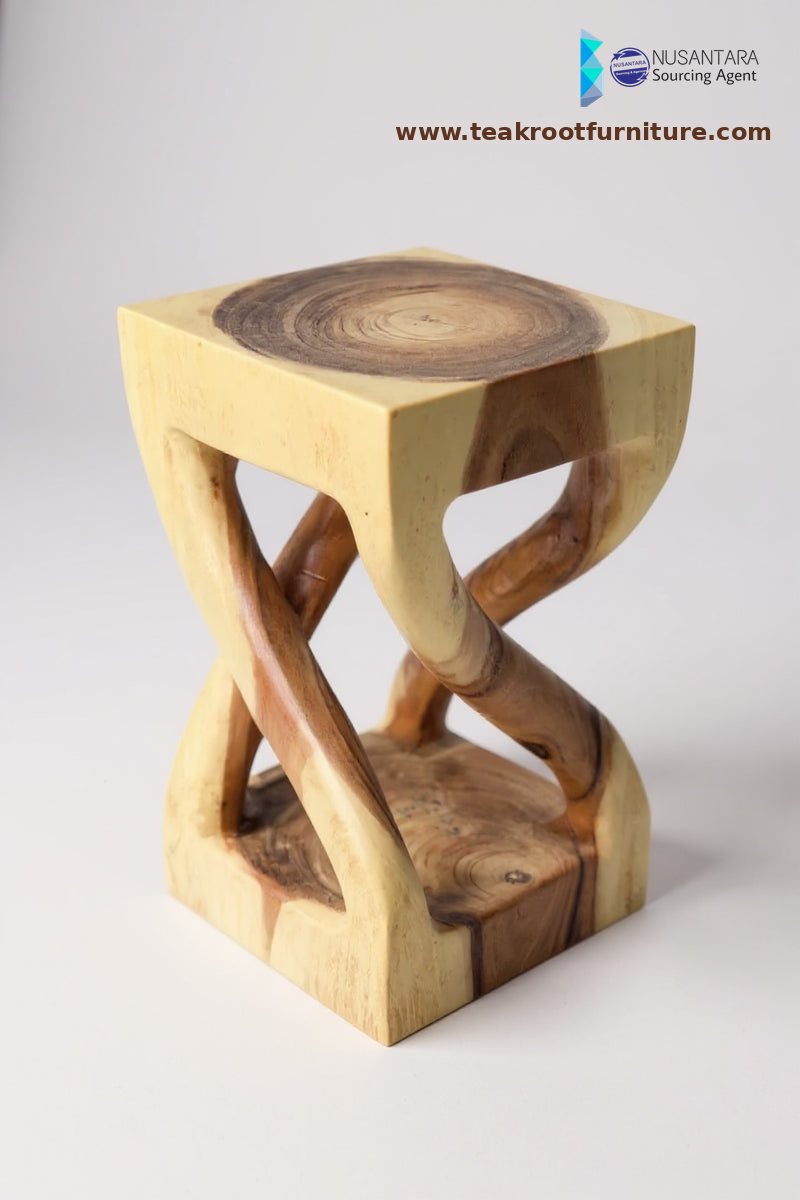
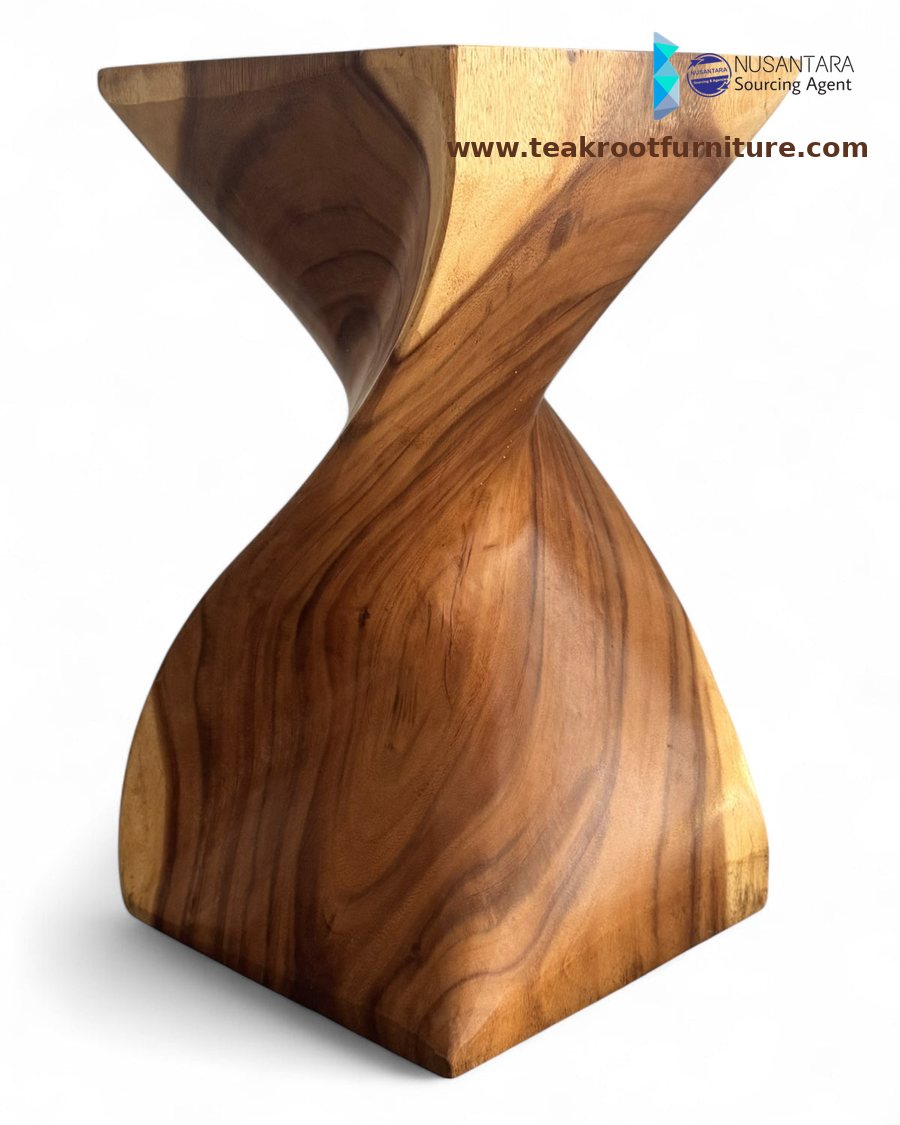
Suar wood stool with sculptural base, natural finish

Baku's Caspian Construction Week closed on 16 October 2026 with the sixth edition of Rebuild Karabakh, and the enquiries that reached us afterwards were not for finished dining sets. They were for roots and branch bases — the structural part of a piece that a local joiner will later build a stone top onto, wrap a banquette around, or turn into a reception desk. That is a different kind of order from a container of tables, and it fails for different reasons.

The timing is not accidental. Azerbaijan's state tourism agency counted 1.09 million foreign visitors in the first half of 2026 from 189 countries; arrivals were 10.3% below a year earlier, but hotel stays fell by less, so the guests who came stayed longer. Georgia recorded roughly 5.5 million international visits in 2025, 8.4% more than 2024, and Galt & Taggart estimated tourism revenue at USD 3.2 billion in the first eight months of 2026. Uzbekistan is working toward 12 million visitors in 2026 on 6,921 accommodation facilities and 185,600 beds. Globally the hotel pipeline stood at a record 15,976 hotels and 2,433,948 rooms at Q2 2026 (Lodging Econometrics, August 2026).

This piece is for the designer or importer in that corridor who has decided to buy the root rather than the finished table: what is being built, what duty and VAT do to landed cost, which route a landlocked delivery takes, which documents stop a container, and how the material is dried and prepared in Jepara, Central Java, Indonesia.

What the Caucasus and Central Asia are building in 2026

Four things are worth knowing before you send a drawing.

Karabakh is a project market, not a retail market. The exhibition organisers put construction and renovation spending there at USD 9.4 billion for 2020–2024, and housing, hotels and civic buildings are being handed over in phases through 2026 and beyond. Those jobs are specified by a contractor working from a bill of quantities — dimensioned schedules and fixed delivery windows, not mixed pallets of best-sellers.

Georgia is the region's busiest fit-out market. Tbilisi and Batumi keep converting apartments into short-let units and older hotels into boutique stock. Those projects buy small — 20 to 80 pieces — but they buy repeatedly, and they care about finish consistency across phases.

Uzbekistan is the volume story. Roughly USD 6.5 billion has gone into tourism development over eight years, adding about 130,000 rooms (TIIF 2026). Samarkand and Tashkent are specifying natural materials as a point of difference against international chain interiors.

Design language has moved toward the object. Sculptural, organic forms are one of the named interior trends for 2026, and a single root carrying a slab reads as furniture and landscape at once. A designer specifying it is not buying a table; they are buying a form that cannot be value-engineered into a copy — which is also why it holds a specification when the material is right, and fails the whole scheme at handover when it is not.

The landed-cost maths worth running before you agree a price

Buyers in this region assume duty is the small line. In the EU it often is; here it is not. Azerbaijan applies ad valorem duties of up to 15%, with finished goods usually at the top of that range (US International Trade Administration country guide, updated January 2026; PwC tax summaries, 2026), on top of 18% VAT.

Georgia is the opposite case: three tariff bands of 0%, 5% and 12% with 18% VAT (ITA, December 2025), so a well-classified furniture entry can clear at zero duty. The gap between a Georgian and an Azerbaijani landed cost on the same container is often wider than the gap between two factories' FOB prices — which is why comparing quotes without a landed-cost sheet is close to meaningless.

MarketDuty, wooden furnitureVAT / import taxWhat it does to your margin
AzerbaijanAd valorem 0–15%, finished goods usually at the top18%, recoverable if VAT-registeredDuty is a true cost — build it into retail before you quote a client
Georgia0%, 5% or 12% by subheading18%, recoverable if VAT-registeredOften the cheapest entry point in the corridor — classification decides it
Kazakhstan (EAEU)EAEU common tariff, set at 10-digit code level16% from 1 January 2026, up from 12%The VAT rise increased the cash needed at clearance by a third
UzbekistanAround 5% on furniture lines — confirm with your brokerImport VAT applies at the borderCertification time usually costs more than the duty

Two practical notes. Insist on FOB Semarang from every factory, so the numbers are finally comparable. And treat VAT as cash flow rather than cost: recoverable if you are registered, but you still fund it for a month or two, and on a USD 40,000 container that is real working capital.

Which route a landlocked delivery actually takes

None of these markets has a container port of its own except Georgia. Everything else arrives through Poti or Batumi on the Black Sea and then travels by rail or road — the container is handled twice, and every extra handling is a chance for a 90 kg root base to arrive chipped.

The corridor is growing. Cargo along the Trans-Caspian Middle Corridor reached 4.1 million tonnes in 2024, up more than 63% year-on-year (Carnegie Endowment, April 2026), and Poti and Batumi handled 375,654 TEU in the first half of 2025. The stated target is 11 million tonnes a year by 2030.

DestinationRouteDoor-to-door, typicalWhere it usually slips
TbilisiSemarang → Poti, road5–7 weeksTransit declaration issued after arrival, not before
BakuSemarang → Poti, rail or road via Baku–Tbilisi–Kars6–8 weeksSecond handling; customs valuation of mixed loads
AlmatySemarang → Poti → Caspian crossing to Aktau or Kuryk → rail7–10 weeksEAEU entry formalities begin at the first customs point
TashkentSemarang → Poti → Caspian → road or rail7–9 weeksImport certification can hold the cargo after it lands

Those windows come from our own shipments, not a carrier schedule; treat them as planning figures and confirm with your forwarder. The pattern that repeats is that landlocked cargo is late at the border, not at sea.

Ready to price a container? Send us your item list and quantities, and we will confirm what fits in one load, the FOB Semarang price and a realistic lead time.

Send your item list for a quote →

Documents that keep a Caspian container moving

The paperwork is not complicated, but it is unforgiving. Five items decide whether your container clears in three days or eleven:

  • ISPM 15 wood packaging. Solid wood packaging thicker than 6 mm must be debarked, heat-treated to the ISPM 15 schedule (56 °C core temperature for 30 minutes) or fumigated, and stamped with the IPPC mark.
  • Phytosanitary certificate. Root and branch pieces are wood, not packaging, and many authorities ask for a certificate from the Indonesian agricultural quarantine service. Ask your supplier whether they issue it per shipment; if they hesitate, that is information.
  • Legality documents. Indonesia's SVLK / V-Legal system is the export licence for timber products, recognised under the EU–Indonesia FLEGT VPA, and every container should carry documentation tying the timber to a legal source.
  • Packing list that matches reality. Landlocked cargo is checked at the transit border and again at destination. Weights and dimensions that differ from the load are the most common cause of a hold, because the transit declaration has to be amended.
  • Correct HS classification. A root structure sold as a table base and one sold as a decorative object can carry different treatment. Classify with your broker before the goods leave.

In our experience the document that fails most often is not the certificate — it is the packing list. Someone weighs the crate on a bathroom scale, the number goes on the invoice, and the discrepancy surfaces 6,000 km later.

Four tests a root structure has to pass before it is packed

A finished teak root dining table hides its faults under a top and a finish. A structure does not. Four things decide whether the piece survives its first year in a hotel lobby.

One: moisture content. Root material fails for one reason above all — water still inside it. Wood that leaves at 20% moisture will move in a dry, heated interior, and a top that was flat in Jepara will not be flat in Baku in February. We kiln-dry, and we report the reading with the photographs so you approve a number rather than a picture.

Two: heat treatment, for two reasons. It satisfies the plant-health requirement, and it kills the insects that live in freshly dug root. Buyers sometimes ask us to skip it to save a week. We do not — and a supplier who offers to is telling you something about the rest of their process.

Three: bark and loose limbs. Nothing ships with loose bark or a limb held by hope. A joiner notices within a minute of unpacking; a client notices within a month. Every branch that carries load is pinned and glued.

Four: contact surfaces. The bottom and the top are cut flat and square. A root that rocks on a stone floor needs shims, and shims on a polished hotel floor are a maintenance complaint waiting to happen.

Put those four points in the purchase order. A factory that can answer them in writing is a different supplier from one that answers with adjectives.

CBM, not unit price: the number that decides your quote

Teak root is bulky and comparatively light, so freight is charged on volume you are not used to paying for. Two suppliers can quote the same table and deliver very different landed costs because one packs it in 1.2 CBM and the other in 1.8. Ask for packed volume per piece before you ask for a discount. The ranges below come from our own loading records — planning figures, not a quotation.

PiecePacked volumePacked weightNote
Root dining table, 200 × 100 cm1.2–1.6 CBM95–140 kgTop and base crated separately
Root coffee table with glass top, 100 cm0.6–0.9 CBM55–80 kgGlass packed in its own crate
Root console, 120 cm0.55–0.8 CBM45–65 kgMost exposed piece in transit
Table base or branch structure0.45–0.9 CBM60–95 kgWeight, not volume, sets the loading plan
Root stool or bench0.15–0.35 CBM12–25 kgStackable, useful as filler
Root planter, 60 cm0.35–0.6 CBM30–45 kgBulky and light — volume-heavy

A 20-foot container takes roughly 28 CBM of packed furniture once loading space is allowed for; a 40-foot high cube about 68 CBM. That arithmetic turns a shopping list into a shipment: 18 dining tables plus 40 stools plus 12 consoles is not a 20-foot load but close to a 40-foot high cube — and quoting it as a 20-foot is how projects end up short.

Unfinished on purpose, so your own workshop can finish it

Many of the structures we ship leave unfinished or lightly sanded, deliberately. A designer matching an oak floor or a lacquer already used in the lobby does not want our finish — they want a neutral surface their own workshop can seal. It also removes an argument: the finish is theirs, so the finish is their responsibility. Natural, bleached or smooth-sanded finishes are done here when you prefer, photographed for approval before packing.

What a 40-key hotel actually orders

A 40-key boutique hotel with a restaurant and lobby lounge typically needs roughly 14 root dining tables, 45 stools and benches, 16 root consoles, 8 coffee tables for suites, and a handful of planters and sculpture pieces. That is around 32 CBM packed — a 40-foot high cube with space left over.

Sequence matters more than the total. Rooms hand over first, so consoles go first; restaurant and lobby second; sculpture and planters last, because those are the pieces most likely to change once the client sees the space. Splitting a project into two shipments costs more in freight and less in rework.

Where these structures come from: Jepara, Central Java, Indonesia

The material is old teak root — the part of the tree left in the ground when plantation teak is felled, dug out, cleaned and dried. It is dense, irregular, and useless for anything that has to be square, which is why it works as a base and a sculptural form. Jepara, on the north coast of Central Java, has been Indonesia's carving town for generations; the skills that cut temple panels are the same ones that decide where to cut a root, so the piece stands without a shim.

Two honest constraints. The material is seasonal — the best roots are dug in the dry months, and a wet season slows drying, which is why kiln capacity rather than labour sets our ceiling. And no two pieces are identical, so a schedule of 40 "same" tables is really 40 variations on a dimension: fine for a lobby, difficult for anyone who needs repetition to the millimetre.

We run 4×40'FCL a month from Jepara, Indonesia, and have shipped more than 300 containers since 2016 — mostly to Europe and North America, increasingly to the Gulf, the Caucasus and Central Asia. Buyers are welcome to inspect the workshop before an order; that conversation is usually shorter than the email chain it replaces.

Frequently Asked Questions

What duty and VAT will I pay on teak root structures into Azerbaijan?

Azerbaijan applies ad valorem duties of up to 15%, with finished goods generally at the top of that range, plus 18% VAT which a registered business recovers. Budget the duty as a real cost, the VAT as cash flow, and confirm the rate for your HS subheading with your broker before you set a retail price.

Can you deliver to Almaty or Tashkent, which have no seaport?

Yes. Both move through Poti or Batumi on the Black Sea, across the Caspian to Aktau or Kuryk, then by rail or road. Plan on seven to ten weeks door to door, and expect EAEU or Uzbek entry formalities to start at the first customs point rather than at final destination.

Do root and branch pieces need a phytosanitary certificate, or is ISPM 15 enough?

They are two different things. ISPM 15 covers wood packaging — crates and pallets — and is proven by the IPPC stamp. The piece itself is a wood product, and many destinations also ask for a phytosanitary certificate from the Indonesian quarantine service. We issue both per shipment; ask any supplier to confirm in writing that they do.

Can you work from our drawing if the top is stone or glass?

Yes, and it is the usual way a structure order starts. Send the drawing or a reference photograph, the finished dimensions, the weight and thickness of the top, and where the fixing points must fall. We reply with real pieces, measured, photographed and priced FOB Semarang — not a catalogue rendering.

Talk to us about your project

Tell us the piece sizes, the quantities, the finish and your project date. We will tell you what fits in a container, what it costs FOB Semarang, and what the timeline actually looks like — including where the schedule is likely to be tight.

Request the price list →

Or write directly to export@teakrootfurniture.com · WhatsApp +62 852 0600 7878 · Mr. August Praymunor (10:00–16:00 Jakarta time, GMT+7)

Packing, loading and shipping

Every structure is wrapped, corner-protected and packed in single-face carton with the contact faces braced, then stacked to a load plan drawn for that specific container. We photograph each piece against its packing list before the doors close, so that what arrives matches what was approved, and we can supply the load plan and weights to your customs broker in advance.

Where does the container actually leave from?
Loading happens at our yard in Jepara, on Java's north coast. The truck run to Semarang takes about two hours, the vessel is booked out of Semarang as the port of loading, and every export document is issued from that same address.

Our office and factory stand at the same address on every document we issue: Jl. RA Rukmini KM.02 Pekalongan RT.02/V, Tahunan, Jepara 59428, Central Java, Indonesia.

MOQ 1×20'FCL mixed · 4×40'FCL per month · 300+ containers shipped since 2016 · export@teakrootfurniture.com

Written by

Mr. August Praymunor — Overseas Marketing Director

CV. Nusantara Sourcing Agent · manufacturer and exporter of teak root furniture in Jepara, Central Java, Indonesia. We have shipped over 300 containers since 2016, loading 4×40’FCL per month for importers, hotel groups and interior contractors in Europe and North America. Every figure in this article comes from the sources noted in the text or from our own shipping records.

export@teakrootfurniture.com · WhatsApp +62 852 0600 7878 · LinkedIn · Jl. RA Rukmini KM.02 Pekalongan RT.02/V, Tahunan, Jepara 59428, Central Java, Indonesia

See also

Model pages — price, CBM and container load

One page per model: size, packed volume, FOB Semarang price and how many fit in a 20ft container.

All model pages →

Share this page:>

Thursday, October 8, 2026

Teak Roots for Cyprus Before the EUDR Deadline

Cyprus closed 2025 with 4,534,073 tourist arrivals, 12.2% more than 2024, and tourism now contributes roughly 14% of the island's GDP. For furniture importers, the date that matters most is 30 December 2026, when the EU Deforestation Regulation applies to wooden furniture placed on the EU market. Cyprus sits inside the EU customs territory with VAT at 19%, so the paperwork must be right before a Limassol container ships.

Summary: Made in Jepara, Indonesia. FOB Semarang, one 20ft container with mixed models. RA Rukmini KM.02 Pekalongan RT.02/V, Tahunan, Jepara 59428, Central Java, Indonesia See also Teak Roots for Greece's Island Hotels One Container, One Island: Teak Roots for Malta How to Import Teak Root Furniture from Indonesia: Step by Step Our teak root furniture range Understanding Furniture Import Duty in Oman: A Buyer's Guide Teakholz Möbel — Hersteller & Exporteur…

Last updated: 7 November 2026

Teak root table with one-off root base, sanded and finished by hand
Suar wood stool with sculptural base, natural finish

Cyprus closed 2025 with its best tourism year on record: 4,534,073 arrivals, up 12.2% on 2024, with revenue climbing 15.3% (Cyprus Statistical Service; Deputy Ministry of Tourism, 2026). Tourism now runs at roughly 14% of the island’s GDP. For an importer or fit-out contractor based on the island, though, the figure that should go into the project calendar is not the arrival count. It is 30 December 2026 — the date the EU Deforestation Regulation starts to bite on wooden furniture placed on the EU market.

Cyprus is a specific market, not a generic EU one. It sits inside the EU customs territory with VAT at 19%, runs a real superyacht cluster at Limassol Marina, and concentrates an unusual share of its prime property activity in a single city. Because it is a member state, the importer — not the factory in Java — is the party that files the deforestation paperwork. That one fact decides how a 2027 order should be timed, and it is the reason this guide leads with compliance rather than with price.

Where Cypriot demand is coming from in 2026

The demand engine here is not one mega-project. It is several high-value refresh cycles running at once across hospitality, prime residential and yachting, and they overlap in the same few cities.

The hospitality side is the most concrete. According to the Cyprus Ministry of Tourism, around 20 new hotels are under construction across the island, with roughly 5,000 new rooms expected by 2026 — properties spread across Limassol, Protaras, Paphos, Ayia Napa and Nicosia, with more than ten hotels due to open during the year. Larnaca is punching above its weight: the Larnaca Hoteliers Association puts more than 20 hotel projects under construction or in advanced planning, on top of the ten-plus hotels that have already opened or been fully renovated in recent years.

Every new room is a bed frame, a bedside table and a stool before it is a guest experience. A refurbished beach hotel typically re-specifies its public areas every seven to ten years, and that is where organic timber lands: the lobby, the pool bar, the à-la-carte restaurant. Prime residential is the second channel. The 50 largest property transactions in Cyprus totalled €286.4 million in the first half of 2026 (Ask Wire, July 2026), and Limassol dominated the list; in the first quarter alone the top 50 deals reached €197.7 million (Department of Lands and Surveys). That money is being spent on high-rise apartments and beachfront villas that are furnished piece by piece, not by the room pack.

ChannelWhat the data says (2026)Where our pieces fit
New hotels~20 under construction, ~5,000 rooms expected (Ministry of Tourism)Dining tables, console tables, stools for public areas
Prime residentialTop-50 deals €286.4m in H1 2026, Limassol-led (Ask Wire)One-off coffee tables, side tables, sculptural features
YachtingLimassol Marina: 650–680 berths, superyacht class (F&S Marinas)Root consoles, stools and table bases for saloons and decks
Meetings and eventsCyprus held the EU Council Presidency, 1 Jan–30 Jun 2026Lounge and breakout furniture in conference and press venues

On the water, Limassol Marina is the anchor. It offers around 650 to 680 berths depending on the operator’s current count (F&S Marinas; Limassol Marina), sized for large yachts and carrying Gold Anchor certification. Yacht and marina interiors reward one-off organic timber: a root console in a saloon, a sculpted root stool on deck, a root table base under a stone top. They also reward a supplier who can match a finish across repeat orders, because a refit two seasons later usually wants more of the same.

A 30-room boutique refit in Limassol or Paphos typically wants a mixed list: a dozen teak root dining tables, a handful of root coffee tables with a glass top for the lobby, several root consoles, a run of root stools and benches, and two or three root sculptures as features. That list rarely fills a 40-foot box on its own, which is why a first order is best built as a mixed load.

What 30 December 2026 actually demands of an importer

The EU Deforestation Regulation (Regulation (EU) 2023/1115) covers wood and wood products, including wooden furniture. From 30 December 2026 it applies to large and medium-sized operators, and to downstream operators and traders of all sizes; micro and small businesses have until 30 June 2027 for the remaining lines. The rule is not a tariff — it is an evidence requirement. To place teak root furniture on the EU market you must show the timber is deforestation-free and legally harvested, with the plot traced to geolocation and the harvest dated. The deforestation cut-off is 31 December 2020: wood from land cleared after that date cannot be placed on the market at all.

Here is the part that catches importers. Your supplier is not the operator. You are. A Cyprus-based importer files a Due Diligence Statement in the EU information system, and you cannot file it without data that only the factory holds — species, plot coordinates, harvest period, and a legal-origin trail. If the factory cannot supply it, the container does not move. That is the argument for choosing an Indonesian supplier whose paperwork is already in place rather than one who promises it later.

Indonesia’s SVLK / V-Legal system is recognised under the EU–Indonesia FLEGT Voluntary Partnership Agreement as proof of timber legality. It does not replace your own due diligence, but it hands you the batch-and-origin trail that turns a month of correspondence into a short file.

One medium-term note worth watching calmly. The EU and Indonesia finalised negotiations on the Comprehensive Economic Partnership Agreement (CEPA) on 23 September 2025 (European Commission, IP/25/2168); EU–Indonesia goods trade already exceeded €27 billion in 2024, and the Commission tabled its CEPA proposal on 29 June 2026. Ratification is still ahead, so do not bank a tariff benefit for a 2027 order. For the main finished-furniture lines the MFN duty is already near zero, which makes CEPA more relevant to raw material and components than to the dining tables themselves.

Ready to price a container? Send us your item list and quantities, and we will confirm what fits in one load, the FOB Semarang price and a realistic lead time for a Cyprus-bound shipment.

Send your item list for a quote →

The landed-cost maths for a Limassol container

First-time importers in Cyprus tend to fixate on duty and then discover it is not the problem. Under the EU Common External Tariff the main finished wooden-furniture line, HS 9403.60, sits at around 0% MFN duty, with some wooden lines reaching 5.6%. Cyprus applies VAT at 19%, which a VAT-registered business recovers, so it is a cash-flow item rather than a true cost. What actually moves your margin is freight, terminal handling, insurance, and — more than anyone admits at the start — finish and packing.

Lay it out like this. The figures below are illustrative, not a quotation; fill them with real numbers from your own forwarder before you commit.

LineBasisWhat to watch
GoodsFOB SemarangConfirm finish and packing are included
Ocean freight1×20'FCL to LimassolRates move; quote per sailing, not per year
Insurance0.3–0.6% of CIF valueCheap cover on breakable glass tops
Terminal and handlingPort of LimassolAsk for the all-in clearing quote
Duty~0% MFN (HS 9403.60)Correct HS code protects this; some lines reach 5.6%
VAT19%Recoverable if VAT-registered
EUDR due diligenceImporter files in the EU systemGet supplier legality and plot data early

The practical takeaway: negotiate on FOB Semarang so you know exactly what is yours and what is the supplier’s, and insist on the same Incoterm from every factory. Mixed Incoterms make quotations impossible to compare, and the cheapest headline number is usually the one with the least included.

Documents and the route into Limassol

Customs rarely stops goods for the reason people fear. It stops them for a missing line on a document. The usual set for teak root furniture entering Cyprus is a commercial invoice, a packing list, the bill of lading, a certificate of origin and proof of legal timber. Send your broker’s list to the supplier before production starts, not when the container is at the gate.

  • SVLK / V-Legal. Indonesia’s timber-legality assurance system, recognised under the EU–Indonesia FLEGT VPA as proof of legality. It is the strongest card a buyer can hold, and it feeds directly into your own due-diligence file.
  • EUDR due-diligence statement. From 30 December 2026 large and medium operators must file it, with plot-level geolocation proving the wood is deforestation-free and legally harvested. A supplier who can hand you legal origin and batch data removes weeks of headache.
  • ISPM-15. Any solid-wood pallets or crates must be heat-treated and stamped. This single detail delays more containers than any tariff line.
  • HS code discipline. Confirm the code per product type — a root dining table, a root coffee table with a glass top and a root planter can raise different questions at the border.

Then there is the geography. Cyprus is an island, so almost everything arrives by sea through the Port of Limassol, the island’s main commercial port for container, general cargo and cruise traffic, with air freight used only for samples and urgent pieces. Plan further ahead than a mainland buyer would, because a missed sailing is a missed month, and put real care into the load plan: a well-stacked mixed container is cheaper per piece than a half-full one.

DATA SHEET - FROM OUR FOB 2026 PRICE LIST

Models that leave the factory most often (FOB Semarang, delivery to Limassol)

ModelCBM/pcFOBMax pcs in one 20ft
Cabak Dining Table dia 100 cm0.75USD 195~32 pcs
Cabak Dining Table dia 120 cm1.08USD 265~22 pcs
Cabak Dining Table dia 150 cm1.8USD 340~13 pcs
Mawar Dining Table dia 120 cm1.08USD 265~22 pcs
Mawar Dining Table dia 150 cm1.69USD 340~14 pcs
Mawar Dining Table dia 200 cm2.43USD 650~9 pcs

Max pcs = if the container carries that model only, using 24 CBM of usable space.

A worked mixed load - 24 pieces, 22.78 CBM, FOB USD 5,310

ItemQtyCBMFOB
Cabak Dining 120 cm88.64USD 2,120
Mawar Dining 150 cm610.14USD 2,040
Izpo Coffee Table 100 cm104.00USD 1,150

Border cost for this load into Cyprus

Goods, FOB SemarangUSD 5,310
Ocean freight (example rate)USD 1,850
Insurance 0.5%USD 36
CIF valueUSD 7,196
Duty: per your tariff line (confirm with your broker)not included
VAT 19%USD 1,367
Landed, before duty, broker and port feesUSD 8,563

Freight is an example rate, quoted per sailing. VAT is the standard rate and is recoverable if you are registered. Duty depends on your tariff line and on the origin certificate; confirm both with your broker. Broker and port charges are set at destination and are not included. Product figures come from our FOB 2026 price list.

Making the first order safe

A cautious first order is not a small order. It is a mixed one. Our minimum is a single 20-foot container with mixed items, which lets a Cyprus buyer test a teak root dining table alongside a root console, a few root stools and a root sculpture before committing to a full programme. Terms are 50% deposit with the balance before shipment, FOB Semarang, with around 12 weeks lead time on a first order.

Three habits separate comfortable importers from stressed ones:

  • Ask for photographs of the finished goods and of the loaded container before it sails. A container loaded to a plan is far easier to reconcile on arrival.
  • Fix the finish in writing. Raw, oiled, matte and gloss behave differently under Cyprus’s strong light and salt-laden coastal air, and the wrong choice is expensive to reverse.
  • Agree the packing. Our standard is single-face carton, and glass tops are packed separately — but if you need triple-wall or crates, say so in the RFQ, because it changes both cost and how the container stacks.

Where these pieces come from

Jepara, on the north coast of Central Java, is Indonesia’s carving town, and it is where our workshop sits. The teak roots we use come from old plantation stumps and fallow land rather than felled forest — a by-product of land already cleared for other use. Each root is cleaned, seasoned and inspected before a carver decides what it becomes: a base for a teak root dining table, the body of a root coffee table with a glass top, a root stool, a planter or a sculpture.

Honestly, the hardest part is not the carving. It is the drying. When the rainy season arrives, green wood cannot move into the workshop on the schedule a European buyer has in mind, because forcing it through the kiln cracks the grain. We build the calendar around the weather rather than against it, which is one reason we quote 12 weeks instead of promising four. Legal timber paperwork is the second discipline: every batch is documented for SVLK, and that is exactly what makes a Cypriot importer’s EUDR file straightforward rather than a scramble.

We ship FOB Semarang, run roughly four 40-foot containers a month, and have loaded more than 300 containers since 2016. That record is what lets a studio in Limassol reorder the same teak root console two seasons later and get the same thing, not a near-match.

Frequently Asked Questions

What import duty and VAT apply to teak root furniture entering Cyprus?

The main finished wooden-furniture line, HS 9403.60, sits at around 0% MFN duty under the EU Common External Tariff, though some wooden lines reach 5.6%. Cyprus applies VAT at 19%, which a VAT-registered business recovers. Freight, insurance, handling and quality control usually influence your margin more than duty, so have your broker confirm the exact code for each piece.

Does the EUDR apply to my Cyprus company, and what do I have to file?

Yes. Cyprus is an EU member state, so from 30 December 2026 large and medium operators placing wooden furniture on the EU market must file a due-diligence statement proving the timber is deforestation-free and legally harvested, with plot-level geolocation and the deforestation cut-off of 31 December 2020. Micro and small businesses follow on 30 June 2027. Your supplier’s SVLK / V-Legal documents and batch-origin data feed straight into that statement.

Which port do you ship to, and what Incoterm do you quote?

We quote FOB Semarang and buyers clear at the Port of Limassol, the island’s main commercial port. CIF can be quoted on request, but keeping FOB lets you compare factories on identical terms and control your own freight.

Can a single Cyprus villa or boutique hotel order one container?

Yes. Our minimum is one 20-foot container with mixed items, so a villa or boutique hotel can combine a teak root dining table, a root coffee table with a glass top, a few root stools or benches and a root sculpture in one load. A first order runs about 12 weeks in production, with 50% deposit and the balance before shipment.

Talk to us about your project

Tell us which pieces you need, how many, and where in Cyprus they are going. We will tell you what fits in a container, what it costs FOB Semarang, and what the timeline really looks like before 30 December.

Request the price list →

Or write directly to export@teakrootfurniture.com · WhatsApp +62 852 0600 7878 · Mr. August Praymunor (10:00–16:00 Jakarta time, GMT+7)

Packing, loading and shipping

Every order is packed with protective wrapping, stacked to a load plan and staged before it leaves the factory. We list each piece so that what arrives matches what was ordered, and we can supply a container load plan for your customs broker.

Where does the container actually leave from?
Loading happens at our yard in Jepara, on Java’s north coast. From there the truck run to Semarang takes about two hours; the vessel is booked out of Semarang as the port of loading, and all export documents are issued from that same address.
We have handled this route repeatedly for Cypriot buyers, so the paperwork and timings are routine for us.

Our office and factory stand at the same address on every document we issue: Jl. RA Rukmini KM.02 Pekalongan RT.02/V, Tahunan, Jepara 59428, Central Java, Indonesia.

MOQ 1×20'FCL mixed · 4×40'FCL per month · 300+ containers shipped since 2016 · export@teakrootfurniture.com

Written by

Mr. August Praymunor — Overseas Marketing Director

CV. Nusantara Sourcing Agent · manufacturer and exporter of teak root furniture in Jepara, Central Java, Indonesia. We have shipped over 300 containers since 2016, loading 4×40’FCL per month for importers, hotel groups and interior contractors in Europe and North America. Every figure in this article comes from the sources noted in the text or from our own shipping records.

export@teakrootfurniture.com · WhatsApp +62 852 0600 7878 · LinkedIn · Jl. RA Rukmini KM.02 Pekalongan RT.02/V, Tahunan, Jepara 59428, Central Java, Indonesia

See also

Modellseiten — Preis, CBM und Containerladung

Eine Seite pro Modell: Größe, Packvolumen, FOB-Preis Semarang und wie viele in einen 20-Fuß-Container passen.

Alle Modellseiten →

Share this page:>