


Most failed first orders follow the same pattern: a supplier replies within the hour, quotes around 15% below everyone else, and months later four table bases have cracked on the way to Rotterdam \u2014 with two of those \u201cmanufacturers\u201d turning out to be sales offices in Jakarta with no workshop and no drying record. Ask three questions before price: how long the root was dried, what moisture the kiln reached, and how the base was levelled before packing.
Summary: Made in Jepara, Indonesia. FOB Semarang, one 20ft container with mixed models. Line Basis to use Source of the number Goods FOB Semarang, per item Our quotation; freight, duty and destination charges excluded Ocean freight Contracted rate per container, not spot Your forwarder; Asia–USEC spot was USD 9,144–10,948 per FEU in H2 2026 (Freightos; Reuters) Marine insurance Percentage of CIF value Your insurer; confirm the declared value first Import duty…

Most buyers who come to us after a failed first order describe the same sequence. The supplier replied within the hour, quoted 15% below everyone else, and then needed nine weeks to explain why four table bases had cracked on the way to Rotterdam. Two of those "manufacturers" turned out to be sales offices in Jakarta with no workshop and no drying record.
The risk is structural. A teak root dining table is built around the root mass of a felled plantation teak tree, so no two are the same shape. Everything a catalogue photo hides decides whether the piece survives a 40-day voyage and a dry hotel lobby: how long the root was dried, what moisture the kiln reached, how the base was levelled before the glass was cut for it.
Two dates make 2026 the wrong year to choose a supplier casually. The EU Deforestation Regulation (EUDR) applies to large and medium operators from 30 December 2026, and to micro and small operators from 30 June 2027 (European Commission). In the US, the reciprocal tariff framework finalised on 19 February 2026 keeps a 19% headline rate on most Indonesian goods (White House; KPMG, February 2026). Both reward the buyer who can prove where the wood grew and who packed it.
What a teak root dining table has to survive before it reaches your showroom
Root wood is stump wood: gritty, full of tension and irregular grain, far less predictable than the quarter-sawn teak used for decks and garden benches. That fact drives every quality question worth asking a teak root furniture manufacturer.
Drying comes first. Export-grade teak is normally kiln-dried to roughly 8–12% moisture content (Mobelindo, 2025); North American lumber guidance treats 6–8% as the accepted range for interior furniture (McIlvain, 2022). Ship root wood wetter than that, and it keeps moving after the doors are sealed: hairline cracks along the grain, sap stain around the outer rings, gaps where the glass should sit flush. A factory without a drying record of dates and readings is guessing.
Levelling comes second. A root coffee table with a glass top is a two-material assembly — heavy base, flat surface — and any wobble reads as a defect the moment a customer touches it. We level every base on a stone bench and re-check before packing. Freight and climate move the last fraction of a millimetre, so glass travels separately and your installer sets it on site.
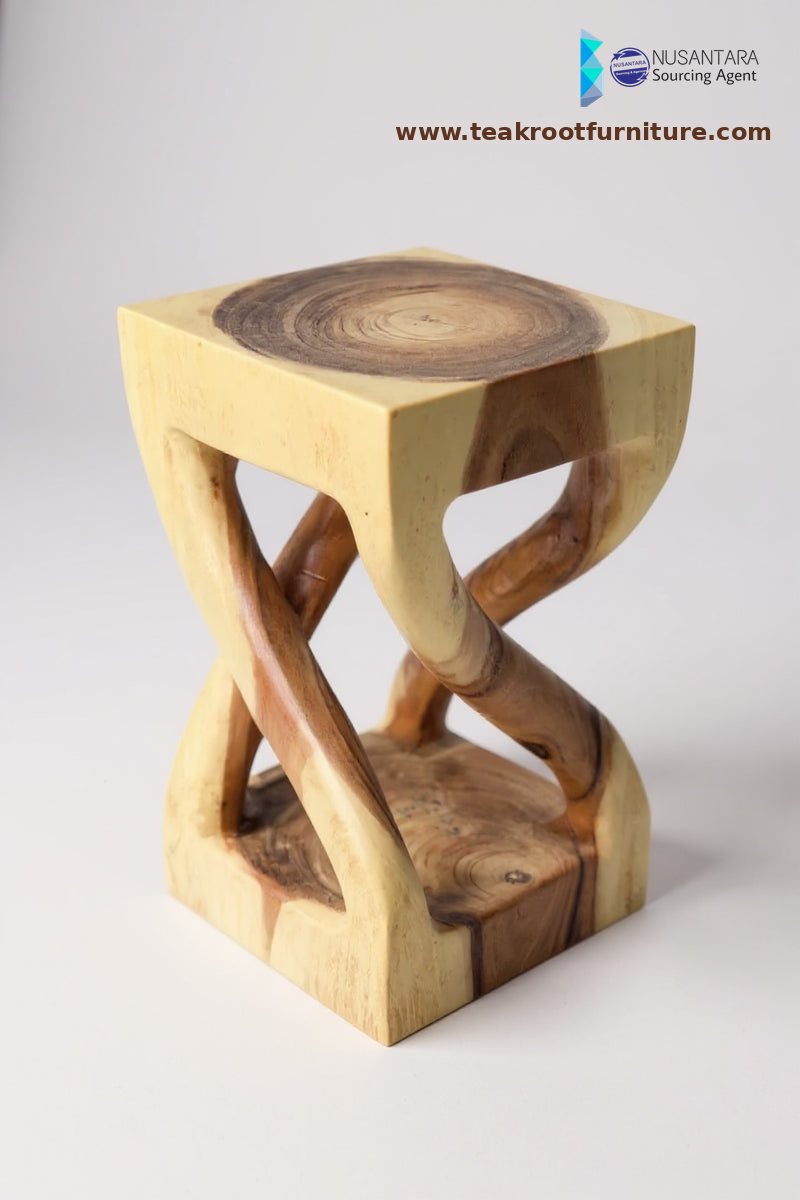
The commercial details decide the rest: a written tolerance on diameter and height (±2 cm on a Ø100 cm top) rather than "approximately", a repair-or-replace rule agreed before the order, and piece-level packing — corner protection on consoles, strapping on stools and benches.
Factory, trading company or broker: how to tell the difference from one email
Indonesia's furniture market was worth about USD 9.1 billion in 2025, forecast to reach roughly USD 15.2 billion by 2034 (IMARC, January 2026). That scale includes genuine workshops, trading houses aggregating from small producers, and commission agents who own neither stock nor kiln. All three can sell you a container; only one can fix a problem at the source.
- Ask for the production address and the business registration number. Search the address: an office tower means the goods come from elsewhere. The NIB activity should read furniture manufacturing, not general trading.
- Ask who holds the SVLK certificate. Indonesia's timber legality verification system has been mandatory for timber businesses since January 2013 (OECD OPSI). The certificate holder must match the exporter of record, because the V-Legal document travels with the container.
- Ask for a two-minute walk-through video of the workshop, drying area and loading bay, filmed the day you ask.
- Ask which port appears on the Bill of Lading. For any factory between Semarang and Surabaya, FOB Semarang is the honest answer; a Jakarta default adds three to seven days of trucking.
Ready to price a container? Send us your item list and quantities, and we will confirm what fits in one load, the FOB Semarang price and a realistic lead time.
Send your item list for a quote →
The paperwork that decides whether your container clears — market by market
Compliance is where a cheap quotation becomes expensive. Delays rarely come from missing documents; they come from documents that contradict each other — a species name on the V-Legal paperwork that does not match the invoice, or a treatment certificate for pallets the loader left behind.
Indonesia is the only country issuing FLEGT licences, and a FLEGT-licensed shipment is accepted as satisfying the EU's legality requirement — reconfirmed for Indonesian products in August 2026. Furniture under HS heading 9403 entered before 30 December 2026 stays under the earlier EU Timber Regulation. What EUDR adds is deforestation-free and geolocation evidence: a factory that knows the estate behind each root order is easier to buy from next year than one buying from market traders.
In the US, the Lacey Act requires a declaration naming species, country of harvest and quantity (USDA APHIS). Teak is Tectona grandis, harvested in Indonesia — simple on paper, but it must match the packing list exactly. Solid wood packaging over 6 mm must be ISPM 15 compliant, heat-treated to 56 °C for 30 minutes and IPPC-stamped.
| Market | What the shipment must carry | What usually holds it up |
|---|---|---|
| EU | SVLK certificate, V-Legal / FLEGT licence, invoice, packing list, Bill of Lading; EUDR evidence from 30 Dec 2026 | Species or volume on the V-Legal not matching the invoice; buyer not registered in the EU system |
| United States | Lacey Act declaration, invoice, packing list, Bill of Lading, ISPM 15-marked packaging | Declaration filed against the wrong HTS line; unmarked pallets or dunnage |
| UK | Invoice, packing list, Bill of Lading, due-diligence records under the UK Timber Regulation | Origin evidence requested after the ship has sailed |
| Australia | ISPM 15-compliant packaging, treatment evidence, packing declaration | Certificates that miss one piece of solid wood in the load |
| GCC | Legalised or certified invoice, certificate of origin, packing list | Legalisation started too close to the sailing date |
For the markets we ship to most; confirm with your broker.
Landed cost: the numbers worth running before you negotiate the price
Importers lose more money on the second and third lines of the build-up than the first: FOB Semarang is the only figure quoted to you, while freight, duty and VAT are the lines that move.
Freight is the volatile line. Asia–US East Coast spot rates for a 40-foot container were reported at USD 9,144 per FEU in August 2026 (Freightos, via Supply Chain Dive) and USD 10,948 in September 2026 (Reuters) — Asia-wide, not Indonesia-specific, and a 20-foot box is usually cheaper for a first order. Transit runs roughly 20–30 days to the US West Coast, 32–45 days to the East and Gulf Coasts with transshipment (Dimerco, 2026).
US duty stacks, and the order of the layers decides the bill. The 19% reciprocal rate on most Indonesian goods (White House, February 2026) sits alongside separate furniture actions, and one tariff-data service quotes a total 10% duty for wooden furniture under HTS 9403.60.80 from Indonesia (Airlift USA, October 2026) — below the headline rate because exemptions apply. Get your own HTS line and product description in writing from a broker before you fix a retail price.
| Line | Basis to use | Source of the number |
|---|---|---|
| Goods | FOB Semarang, per item | Our quotation; freight, duty and destination charges excluded |
| Ocean freight | Contracted rate per container, not spot | Your forwarder; Asia–USEC spot was USD 9,144–10,948 per FEU in H2 2026 (Freightos; Reuters) |
| Marine insurance | Percentage of CIF value | Your insurer; confirm the declared value first |
| Import duty | Applied to customs value, layered by product list | 19% reciprocal headline for most Indonesian goods (White House, 2026); verify your HTS line |
| VAT / sales tax | Applied to the duty-paid value | Destination country; generally 19–23% in the EU markets we ship to |
Payment belongs in the same spreadsheet. First orders run on a 50% deposit, balance before shipment — enough security for a factory buying kiln-dried root in cash, not so much of your money abroad before inspection.
A 40-room hotel fit-out, priced in pieces
Quality talk gets concrete when you count pieces. A 40-room boutique hotel with one restaurant and a lobby typically needs around 40 teak root dining tables, 60 root stools or benches, 20 root coffee tables with glass tops, 15–20 root consoles and side tables, a few root planters for the terrace and one or two root sculptures at the entrance. Add 3–5% spares for site breakage.
Volume catches people out. A 20-foot container takes roughly 25–28 cubic metres of usable cargo; a 40-foot dry container holds about 67.7 CBM internally (CBM Calculator, 2026). A 100-piece mix of tables, stools and consoles usually lands between 24 and 28 CBM, which is why a first order is normally one mixed 20'FCL: it spreads risk across more SKUs and lets you trial a table base programme before committing to a full dining range.
Our terms are built for that container: MOQ one 20'FCL mixed, FOB Semarang, 12 weeks lead time on a first order, samples on request, inspection at the factory before loading.
Where these pieces are actually made — and why Jepara
Jepara sits on the north coast of Central Java, about two hours by road from the port of Semarang, and it has been Indonesia's carving town for generations. Teak root is a by-product of plantation teak, most of it grown on state plantation land under Perum Perhutani; when a cycle of trees is felled and the land replanted, the root mass is lifted, cleaned and sold to the workshops. Nothing here depends on clearing forest: the root exists because the timber was taken for other purposes, which is why EUDR evidence is manageable for factories that know their root source.
In practice, the work is unglamorous. Roots arrive wet and gritty, are pressure-washed and roughed out, then spend weeks air drying before the kiln. Between November and March the monsoon keeps humidity high, drying slows and the kiln queue lengthens — the most common reason a delivery date slips, and why we quote 12 weeks instead of promising six. Carvers then finish each shape by hand.
CV. Nusantara Sourcing Agent has shipped more than 300 containers since 2016 and loads four 40-foot containers a month, mainly for importers, hotel groups and interior contractors in Europe and North America. The reason buyers stay is narrower than volume: one person owns the order from production to loading, and whoever answers your question can walk to the kiln.
Finished teak root tables and consoles stacked in our Jepara warehouse.
Ten questions to send before you ask for a price
- What is the production address, and can we see a walk-through video of the drying area?
- What moisture content do you kiln-dry to, and can the drying record travel with the documents?
- Who holds the SVLK certificate, and will the V-Legal document name the same company as the invoice?
- Which port appears as the place of loading on the Bill of Lading?
- What are your tolerances on diameter, height and flatness for a table base?
- How do you pack a glass top, and is the glass crated separately from the base?
- What happens when a piece fails your inspection — repair, replace or credit?
- Can we send our own inspector, or appoint an agent, before loading?
- What payment structure do you use, and what delivery window goes in writing?
- Can you name two buyers in our market we may contact?
A supplier who answers all ten the same day is worth a deposit. One who dodges the SVLK and port questions has told you where the risk sits.
Frequently Asked Questions
What duty will my container pay at a US port in 2026?
The reciprocal framework finalised on 19 February 2026 keeps a 19% headline rate on most Indonesian goods, some products at 0% (White House; KPMG, February 2026). On wooden furniture under HTS 9403.60.80, one tariff-data service quotes a total duty of 10% for Indonesian shipments (Airlift USA, October 2026). Get a written classification for your exact HTS line before you set a retail price.
Is Indonesian teak root furniture compliant with the EUDR?
Indonesia is the only country issuing FLEGT licences, and FLEGT-licensed timber satisfies the EU's legality requirement, reconfirmed for Indonesian products in August 2026. Furniture under HS 9403 entered before 30 December 2026 stays under the earlier EU Timber Regulation; after that date, large and medium operators must run EUDR due diligence, including geolocation evidence.
How can I verify a factory without flying to Indonesia?
Ask for the business registration number, production address, SVLK certificate holder name, and an unedited walk-through video filmed the same day. Then check that the loading port on the Bill of Lading matches the factory's region — for Jepara, Semarang. Buyers are welcome to visit, and third-party inspection before loading can be arranged.
How should a first order be structured to keep the risk low?
Keep the first container mixed rather than deep in one product. Put packing, tolerances and the replacement policy in the order confirmation, pay 50% deposit with balance before shipment, and book a pre-loading inspection. First orders typically run 12 weeks; if a quote promises four, ask what will be sacrificed.
The same checks matter wherever you import from. Buyers in these markets ask us about them most:
- Teak root furniture wholesale for US importers and designers
- Teak root furniture wholesale for the United Kingdom
- Teak root tables and consoles for German importers
- Teak root tables and consoles for French importers
- Teak root dining tables for Australia's importers
- Teak root dining tables for Canadian importers
- Teak root tables and consoles for UAE importers
- Teak roots for Cyprus before the EUDR deadline
- Europe hub · Middle East hub · Africa hub · Wholesale terms
Talk to us about your project
Send your item list with sizes and quantities, the port you import into, and the month you need the goods on site. We reply within one working day with the FOB Semarang price, what fits in one container, and a realistic lead time — including the honest version, if the kiln queue is long.
Send your item list for a quote →
Packing, loading and shipping
Container loading in Jepara — counted against the packing list before the doors close.
Every order is wrapped, stacked to a load plan and staged before it leaves the factory. Stools and benches go into single-face carton with corner protection, table bases are braced so they cannot rack in transit, and glass tops are crated and stowed mid-load. Each carton is numbered against the packing list, and we can supply a container load plan for your broker or insurance file.
Where does the container actually leave from?
Our loading team works in Jepara, roughly two hours by road from the port of Semarang on Java’s north coast. The container is loaded and photographed at the warehouse, driven to Semarang, checked once more against the packing list, and lifted onto the vessel. FOB Semarang is the term we quote as standard — if your forwarder prefers another port or a CIF rate, say so before the booking, not after.
Our office and factory stand at the same address on every document we issue: Jl. RA Rukmini KM.02 Pekalongan RT.02/V, Tahunan, Jepara 59428, Central Java, Indonesia.
MOQ 1×20'FCL mixed · 4×40'FCL per month · 300+ containers shipped since 2016
Written by
Mr. August Praymunor — Overseas Marketing Director
CV. Nusantara Sourcing Agent · manufacturer and exporter of teak root furniture in Jepara, Central Java, Indonesia. We have shipped over 300 containers since 2016, loading 4×40’FCL per month for importers, hotel groups and interior contractors in Europe and North America. Every figure in this article comes from the sources noted in the text or from our own shipping records.
export@teakrootfurniture.com · WhatsApp +62 852 0600 7878 · LinkedIn · Jl. RA Rukmini KM.02 Pekalongan RT.02/V, Tahunan, Jepara 59428, Central Java, Indonesia
See also
- Teak Root Furniture for Spain: Sourcing for Hospitality and Retail
- Teak Root Furniture Wholesale for Belgian Importers
- Teak Root Furniture for Australia's Importers and Retailers
- Our teak root furniture range
Model pages — price, CBM and container load
One page per model: size, packed volume, FOB Semarang price and how many fit in a 20ft container.
- Mawar Dining Table dia 200 cm — USD 650 · 2.43 CBM
- Oval root dining table 200 cm — USD 365 · 1.50 CBM
- Cabak Dining Table dia 150 cm — USD 340 · 1.80 CBM
0 comments:
Post a Comment