


Most delayed furniture containers are not delayed by production. They are delayed by paperwork: the bill of lading is right, the invoice is not; the wood is legal, the document proving it arrives a day late. In 2026 the stakes rose, because the EU deforestation rule turns the document set into a numbered submission that must exist before the goods clear, by 30 December 2026.
Summary: Made in Jepara, Indonesia. FOB Semarang, one 20ft container with mixed models. See also How to Import Teak Root Furniture from Indonesia: Step by Step From Order to Loading: What Happens in the 12 Weeks Before Your Container Ships How to Compare Furniture Quotations from Indonesian Suppliers Our teak root furniture range Teak Root Furniture: A Canadian Importer's Sourcing Overview Teak Root Furniture for Maldives Resorts and Villas Teak Root…

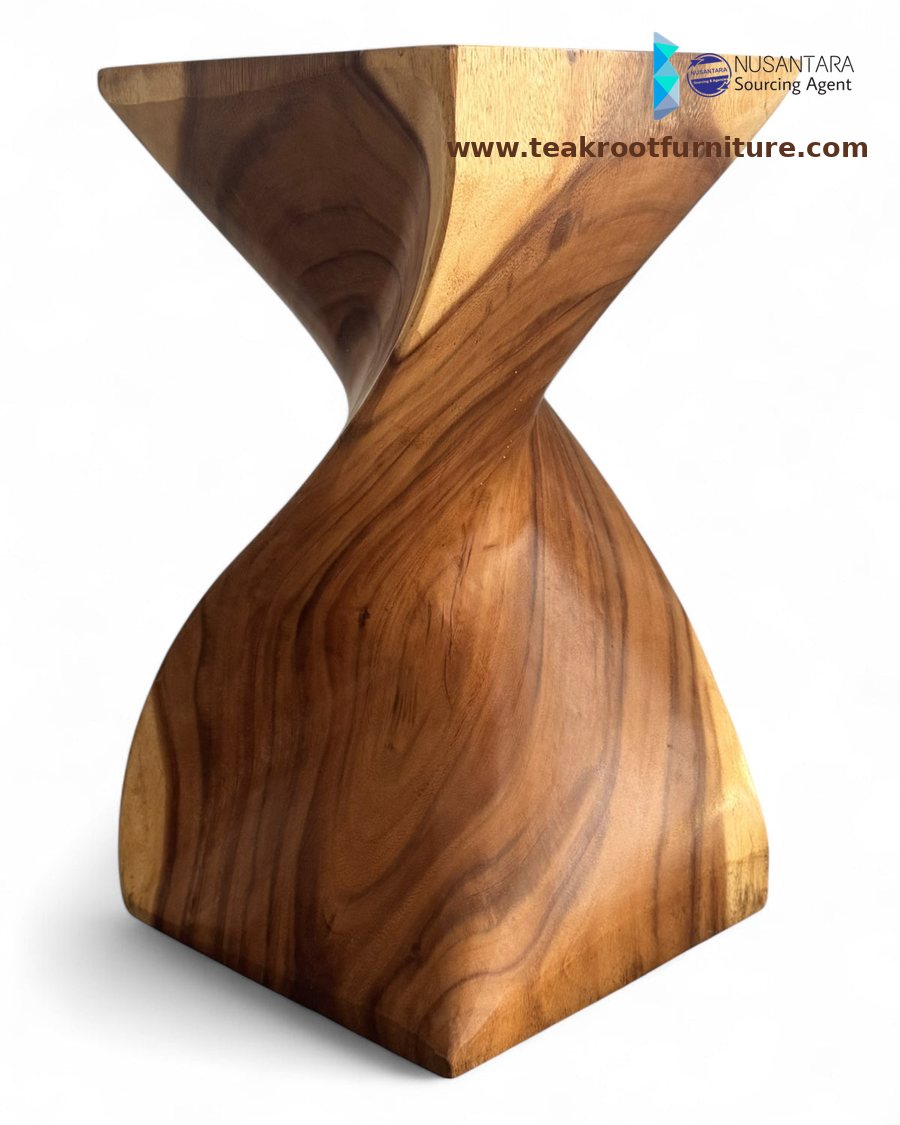
Most delayed furniture containers are not delayed by production. They are delayed by paperwork. The bill of lading is right, the invoice is not; the wood is legal, the document that proves it arrives a day late. In 2026 the stakes rose, because the European Union’s deforestation rule turns the document set from a folder your broker keeps on file into a numbered submission that must exist before the goods clear.
This is the document list a teak root container actually travels with, the three mismatches that most often stop one, and what the EUDR deadline of 30 December 2026 really changes for buyers of Indonesian root dining tables, consoles and seating.
What changes on 30 December 2026
The EU Deforestation Regulation (EUDR) has been postponed twice. A first 12-month delay was agreed at the end of 2024; then Regulation (EU) 2025/2650, published in December 2025, pushed application back again. As of the Council of the EU’s September 2026 status, medium and large operators must comply from 30 December 2026, and micro and small operators from 30 June 2027, under a simplified reporting regime.
Wood is one of seven commodities the regulation covers — alongside cattle, cocoa, coffee, oil palm, rubber and soya. It also covers derived products listed in Annex I of the regulation by customs (HS) code, and wooden furniture is on that list. On 13 July 2026 the European Commission adopted two supporting measures: a Delegated Act that updates and simplifies the Annex I product list, and an Implementing Act that sets out how the Information System for submitting due diligence statements, and simplified declarations, will work.
The practical consequence for a furniture importer is concrete. Before goods are placed on the EU market, the operator files a Due Diligence Statement (DDS) and receives a reference number that travels with the consignment. The statement rests on information that starts with the supplier: where the timber was harvested, at plot level, and evidence that it was not linked to deforestation. For a handcrafted product, that information has to be assembled while the order is still being made — not while the container is on the water.
Indonesia sits in a particular position here. It is the only country whose timber exports carried FLEGT licences under the Indonesia–EU Voluntary Partnership Agreement, which gave shipments an automatic legality pass under the old EU Timber Regulation. The EUDR keeps a version of that recognition, but it removes the free ride: an Indonesian legal-timber licence still supports the file, yet a due diligence statement is still required. Buyers who assume the FLEGT licence alone is enough are the ones who will discover the gap closest to the deadline.
The document set a teak root container travels with
Every export we prepare moves with the same core file. What changes by destination is the layers added on top.
- Commercial invoice — itemised, matching the purchase order line by line
- Packing list — piece by piece, with sizes, finishes and carton counts
- Bill of lading — issued by the shipping line after loading, not before
- Certificate of origin — issued through the relevant Indonesian authority
- SVLK / V-Legal document — Indonesia’s timber legality assurance paperwork, tracing the wood from origin to the export dock
- Fumigation certificate — where the destination requires it for solid wood
- ISPM 15 mark on wood packaging — the IPPC stamp, applied by an approved treatment provider
- EUDR due diligence statement and reference number — for the EU market from 30 December 2026
- HS code for every product line — agreed before production, not guessed at loading
One detail that catches exporters out: since 2025 the IPPC mark on wood packaging must be machine-applied. Hand-drawn marks are no longer accepted. If any solid-wood component or dunnage is used, it must be treated — typically by heat treatment, and only in restricted cases by methyl bromide — and stamped accordingly, under the EU’s Plant Health Law (Regulation (EU) 2016/2031). Our standard packing is single-face carton, which avoids the issue for the goods themselves; where a destination still inspects wood dunnage, we confirm the marking against the broker’s instruction rather than assume.
Planning a first order? Send your item list and quantities, and we will come back with what fits in a container, the FOB Semarang price and a realistic timeline.
A document map by market, worth keeping on the wall
Rules do not travel. The same container can clear easily in one market and stall in another because of one extra certificate. This is the map we work from — confirm the specifics with your own broker, because rates and conditions move.
| Market | Legality / deforestation layer | Packaging layer | Note on duty & tax |
|---|---|---|---|
| European Union | SVLK/V-Legal + EUDR due diligence statement (from 30 Dec 2026) | ISPM 15 for wood packaging | Furniture (HS 9403) around 3.7% MFN on CIF; wooden lines often 3–5.6%; VAT at the member state of import |
| United Kingdom | Separate UK timber regulation; legality evidence expected | ISPM 15 for wood packaging | UK Global Tariff applies; VAT charged at import |
| United States | Lacey Act declaration — species and origin of the timber | ISPM 15 for wood packaging | Duty depends on HS code and current tariff measures; confirm with your broker |
| Australia | Biosecurity screening by DAFF; timber legality expected | ISPM 15 strictly enforced; phytosanitary rules for some solid wood | GST applied at import; duty varies by line |
The column that surprises importers most is the last: two EU member states importing the identical container can show very different cash outlays, because the standard VAT rate ranges from 17% in Luxembourg to 27% in Hungary (2026 rates). The entry country changes your working capital, not just your paperwork.
Where the days and the money are actually lost
In our experience, the delays cluster in a handful of repeat mistakes, and almost all of them were avoidable at the quotation stage:
- The invoice and the packing list disagree. Forty pieces on the invoice, thirty-eight on the list. The container stops until someone reconciles it line by line.
- The product is described too loosely. If the invoice says “wooden furniture” but the container holds five distinct product types — a root dining table, a console, a stool, a table base, a planter — an officer has a reason to open it and inspect each one.
- The HS code does not match the goods. A code chosen for the cheapest rate rarely survives inspection.
- Documents start the week of shipment. Certificates have processing time of their own.
- Untreated wood packaging. The importer usually carries the cost of treatment or rejection on arrival, not the exporter.
- The legality file is thin. Under the EUDR, a consignment without a due diligence reference cannot lawfully be placed on the EU market, whatever else is correct.
There is a cheap fix for all of it, and it is the same one every time: agree the document list before production, not after. Send your supplier the exact list your broker wants, in writing and early. Ask them to name every product type in the invoice language, and confirm the HS code per line. It is unglamorous, and it removes most of the risk. If you would rather have that list checked against your own product and destination, write to export@teakrootfurniture.com or message +62 852 0600 7878 on WhatsApp, and we will send the file we prepare for your market.
The landed-cost arithmetic worth running before you agree a price
A FOB price is not a landed cost, and the gap between them is where budgets quietly break. Before you compare quotations, run your own numbers through the same sequence. The example below is illustrative — substitute your own freight, duty and VAT rates, because both duty and VAT depend on the HS code and the member state of import.
| Step | What it is | Illustrative figure |
|---|---|---|
| FOB Semarang | Goods loaded on board at Semarang | your quote |
| + Ocean freight & insurance | Semarang to a European port | your forwarder |
| = CIF value | The base customs uses | €20,000 (example) |
| + Import duty | Around 3.7% for furniture under HS 9403 | + €740 |
| + Import VAT | 20% example (rates run 17–27%) | + €4,148 |
| + Port & handling | Terminal, THC, inland leg | your forwarder |
| = Landed, before inland | The number your margin actually faces | ~€24,888 |
Two planning figures sit outside that table and are easy to forget. Ocean transit from Semarang to Rotterdam runs around 30 days port to port under normal conditions, but congestion at Rotterdam, Antwerp and Hamburg through 2025 pushed realistic ageing well past that — one freight benchmark recorded an average of about 46 days with an average arrival delay near 11 days on that lane. Build your schedule from the buffer, not the brochure. And remember that VAT is usually recoverable for a registered business, while duty is not, so a sheet that treats the two as one number will mislead you.
Inside Jepara: where the paperwork is earned
A clean document set is not something anyone can rush from the other side of the world. It is the visible output of a workshop that keeps records, and in Jepara that habit starts with the raw material. The teak root behind a glass-top coffee table does not arrive with a barcode. Roots and stumps are collected, sorted and worked by hand in workshops that have done this for generations, and every piece has to be accounted for before it can leave. For export, that accounting is what the SVLK system formalises — tracing the timber from origin through the supply chain to the dock, with the V-Legal document as proof.
The physical side of documentation matters just as much. A container has to be loaded to a plan, so the packing list matches reality carton by carton. Fumigation, where required, has to be scheduled around loading rather than after it. In the rainy season, when roots are still drying and sanding slows, the paperwork is what stops a shipment slipping another two weeks while the goods catch up. Our workshop loads four 40-foot containers a month and has shipped more than 300 containers since 2016; that record exists mainly because the documents travel with the goods, never behind them. This is also why Jepara has held its position as Indonesia’s carving centre — the record-keeping and the craft grew up in the same place.
Frequently Asked Questions
When does the EUDR start applying to teak root furniture shipped to the EU?
Medium and large operators from 30 December 2026, and micro and small operators from 30 June 2027 (Council of the EU, 2026). Wooden furniture is in scope because wood is one of the seven covered commodities and furniture appears in the regulation’s Annex I product list.
Does Indonesia’s SVLK or FLEGT licence remove the need for an EUDR statement?
No. The licence is strong supporting evidence of legality, and under the old EU Timber Regulation it gave an automatic pass. Under the EUDR a due diligence statement with a reference number is still required before the goods are placed on the EU market.
What duty and VAT should I budget for a mixed container into the EU?
Furniture under HS 9403 is around 3.7% on the CIF value, with wooden lines often between 3% and 5.6%; import VAT is charged at the standard rate of the member state of import, which ranges from 17% to 27% in 2026. Confirm the exact code and rate with your broker.
What single mismatch most often delays a furniture container?
An invoice and packing list that do not agree on quantities or product descriptions. It forces a line-by-line reconciliation at the port. Naming every product type — dining table, console, stool, table base — and agreeing HS codes before production prevents almost all of it.
Talk to us about your project
Send your target items and quantities — a mixed first order of teak root dining tables, root coffee tables with glass tops, consoles and stools is welcome — and we will tell you what fits in a container, what it costs FOB Semarang, and how long it takes. We will also send the document checklist for your market, and the SVLK and EUDR material your broker will ask for, before you commit to anything.
Or write directly to export@teakrootfurniture.com · WhatsApp +62 852 0600 7878 · Mr. August Praymunor (10:00–16:00 Jakarta time, GMT+7)
Packing, loading and shipping
Each piece is wrapped and corner-protected, then packed in single-face carton to keep the load light and the volume predictable. We work to a stack plan so fragile tops and heavier bases never share a face, and we build the packing list and loading plan against the physical count, carton by carton, so the paperwork your broker receives matches what the surveyor sees. Fumigation, where your market requires it, is scheduled before loading, not after.
Where does the container actually leave from?
Port of loading: Semarang, Central Java. The factory is inland by about two hours, so we build the load plan in Jepara, check the cartons against it and only then release the truck.
Our office and factory stand at the same address on every document we issue: Jl. RA Rukmini KM.02 Pekalongan RT.02/V, Tahunan, Jepara 59428, Central Java, Indonesia.
MOQ 1×20'FCL mixed · 4×40'FCL per month · 300+ containers shipped since 2016 · export@teakrootfurniture.com
Written by
Mr. August Praymunor · Overseas Marketing Director
CV. Nusantara Sourcing Agent — manufacturer and exporter of teak root furniture in Jepara, Central Java, Indonesia. Over 300 containers shipped since 2016, loading 4 x 40 FCL per month.
export@teakrootfurniture.com · WhatsApp +62 852 0600 7878 · LinkedIn · Jl. RA Rukmini KM.02 Pekalongan RT.02/V, Tahunan, Jepara 59428, Central Java, Indonesia
Buying coffee tables by the container? The teak root coffee table range with FOB prices, sizes and volume puts the numbers next to the models.
For a container of teak root dining tables, the price and volume table shows what fits and what it costs per piece.
See also
- How to Import Teak Root Furniture from Indonesia: Step by Step
- From Order to Loading: What Happens in the 12 Weeks Before Your Container Ships
- How to Compare Furniture Quotations from Indonesian Suppliers
- Our teak root furniture range
- Teak Root Furniture: A Canadian Importer's Sourcing Overview
- Teak Root Furniture for Maldives Resorts and Villas
- Teak Root Tables for Oman: Import Duty & Buyer Guide
- Teak Root Furniture Wholesale for US Importers and Designers
- Teak Root Dining Tables & Consoles for Switzerland
- Teak Root Dining & Coffee Tables for Asia & Oceania | Wholesale
Modellseiten — Preis, CBM und Containerladung
Eine Seite pro Modell: Größe, Packvolumen, FOB-Preis Semarang und wie viele in einen 20-Fuß-Container passen.
- Mawar Dining Table dia 200 cm — USD 650 · 2.43 CBM
- Oval root dining table 200 cm — USD 365 · 1.50 CBM
- Cabak Dining Table dia 150 cm — USD 340 · 1.80 CBM
0 comments:
Post a Comment