


Dubai alone welcomed 19.59 million international overnight visitors in 2025, and Gulf buyers do not lack designs — they lack a supplier who can repeat the same finish, dimensions and packing container after container. That is what we build for: mixed 20-foot containers of teak root furniture from Jepara, FOB Semarang, about 12 weeks, with a measurement sheet and photo approval signed off before every loading.
Summary: Made in Jepara, Indonesia. FOB Semarang, one 20ft container with mixed models. Abu Dhabi is investing for the long term: Sphere Abu Dhabi on Yas Island carries a $1.7 billion construction budget and will hold up to 20,000 people, and Miral has committed more than Dh12 billion across Yas Island over five years.

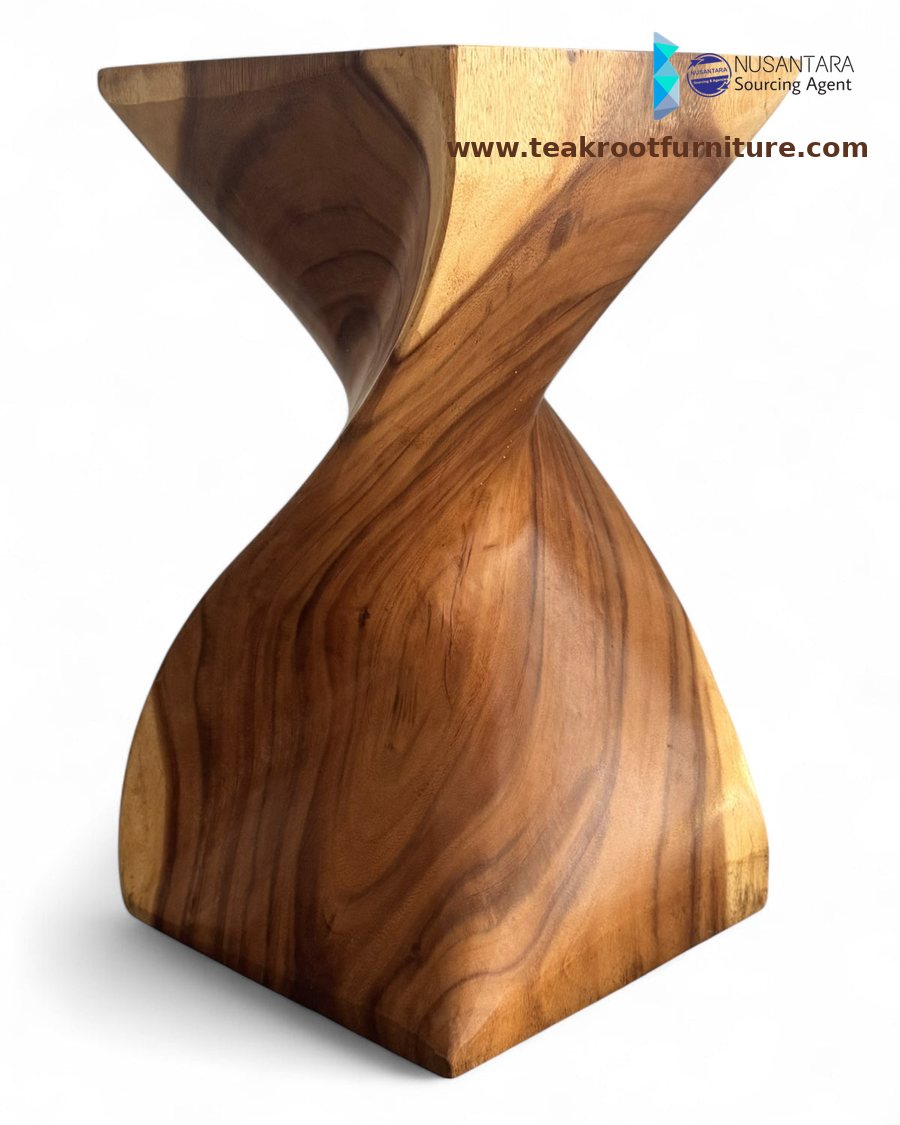
Buyers in the Gulf are not short of beautiful furniture. What they run short of is a supplier who can repeat it — the same finish, the same dimensions, the same packing, container after container. Whenever I speak with a project buyer in Dubai or a fit-out contractor in Abu Dhabi, the conversation starts with the look and ends with the schedule. That gap between desire and dependable delivery is where most teak root orders are won or lost.
This piece is written for the buyer who already likes organic teak root pieces and now has to make them arrive on time and on budget. It covers what the Gulf is specifying in 2026, how to read the real landed cost through a Jebel Ali delivery, which documents keep a container moving through UAE customs, and how these pieces are actually made on the other side.
What the Gulf is specifying right now
UAE tourism hit another record in 2025: Dubai alone welcomed 19.59 million international overnight visitors, up 5% on the 18.72 million of 2024, with hotel occupancy at 80.7% and average daily rates around AED 579, according to Dubai’s Department of Economy and Tourism. Occupancy that high means rooms are constantly being refurbished, and every refurbishment is furniture.
The pipeline behind it is deeper still. Lodging Econometrics put the Middle East hotel construction pipeline at an all-time high of 659 projects and 163,816 rooms at the close of Q3 2025, up 8% by projects and 9% by rooms year on year, with 337 projects and 86,447 rooms physically under construction at Q2 2025. The Gulf carries most of that. Ras Al Khaimah alone has a queue of openings — SO/ (257 rooms), Mangrove Rotana (258), Fairmont Al Marjan (250), Four Seasons at Mina (150 rooms plus 130 branded residences) and Saij, a 70-key mountain eco-lodge — while Wynn Al Marjan Island is the project everyone in the trade is watching, because it brings regulated gaming and a fresh events calendar to the emirate.
Abu Dhabi is investing for the long term: Sphere Abu Dhabi on Yas Island carries a $1.7 billion construction budget and will hold up to 20,000 people, and Miral has committed more than Dh12 billion across Yas Island over five years. Dubai has approved the Al Layan Oasis and a Dh500 million redevelopment of Umm Suqeim Beach. In Sharjah, Khorfakkan is getting the seven-million-square-foot Abu Al Keizan Marine Village and the Dh700 million Khorfakkan Resort, with 573 residential units.
The design direction helps us. Across 2026 trend reports, biophilic and nature-led hospitality design has moved from a niche wellness idea to an expectation: natural wood used as structure rather than background, visible grain, tactile surfaces, quiet luxury. A teak root that once held a hundred-year-old tree is a story as much as a material, which is exactly what a design-led lobby, lounge or villa asks for.
The landed-cost maths for a Jebel Ali delivery
First-time importers fixate on duty. In the UAE the numbers are simple enough to remember: the GCC Common External Tariff is 5% on the CIF value (goods, freight and insurance), and VAT is 5% on the CIF value plus duty. Stacked together that is roughly 10–11% of the goods value at the border — real money, but rarely the number that decides your margin. Freight, terminal handling and finish quality move the margin far more.
Here is how a buyer should lay it out. The figures below are illustrative, not a quotation; fill them with real numbers from your own forwarder and broker before you commit.
| Line | Basis | What to watch |
|---|---|---|
| Goods | FOB Semarang | Confirm finish and packing are included |
| Ocean freight | 1 × 20'FCL to Jebel Ali | Rates move; quote per sailing, not per year |
| Insurance | 0.3–0.6% of CIF value | Cheap peace of mind on breakable tops |
| Terminal & handling | Jebel Ali / Khalifa / Port Rashid | Ask for the all-in clearing quote |
| Duty | 5% of CIF (GCC CET) | Declare actual freight and insurance |
| VAT | 5% of (CIF + duty) | Recoverable if VAT-registered |
Two nuances are worth knowing. Duty is assessed on CIF even when you buy FOB, so declare your actual freight and insurance when you file. And Dubai relieves duty on qualifying consignments of about AED 1,000 or less — useful for samples, irrelevant for a container.
Which emirate you land in changes less than new buyers expect, because duty and VAT are national, not local. What changes is inland haulage, free-zone handling and how quickly your goods reach the project:
| Emirate | Main gateway | Border cost | What is driving demand |
|---|---|---|---|
| Dubai | Jebel Ali, Port Rashid | 5% duty + 5% VAT | Hotel refurbishment, retail, villas |
| Abu Dhabi | Khalifa Port (Taweelah) | 5% duty + 5% VAT | Yas Island, culture and events venues |
| Sharjah | Khorfakkan, Hamriyah | 5% duty + 5% VAT | Coastal resorts, Khorfakkan village |
| Ras Al Khaimah | Jebel Ali / Khalifa, by road | 5% duty + 5% VAT | Al Marjan Island, Wynn, mountain lodges |
The practical takeaway: negotiate on FOB Semarang so you know exactly what is yours and what is the supplier’s, and insist on the same Incoterm from every factory you approach. Mixed Incoterms make quotations impossible to compare, and the “cheapest” number is usually the one with the least included.
Ready to price a container? Send us your item list and quantities, and we will confirm what fits in one load, the FOB Semarang price and a realistic lead time.
Send your item list for a quote →
Documents that keep a UAE container moving
Customs rarely stops goods for the reason people fear. It stops them for a missing line on a document. The standard set for teak root furniture entering the UAE is a commercial invoice, a packing list, the bill of lading and a certificate of origin, filed through the UAE’s Mirsal 2 declaration system. Send your broker’s exact list to the supplier before production starts — not when the container is already at the gate.
- SVLK / V-Legal. Indonesia’s timber legality licence. It is not a UAE import requirement in itself, but it is the cleanest proof that the teak is legally harvested, and it keeps your compliance file intact if the same goods later move to Europe.
- ECAS / MoIAT. The Emirates Conformity Assessment Scheme, run by the Ministry of Industry and Advanced Technology (formerly ESMA), applies to a defined list of regulated products — mostly electrical, telecom and safety goods. Furniture is generally outside that mandatory scope, but confirm with your broker, because a fixed installation carrying electrical components can change the answer.
- Do not confuse SABER with the UAE. SABER is Saudi Arabia’s platform. UAE importers deal with MoIAT and their clearing agent — quoting SABER for a Jebel Ali shipment only slows the conversation.
- ISPM-15. Any solid-wood pallets or crates must be heat-treated and stamped. This one detail delays more containers than any tariff line.
- HS code discipline. Confirm the code per product type — a teak root dining table, a root coffee table with a glass top and a root planter can raise different questions.
Ports matter less than paperwork, but they still matter. Jebel Ali is the region’s largest terminal, handling 15.5 million TEU in 2024; Khalifa Port at Taweelah serves Abu Dhabi; Port Rashid and Khorfakkan serve the older and northern corridors. Your forwarder will pick the sailing; your job is to have the documents that let it clear on arrival.
DATA SHEET - FROM OUR FOB 2026 PRICE LIST
Models that leave the factory most often (FOB Semarang, delivery to Jebel Ali)
| Model | CBM/pc | FOB | Max pcs in one 20ft |
|---|---|---|---|
| Cabak Dining Table dia 100 cm | 0.75 | USD 195 | ~32 pcs |
| Cabak Dining Table dia 120 cm | 1.08 | USD 265 | ~22 pcs |
| Cabak Dining Table dia 150 cm | 1.8 | USD 340 | ~13 pcs |
| Mawar Dining Table dia 120 cm | 1.08 | USD 265 | ~22 pcs |
| Mawar Dining Table dia 150 cm | 1.69 | USD 340 | ~14 pcs |
| Mawar Dining Table dia 200 cm | 2.43 | USD 650 | ~9 pcs |
Max pcs = if the container carries that model only, using 24 CBM of usable space.
A worked mixed load - 24 pieces, 22.78 CBM, FOB USD 5,310
| Item | Qty | CBM | FOB |
|---|---|---|---|
| Cabak Dining 120 cm | 8 | 8.64 | USD 2,120 |
| Mawar Dining 150 cm | 6 | 10.14 | USD 2,040 |
| Izpo Coffee Table 100 cm | 10 | 4.00 | USD 1,150 |
Border cost for this load into the UAE
| Goods, FOB Semarang | USD 5,310 |
| Ocean freight (example rate) | USD 1,400 |
| Insurance 0.5% | USD 34 |
| CIF value | USD 6,744 |
| Duty: per your tariff line (confirm with your broker) | not included |
| VAT 5% | USD 337 |
| Landed, before duty, broker and port fees | USD 7,081 |
Freight is an example rate, quoted per sailing. VAT is the standard rate and is recoverable if you are registered. Duty depends on your tariff line and on the origin certificate; confirm both with your broker. Broker and port charges are set at destination and are not included. Product figures come from our FOB 2026 price list.
Making the first order safe
A cautious first order is not a small order — it is a mixed one. Our minimum is a single 20-foot container with mixed items, which lets a UAE buyer test a teak root dining table alongside a root console, a few root stools or benches and a root sculpture before committing to a full programme. Our terms are 50% deposit with the balance before shipment, quoted FOB Semarang, with around 12 weeks lead time on a first order.
Three habits separate comfortable importers from stressed ones:
- Ask for photographs of the finished goods and of the loaded container before it sails. A container loaded to a plan is far easier to reconcile on arrival.
- Fix the finish in writing. Raw, oiled, matte and gloss behave differently, and UAE interiors swing between coastal humidity in Dubai and the dry, heavily air-conditioned air of an Abu Dhabi lobby. Agree the finish and the packing for humidity before production.
- Agree the packing. Our standard is single-face carton, and glass tops are packed separately — but if you need triple-wall or crates, say so in the RFQ, because it changes both cost and how the container stacks.
When you compare suppliers, compare like with like: the same products, sizes, quantities and finish, on the same Incoterm, with the same packing. A vague enquiry returns a vague price you cannot compare against anyone else.
Where these pieces come from
Jepara, on the north coast of Central Java, is Indonesia’s carving town, and it is where our workshop sits. The teak roots we use come from old plantation stumps and fallow land rather than felled forest — a piece that is a by-product of land already cleared for other use. Each root is cleaned, seasoned and inspected before a carver decides what it wants to become: a base for a teak root dining table, the body of a root coffee table with a glass top, a root stool, a root planter or a standing root sculpture.
Honestly, the hardest part is not the carving. It is the drying. When the rainy season arrives, green wood cannot move into the workshop on the schedule a Gulf buyer has in mind, because forcing it through the kiln cracks the grain. We build the calendar around the weather instead of against it, and that is one reason we quote 12 weeks rather than promise four. Legal timber paperwork is the second discipline — every batch is documented for SVLK, which keeps a GCC importer’s compliance file clean.
We ship across Europe and North America from FOB Semarang, run roughly four 40-foot containers a month, and have loaded more than 300 containers since 2016. The volume is not the point. The point is that an importer in Dubai can reorder the same teak root console two seasons later and get the same thing.
Frequently Asked Questions
What duty and VAT apply when importing teak furniture into the UAE?
The GCC Common External Tariff applies 5% duty on the CIF value, and VAT is 5% on the CIF value plus duty — roughly 10–11% of the goods value at the border. A VAT-registered business recovers the VAT as input tax, so it is a cash-flow item rather than a true cost. Always confirm the exact HS code and valuation with your broker.
Do teak root furniture imports need ECAS or SABER certification in the UAE?
Furniture is generally not on the UAE’s mandatory ECAS/MoIAT regulated-products list, which covers mostly electrical, telecom and safety goods; SABER is Saudi Arabia’s scheme, not the UAE’s. We supply SVLK / V-Legal legal timber documentation with each batch. If a piece is a fixed installation with electrical parts, ask your broker to confirm whether a conformity certificate is triggered.
Which UAE ports do you ship to, and what is the Incoterm?
We quote FOB Semarang and buyers clear through Jebel Ali, Khalifa Port, Port Rashid or Khorfakkan, depending on the destination. CIF can be quoted on request, but FOB lets you compare factories on identical terms and control your own freight.
Can a UAE buyer order just one container?
Yes. Our minimum is one 20-foot container with mixed items, so a hotel, a fit-out contractor or a showroom can combine a teak root dining table, a root coffee table with a glass top and a few root stools or benches in one load. A first order runs about 12 weeks in production, with 50% deposit and the balance before shipment.
Talk to us about your project
Tell us which pieces you need, how many, and where in the UAE they are going. We will tell you what fits in a container, what it costs FOB Semarang, and what the timeline really looks like.
Or write directly to export@teakrootfurniture.com · WhatsApp +62 852 0600 7878 · Mr. August Praymunor (10:00–16:00 Jakarta time, GMT+7)
Packing, loading and shipping
Every order is packed with protective wrapping, stacked to a load plan and staged before it leaves the factory. We list each piece so that what arrives matches what was ordered, and we can supply a container load plan for your customs broker.
Where does the container actually leave from?
Everything goes out of Semarang in Central Java. The workshop sits roughly two road-hours from the terminal, so cartons are staged, cross-checked against the packing list and trucked down in the days before the vessel cuts off.
We have handled this route repeatedly for UAE buyers, so the paperwork and timings are routine for us.
Our office and factory stand at the same address on every document we issue: Jl. RA Rukmini KM.02 Pekalongan RT.02/V, Tahunan, Jepara 59428, Central Java, Indonesia.
MOQ 1×20'FCL mixed · 4×40'FCL per month · 300+ containers shipped since 2016 · export@teakrootfurniture.com
Written by
Mr. August Praymunor — Overseas Marketing Director
CV. Nusantara Sourcing Agent · manufacturer and exporter of teak root furniture in Jepara, Central Java, Indonesia. We have shipped over 300 containers since 2016, loading 4×40’FCL per month for importers, hotel groups and interior contractors in Europe and North America. Every figure in this article comes from the sources noted in the text or from our own shipping records.
export@teakrootfurniture.com · WhatsApp +62 852 0600 7878 · LinkedIn · Jl. RA Rukmini KM.02 Pekalongan RT.02/V, Tahunan, Jepara 59428, Central Java, Indonesia
See also
- Furnishing Gulf Hotels with Teak Root Furniture
- Understanding Furniture Import Duty in Oman: A Buyer’s Guide
- How to Import Teak Root Furniture from Indonesia: Step by Step
- Our teak root furniture range
Model pages — price, CBM and container load
One page per model: size, packed volume, FOB Semarang price and how many fit in a 20ft container.
- Console 200 cm — USD 215 · 0.61 CBM
- Console 180 cm — USD 185 · 0.55 CBM
0 comments:
Post a Comment