


Two tariff events in twelve months changed what an Indonesian furniture container costs to land: in the United States the 19% reciprocal tariff stopped being collected on 24 February 2026 and a 10% Section 301 duty took its place on 24 July 2026; in the European Union the main wooden-furniture lines still clear at 0% duty, but the EUDR applies to wooden furniture from 30 December 2026. Containers still leave Semarang weekly, FOB, about 12 weeks from deposit.
Summary: Made in Jepara, Indonesia. FOB Semarang, one 20ft container with mixed models. For planning, the benchmark Semarang to Rotterdam lane runs about 6,274 nautical miles with an average transit of around 46 days and an average market rate near USD 3,800 per forty-foot container in late 2026 (Cargoplot).

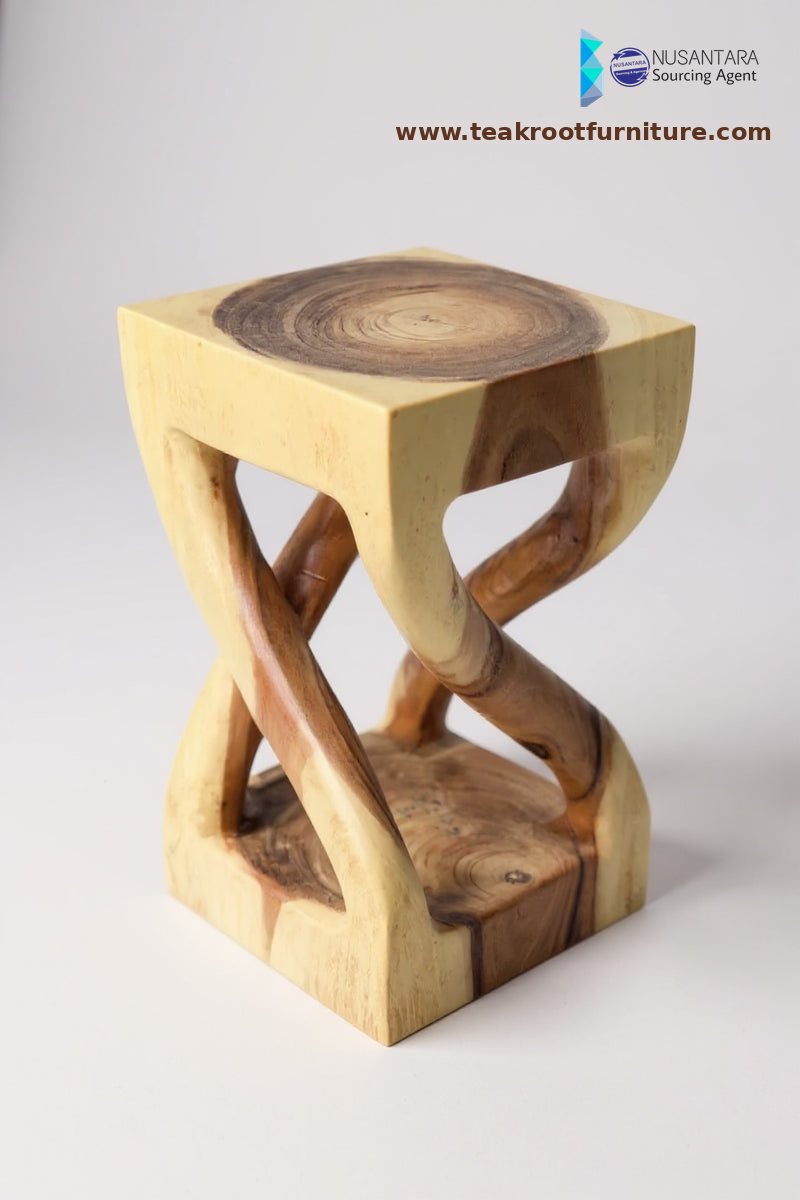
Two tariff events in twelve months have quietly rewritten what an Indonesian furniture container costs to land, and many buyers are still working from price lists built in 2025. In the United States, the 19% reciprocal tariff on Indonesian goods stopped being collected on 24 February 2026, and a 10% Section 301 duty took its place on 24 July 2026 (Airlift USA tariff tracker, September 2026). In the European Union, the main wooden-furniture tariff lines still clear at 0% duty, but the EU Deforestation Regulation now applies to wooden furniture from 30 December 2026. Neither change makes importing harder. Both make the calendar, and the paperwork behind it, more valuable than the number at the bottom of a quotation.
The trade is large, which is why details move real money. Indonesia shipped around USD 2.22 billion of furniture and handicraft in the eleven months to November 2024, and the leading destinations were the United States, Japan, the Netherlands, Germany and Belgium (Indonesian Ministry of Trade). When a buyer asks us to import teak root furniture from Indonesia, the questions are almost the same wherever the port at the other end sits: what will it land at, when must the container sail, and who signs the paperwork if something goes wrong. This guide answers those three.
What an Indonesian teak root container costs to land in 2026
Landed cost is not the FOB price. It is the FOB price plus freight, duty, the destination's consumption tax, port and customs fees, and the cost of the paperwork that keeps all of it moving.
In the European Union, most furniture lines clear at 0% duty: the main HS 9403 lines show 0% in the TARIC database, though some national sources quote up to about 3.7% on certain subheadings, so confirm the exact ten-digit code before you price (TARIC, August 2026). What surprises EU buyers is rarely duty, it is VAT, which runs from about 17% to 27% by member state.
In the United States, the stack is heavier, and it has moved twice in a year. Beyond the normal Column 1 duty for the HTS line, Indonesian goods pay a 10% Section 301 duty under heading 9903.05.45, in force since 24 July 2026. The 19% IEEPA reciprocal tariff that dominated 2025 conversations was collected only to 24 February 2026, and the 10% Section 122 surcharge that bridged it expired on 24 July 2026. Separately, Section 232 timber measures that began on 14 October 2025 carry 10% to 25% on softwood lumber, and on upholstered wooden furniture and kitchen cabinets. Most solid teak root tables, consoles and stools sit outside those specific lines, but confirm your own HTS code with a broker, because the wording of the annexes decides it.
What a container pays, by market (as of late 2026)
| Cost layer | European Union | United States |
|---|---|---|
| Import duty on wooden furniture | 0% on the main HS 9403 lines (TARIC, checked Aug 2026); some subheadings quoted up to ~3.7% | Normal Column 1 HTS duty, plus a 10% Section 301 duty since 24 Jul 2026 |
| Recent levy changes | No new levy; the change is regulatory (EUDR) | 19% IEEPA rate ended 24 Feb 2026; 10% Section 122 surcharge expired 24 Jul 2026 |
| Consumption tax | VAT, roughly 17% to 27% by member state | State sales and use tax varies; no federal VAT |
| Wood-specific measure | None on duty, but see the EUDR clock below | Section 232 timber measures from 14 Oct 2025 (10% to 25%) on listed wood products |
| Legality paperwork | EUDR due diligence statement (from 30 Dec 2026) | Lacey Act declaration (APHIS, filed in ACE or LAWGS) |
| Port and entry fees | ISPM 15 marks on all wood packaging | Harbor maintenance fee, 0.125% of cargo value |
Ready to price a container? Send us your item list and quantities, and we will confirm what fits in one load, the FOB Semarang price and a realistic lead time.
Send your item list for a quote →
The two compliance clocks that decide your sailing date
Compliance is now a scheduling problem, not an afterthought. For wood furniture, two clocks run at once, with different deadlines and different geographies.
Europe: the Deforestation Regulation. Regulation (EU) 2023/1115 covers wood among its seven commodities, and wooden furniture under heading 9403 was already listed in the annex to the older EU Timber Regulation, which is why it does not get the small-business breathing room that other products do. Application of the EUDR was postponed once more by Regulation (EU) 2025/2650, published in December 2025. The result for furniture is specific: the due diligence obligation applies from 30 December 2026 whatever the size of the importing company, while the later date of 30 June 2027 mainly helps small operators on goods that were not in the old annex. From 30 December 2026, a container without a valid due diligence reference number in its customs declaration will not be released.
The due diligence statement is not a form you complete at the last minute. For a teak root dining table it needs the full scientific name of every wood species in the piece, the geolocation of the harvest plots and the country of harvest. One statement can cover deliveries from a supplier for up to a year, which is how most importers make it workable. The practical implication for a buyer in Rotterdam, Antwerp or Hamburg is simple: your supplier has to hand over species names and plot coordinates, and a workshop that cannot is a risk you inherit.
Indonesia: SVLK and V-Legal. Indonesian exporters work inside SVLK (Sistem Verifikasi Legalitas Kayu), the country's mandatory timber legality assurance system. Its documents, including the V-Legal export notification, are what an EU or American importer receives as proof that the teak was legally harvested and the chain of custody is intact. For the EUDR, SVLK is a strong starting point but not a full substitute, because plot-level geodata still has to be supplied.
United States: the Lacey Act. Since 2009, an importer of plant products, wood furniture included, has filed a Lacey Act declaration using the data once collected on PPQ Form 505, now filed electronically through APHIS in ACE or through the LAWGS system. The Phase VII expansion brings a wide range of wood and cork furniture explicitly into scope, and the declaration asks for the scientific name of the plant, the country of harvest, quantity and value. File it accurately: a mismatch is a customs hold, and a hold on a forty-foot container is a storage bill.
The dates that decide your sailing window
| Date | What changes | Who it hits |
|---|---|---|
| 24 Feb 2026 | US 19% IEEPA reciprocal tariff no longer collected | US importers |
| 24 Jul 2026 | US 10% Section 301 duty on Indonesian goods takes effect | US importers |
| 30 Dec 2026 | EUDR due diligence applies to wooden furniture (HS 9403) regardless of company size | EU importers |
| 30 Jun 2027 | EUDR start for micro and small operators on goods outside the old annex | smaller EU traders |
Which port your container actually leaves from
Almost all teak root from the Jepara cluster leaves through Tanjung Emas, the port of Semarang on Java's north coast. It is a capable but modest gateway: it moved just over one million TEU in 2025, and its access channel, around ten metres of depth against a deeper twelve-metre terminal basin, keeps most vessels to roughly nine metres of draft (Cargoplot lane data, September 2026). That single fact explains two things buyers notice: sailings to Europe are fewer than from Singapore or Port Klang, and schedules shift more than a spreadsheet assumes.
For planning, the benchmark Semarang to Rotterdam lane runs about 6,274 nautical miles with an average transit of around 46 days and an average market rate near USD 3,800 per forty-foot container in late 2026 (Cargoplot). Clearance at Rotterdam on this lane averages about 1.4 days, with roughly half of tracked shipments clearing the same day. Every EU consignee needs an EORI number; without it, the shipment cannot be declared at all. FOB Semarang is the term we quote as standard, which means the buyer's forwarder controls the ocean leg while we control everything up to the ship's rail.
What one 20'FCL really holds for teak root
Teak root is not flat-pack, and it does not cube like a wardrobe. Every piece is an irregular solid, so we quote and load by volume and by how well shapes nest. A root coffee table with a glass top is bulky but light; a heavy dining base cut for a stone top is the opposite. That is why a straight "how many tables in a container" answer misleads, and why a load plan built from your actual item list beats any rule of thumb.
In our experience, the honest planning unit is the mixed container. A single 20'FCL can combine several teak root dining tables with their bases, a run of root coffee tables with glass tops, root consoles for a hotel lobby, stools and benches for a restaurant, table bases sold on their own, planters and one or two root sculptures, and the nesting decides the final count. For a first order from a hotel or restaurant project, a mixed 20'FCL has two advantages: it meets our minimum of one 20'FCL mixed, and it lets the operator test several families at once before committing to repeat volume. We build and load up to 4×40'FCL per month, so a project that grows after the first container does not have to wait a season.
Making the first order safe
The first container carries the most risk and the least information. Three things reduce both.
- Agree the specification in writing before the deposit, down to finish, size tolerance and whether glass is included. A "teak root dining table" can mean a 120 cm round or a 200 cm oval, and 30 cm of difference changes both the price and the load plan.
- Split the money. Our standard terms are 50% deposit with the balance before shipment, which is normal for this trade and gives both sides a reason to finish properly. Ask for photographs and, on larger orders, third-party inspection before loading. We supply inspection photos and video as standard, and a buyer's inspector is welcome at the factory in Jepara, Central Java, Indonesia.
- Match the paperwork to the destination before the container sails, not after. That means the SVLK documents, the right HS code, an EUDR due diligence reference if you are in the EU, and a Lacey Act declaration if you are in the United States. Our article Furniture Import Documents: What You Need and What Delays Containers walks through the sequence in detail, and From Order to Loading shows the twelve-week timeline that a first order usually follows.
The same checks matter wherever you import from. Buyers in these markets ask us about them most:
- Italy · Poland · Germany
- Netherlands · United Kingdom · France
- United States · Canada · Australia
Where these pieces come from
Jepara is a small town on the north coast of Central Java, Indonesia, and it has been a woodcarving centre for centuries. The carved-furniture cluster that has grown around it is now valued at well over USD 2 billion by industry estimates (2026), and what that number hides is how the work is organised: thousands of small workshops, each with one specialism, from mortise-and-tenon frames to hand-carving, finishing and glass.
The material itself sets the rhythm. Teak root is the part of the tree that the sawmill used to leave behind, and the shapes are one of a kind, so each piece is a design decision rather than a repeat of a mould. Through the wet season on Java, root sections take longer to dry, and rushing that drying is how a table arrives with a crack two months later. Good workshops slow down in the rain and speed up in the dry months, and that seasonal swing is one honest reason a first order carries a twelve-week lead time.
We are CV. Nusantara Sourcing Agent, working from Jepara, Indonesia since 2016, and teak root is most of what we do. We have shipped more than 300 containers since 2016 to importers, hotel groups and interior contractors in Europe and North America, and the products have stayed deliberately narrow: teak root dining tables, root coffee tables with glass tops, root consoles, stools and benches, table bases, planters and sculptures. That focus is why our load-plan answers hold.
Frequently Asked Questions
Has the US tariff on Indonesian furniture changed since 2025?
Yes, twice. The 19% IEEPA reciprocal tariff stopped being collected on 24 February 2026, and a 10% Section 301 duty on Indonesian goods took effect on 24 July 2026. The exact bill depends on your HTS code, so confirm the current stack with your customs broker before you price a landed cost.
Does the EU Deforestation Regulation apply to a teak root table order?
For wooden furniture under HS 9403, yes, and from 30 December 2026 regardless of your company's size, because these lines sat in the annex to the older EU Timber Regulation. Your due diligence statement needs the scientific species name, the harvest plot coordinates and the country of harvest. We supply the species and origin data with the SVLK documents.
How long from purchase order to a loaded container?
For a first order, plan on about twelve weeks to production and packing, then the ocean leg on top, roughly 46 days to Rotterdam on the benchmark lane. Repeat orders move faster once the specification is fixed. The 50% deposit starts the schedule.
Can I mix different products and sizes in one container?
Yes, and for a first order you should. Our minimum is one 20'FCL mixed, so a single container can hold dining tables, coffee tables with glass tops, consoles, stools and table bases together. Send the item list, and we will confirm what fits, with the FOB Semarang price and a lead time.
Talk to us about your project
If you are planning a hotel, restaurant, retail or residential order and want to know what a container will land at in your market, the fastest path is one email. Send your item list, sizes, quantities and the destination port, and we will reply with what fits in one load, the FOB Semarang price and a realistic lead time. We answer within one working day.
Send your item list for a quote →
Packing, loading and shipping
Packing starts at the bench, not at the door. Every piece is inspected, then wrapped so that contact points and any glass top cannot touch bare wood or each other; the heaviest bases load first and the irregular pieces are nested to stop movement inside the container. We build a stack plan, prepare the packing list so it matches what actually ships, and give your forwarder a load plan before the truck leaves the yard. The export standard is single-face carton, or per buyer requirement.
Where does the container actually leave from?
The port of loading is Semarang, on Java's north coast. Our workshop in Jepara is about two hours by road from the terminal, so every carton is staged and checked against the packing list at the factory first, then moved down to Tanjung Emas, lifted onto the ship and carried under the FOB Semarang terms we quote as standard.
Our office and factory stand at the same address on every document we issue: Jl. RA Rukmini KM.02 Pekalongan RT.02/V, Tahunan, Jepara 59428, Central Java, Indonesia.
MOQ 1×20'FCL mixed · 4×40'FCL per month · 300+ containers shipped since 2016 · export@teakrootfurniture.com
Written by
Mr. August Praymunor — Overseas Marketing Director
CV. Nusantara Sourcing Agent · manufacturer and exporter of teak root furniture in Jepara, Central Java, Indonesia. We have shipped over 300 containers since 2016, loading 4×40’FCL per month for importers, hotel groups and interior contractors in Europe and North America. Every figure in this article comes from the sources noted in the text or from our own shipping records.
export@teakrootfurniture.com · WhatsApp +62 852 0600 7878 · LinkedIn · Jl. RA Rukmini KM.02 Pekalongan RT.02/V, Tahunan, Jepara 59428, Central Java, Indonesia
See also
- Bulk Teak Root Furniture Supply for Importers and Distributors
- Inside a Teak Root Furniture Factory in Jepara, Indonesia
- Teak Root Table Bases for Glass and Stone Tops
- Our teak root furniture range
Model pages — price, CBM and container load
One page per model: size, packed volume, FOB Semarang price and how many fit in a 20ft container.
- Mawar Dining Table dia 200 cm — USD 650 · 2.43 CBM
- Oval root dining table 200 cm — USD 365 · 1.50 CBM
- Cabak Dining Table dia 150 cm — USD 340 · 1.80 CBM
0 comments:
Post a Comment