


Indonesia exported about US$2.39 billion of furniture in 2025, roughly 55% of it to the United States, and the first quarter of 2026 came in at US$581.5 million, down 13.0% year on year. When volumes fall while tariffs rise, the importers who keep their margin are the ones who understand the factory behind the quotation: how the root is dried, how moisture is measured, and who signs off the pieces before the container is closed.
Summary: Made in Jepara, Indonesia. FOB Semarang, one 20ft container with mixed models. Our own terms are simple to model: a minimum of 1x20'FCL mixed , priced FOB Semarang , with a first-order lead time of about 12 weeks , 50% deposit and the balance before shipment, single-face carton packing, and capacity for 4x40'FCL per month .

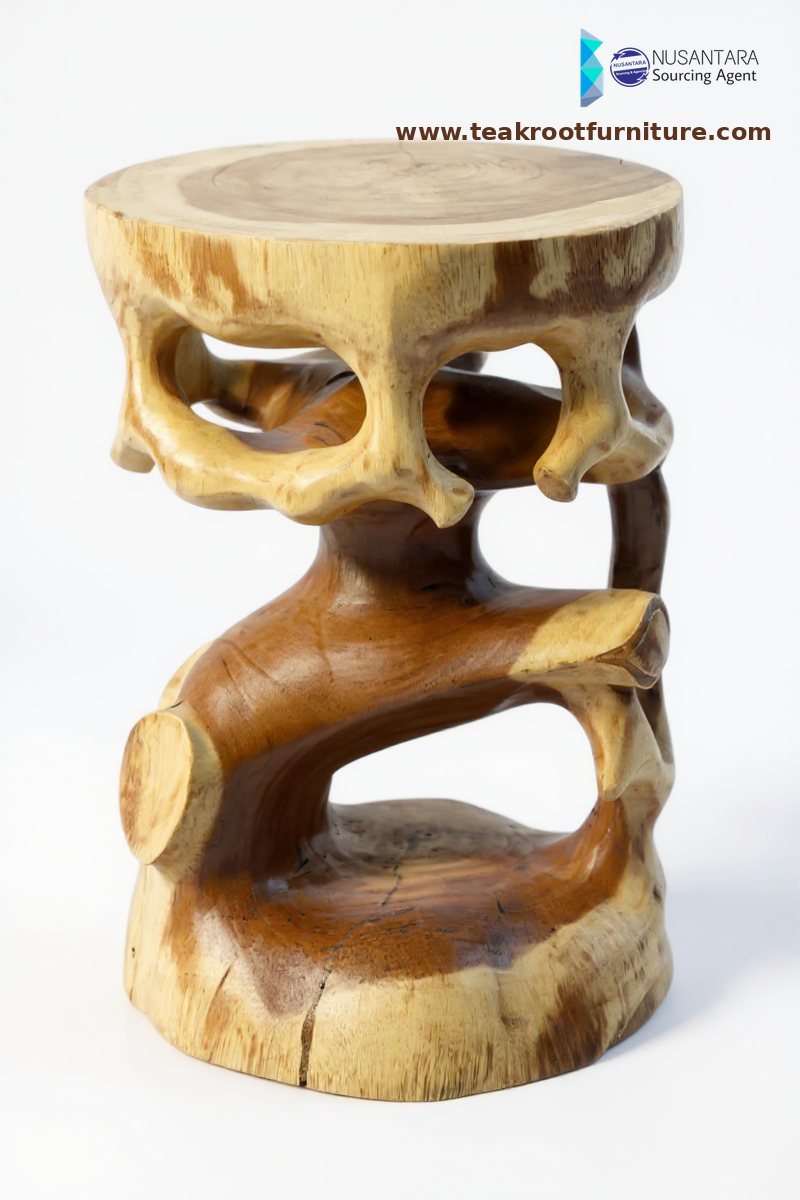
Indonesia exported about US$2.39 billion of furniture in 2025, and the United States took roughly 55% of it. Then the first quarter of 2026 landed at US$581.5 million — down 13.0% on the same quarter a year earlier (trade data reported in July 2026). When volumes fall and tariffs rise at the same time, the importers who hold their margin are rarely the ones chasing the lowest quote. They are the ones who understand the factory behind it.
This is a working tour of what actually happens inside a teak root furniture factory in Jepara, on the north coast of Central Java, Indonesia — the town that has been Indonesia's carving centre for generations. If you import teak root furniture from Indonesia, the checkpoints below are the ones that decide whether the container you receive matches the sample you approved. Miss them, and the gap shows up as claims, rework or a discount you have to give your own customer.
What changed for importers in 2026
Three things moved at once, and they all push in the same direction: documentation and process now matter as much as price.
- United States. The reciprocal tariff on Indonesian goods settled at 19% (White House fact sheet, February 2026), replacing a threatened 32%. It is built into the landed cost now, not a temporary scare.
- European Union. Under the EU Deforestation Regulation (EUDR), large and medium operators must comply from 30 December 2026, and micro and small operators from 30 June 2027 (European Commission). Wood furniture is in scope.
- Market share. Indonesia's share of global furniture and handicraft exports slipped from 3.47% in 2021 to 2.37% in 2024 (Indonesian trade analysis, March 2025) — partly because buyers consolidated to fewer suppliers who could document their supply chain.
The practical takeaway for a buyer: a factory that can show you its drying records, its legality paperwork and its packing photos is worth more in 2026 than one that is simply cheaper per unit. Rework and customs delays cost more than the difference you negotiate off the FOB price.
Where the roots come from — and why that decides your quality
Teak root furniture does not start with a log. It starts with a stump. On the teak estates of Java, roots are cleared after the timber harvest and would otherwise be burned or left to rot. A factory buys those roots, hauls them to the yard and cleans off soil, stone and grit before anything is cut. Teak root dining tables, coffee tables, consoles and stools are, in effect, a second harvest from the same tree.
This is also where legality is set. Indonesian law requires timber-legality verification — SVLK, issued with a V-Legal document — for wood products leaving the country, and the EU accepts V-Legal as proof of legality under the 2013 Voluntary Partnership Agreement (SCS Global Services; Indonesian regulation). A supplier that cannot name its SVLK permit and give you a V-Legal number is a risk you cannot pass on to your own customs broker.
The first quality decision happens at grading. Roots vary enormously: some are dense and sound, some are hollow or soft in the middle. The reject rate at this step is one of the clearest signals of a serious workshop. A factory that accepts everything will produce a beautiful-looking table that moves, splits or sags within a year.
The six steps from stump to sealed crate
Every piece of teak root moves through the same sequence. Here is each step, where it usually goes wrong, and the question you should ask your supplier about it.
| Step | What happens | Where it usually fails | Ask your supplier |
|---|---|---|---|
| 1. Sourcing and legality | Roots collected from plantation stumps, cleaned, checked against SVLK paperwork | Mixing undocumented stock into a batch | "Which permit and V-Legal number cover this batch?" |
| 2. Cleaning and grading | Soil and stone removed; density graded | Soft or hollow roots accepted to fill an order | "What is your reject rate at grading?" |
| 3. Cutting and shaping | Root cut to a workable form; base levelled | Rushed levelling — a base that rocks on a flat floor | "How exactly is the base levelled and checked?" |
| 4. Kiln drying | Moisture content brought into the export range | Under-drying — the piece moves after it reaches a heated room | "Can I see the moisture readings for this batch?" |
| 5. Sanding and finishing | Progressive sanding, then a hand-applied finish in the agreed tone | Finish hides a structural crack | "Which finish and which tone, and on which sample?" |
| 6. QC and packing | Stability check, packing list, load plan | Packing that lets heavy pieces shift in transit | "Will you send loading and packing photos?" |
Ready to price a container? Send us your item list and quantities, and we will confirm what fits in one load, the FOB Semarang price and a realistic lead time.
Send your item list for a quote →
The moisture number that decides whether your table survives winter
If you remember one technical figure from this article, make it this one: moisture content of roughly 8–12% is the accepted baseline for export-grade solid-wood furniture (Indonesian furniture practice reported through 2025–2026). Wood at that level has been stabilised to sit in a normal indoor environment without large movement.
Here is the trap. When a root piece arrives at 16% or 18% moisture and is placed in a heated home or hotel in Europe or North America, where indoor relative humidity can drop to 30–40% in winter, the wood releases that moisture and shrinks. A tabletop attached with nails or tight screws has nowhere to go, so it cracks, opens a seam or lifts. This is not a "cheap wood" problem; it is a drying problem, and it is why kiln drying is the most expensive and least visible part of a factory.
Two habits protect you. First, ask for moisture readings by batch before loading, not one number for the whole order. Second, carry a pin or pinless moisture meter to the DC and spot-check a few pieces when the container is unloaded. A reading inside range tells you the factory dried to specification; a reading far outside it tells you to raise the issue while the shipment is still fresh.
What importers misread about finish and "defects"
Root furniture is not joinery, and judging it by furniture-factory rules sets you up for disputes. Natural cavities, irregular grain, colour variation and old nail scars are the character of the material, and a good workshop preserves them deliberately — the difference between a mass-produced tabletop and a root coffee table with a glass top that a designer will photograph.
What is genuinely a defect is different: a structural crack that will grow, a base that rocks, a piece that will not carry the load, or a finish that lets moisture in. The line between "character" and "defect" should be written down in your specification and matched to a physical sample you have approved. Finish is usually supplied natural, bleached or a warmer gold tone; pick one, and photograph the approved sample. On our own orders, most finish disagreements trace back to a buyer approving a photo rather than a sample. Approve the sample.
Inside a working day in Jepara
The town is small — it is not a capital city — and the whole industry is built on it. The district is usually described as holding around 15,000 furniture business units that support roughly 170,000 workers (CIFOR Furniture Value Chain project): carving skills passed down through families, with workshops stacked along the coastal road. When a buyer asks why the work is done here rather than in a generic industrial park, the honest answer is the labour pool: the carvers, sanders and finishers who can read a root already exist in one place.
The work is also seasonal. Java's rainy season, broadly November to March, slows drying and can stretch a production schedule; the dry months move faster. Teak log and root prices rise and fall, and the rupiah moves against the dollar, which is why a responsible factory quotes a validity window rather than a permanent price. And SVLK compliance, while it protects the buyer, is real cost and paperwork the factory has to carry every month — one more reason a suspiciously low quote deserves a second look.
That combination — a deep local labour pool, an export process built over years, and a factory in Jepara, Central Java, Indonesia that buyers can physically visit — is what makes this supply base work for importers in Europe and North America.
Rules that follow a teak root container in 2026
Nothing here is exotic, but each rule has a date or a document attached. Budget for them before you negotiate.
| Market | Rule | Key date | What it means for you |
|---|---|---|---|
| United States | Reciprocal tariff of 19%; Lacey Act declaration on wood imports | Tariff settled February 2026 | Build duty into the landed cost; declare the species correctly at entry |
| European Union | EU Deforestation Regulation (EUDR) on wood products | 30 December 2026 for large and medium operators | You will need legality and, where required, plot-level data from your supplier |
| European Union | V-Legal accepted as legality proof under the 2013 VPA | In force | Ask for the V-Legal document with every shipment |
| Australia | ISPM 15 for solid-wood packaging | In force | Confirm pallets and crates are heat-treated and stamped |
| All markets | SVLK timber-legality verification | Mandatory | No SVLK means no legal export — it is a red flag if a supplier dodges it |
What natural-material furniture is worth on your shelf
The demand signal is easy to read at retail. A handcrafted teak root coffee table with a glass top typically lists around US$1,300 to US$1,400 in the United States (US retail listings, 2025–2026), while UK outlets discount the same category to a few hundred pounds on offer. The spread between those two numbers — not the FOB price — is where your business lives. It is also why the category keeps selling: organic shape, natural material and visible hand-work are exactly what interior designers specify for hospitality and residential projects, and none of it is reproducible on a machine line.
For a boutique hotel or a restaurant fit-out, that pulls a predictable list: teak root dining tables for the main room, root coffee tables with glass tops for lounges, root consoles and side tables for corridors, and root stools or benches to seat the bar. A single mixed load usually covers all of it, which is often simpler than ordering from three suppliers.
Load planning: what a mixed 20'FCL really holds
Root furniture is bulky and irregular, so volume fills before weight. A 20'FCL is the usual starting point, and a mixed container lets a first order test several products in one shipment rather than committing to a whole container of one line. Requested volumes for a 20'FCL sit in a wide range — commonly cited around 28 to 33 cubic metres of usable space — but the real number depends on piece shapes, so confirm it with your freight forwarder and your supplier's load plan rather than assuming.
Two things make a mixed load safer. First, a detailed item list with sizes, quantities and finish so the load plan can be built before production. Second, agreement on how pieces nest and where the gaps go, because a load planned badly wastes cubic metres you already paid to ship.
Our own terms are simple to model: a minimum of 1x20'FCL mixed, priced FOB Semarang, with a first-order lead time of about 12 weeks, 50% deposit and the balance before shipment, single-face carton packing, and capacity for 4x40'FCL per month. Buyers are welcome to inspect the factory in Jepara before the first container.
Frequently Asked Questions
Can I actually audit a Jepara factory before I place a first order?
Yes, and we encourage it. You can visit the workshop in Jepara, Central Java, Indonesia by arrangement, walk the drying and finishing areas, and see finished stock. If travel is not practical, we provide photographs and video of production and packing, plus the moisture readings and V-Legal paperwork for your batch.
What legality document must travel with a teak root container?
Every wood-product export from Indonesia needs SVLK timber-legality verification, issued with a V-Legal document, and the EU accepts V-Legal as legality proof under the 2013 Voluntary Partnership Agreement. For the EU, plan ahead for the EUDR obligations that apply to large and medium operators from 30 December 2026.
How long does it take from deposit to a sealed container?
For a first order, plan on around 12 weeks from confirmed deposit to a sealed, loading-ready container — drying time and the mixed-product build are the main variables. Repeat orders usually run faster once the specification, finish and packing are fixed, and we load up to 4x40'FCL per month.
How do you stop moisture damage in transit and after arrival?
We dry to the export range of roughly 8–12% moisture content and inspect again after drying. Packing protects contact points and stops pieces moving in the container. On arrival, spot-check a few pieces with a moisture meter and let the furniture acclimatise indoors for a few days before placing heavy loads on it.
Talk to us about your project
Send your item list with sizes, quantities and finish, and we will come back with what fits a mixed load, the FOB Semarang price and a realistic timeline. One email is enough to start — you will have a quotation within one working day, and you are welcome to inspect the factory in Jepara before anything ships.
Send your item list for a quote →
Packing, loading and shipping
Root furniture is bulky and irregular, so packing is designed around sea freight: contact points are wrapped and protected, pieces are separated so they cannot knock against each other, and the load plan is built so that nothing can shift once the doors are closed. Every shipment leaves with a packing list that matches the load, and we photograph the loading so that your broker sees what went in before the container moves.
Where does the container actually leave from? It is stuffed at our yard in Jepara, on the north coast of Central Java, then driven the roughly 65–70 km to the port of Semarang — about two hours on the road. Pieces are checked against the packing list, weighed, photographed and sealed before the truck leaves, and FOB Semarang is our standard term.
Our office and factory stand at the same address on every document we issue: Jl. RA Rukmini KM.02 Pekalongan RT.02/V, Tahunan, Jepara 59428, Central Java, Indonesia.
MOQ 1x20'FCL mixed · 4x40'FCL per month · 300+ containers shipped since 2016 · export@teakrootfurniture.com
Written by
Mr. August Praymunor — Overseas Marketing Director
CV. Nusantara Sourcing Agent · manufacturer and exporter of teak root furniture in Jepara, Central Java, Indonesia. We have shipped over 300 containers since 2016, loading 4×40’FCL per month for importers, hotel groups and interior contractors in Europe and North America. Every figure in this article comes from the sources noted in the text or from our own shipping records.
export@teakrootfurniture.com · WhatsApp +62 852 0600 7878 · LinkedIn · Jl. RA Rukmini KM.02 Pekalongan RT.02/V, Tahunan, Jepara 59428, Central Java, Indonesia
See also
- Teak Root Table Bases for Glass and Stone Tops
- Choosing an Indonesian Teak Root Furniture Supplier: A Buyer's Checklist
- How to Choose a Teak Root Furniture Manufacturer in Indonesia
- Our teak root furniture range
Model pages — price, CBM and container load
One page per model: size, packed volume, FOB Semarang price and how many fit in a 20ft container.
- Karang Coffee Table 140 x 70 cm — USD 155 · 0.39 CBM
- Coffee table live edge 120 x 80 cm — USD 145 · 0.38 CBM
- Java coffee table dia 120 cm — USD 138 · 0.58 CBM
0 comments:
Post a Comment