


A finished 120 cm teak root dining table moves air; the same root as a base-only piece travels as a dense, stackable block that fills a fraction of the container — which is why a growing share of what we load in Jepara leaves as bases only, with the glass, stone or engineered top cut close to the buyer. It cuts freight per piece, and it keeps duty on the lower-value component.
Summary: Made in Jepara, Indonesia. FOB Semarang, one 20ft container with mixed models. Freight in mid-October 2026 was not cheap: Drewry's World Container Index put the composite at $4,485 per 40 ft container, Shanghai–Rotterdam at $3,522 and Shanghai–Los Angeles at $7,884 (Drewry World Container Index, 15 October 2026).

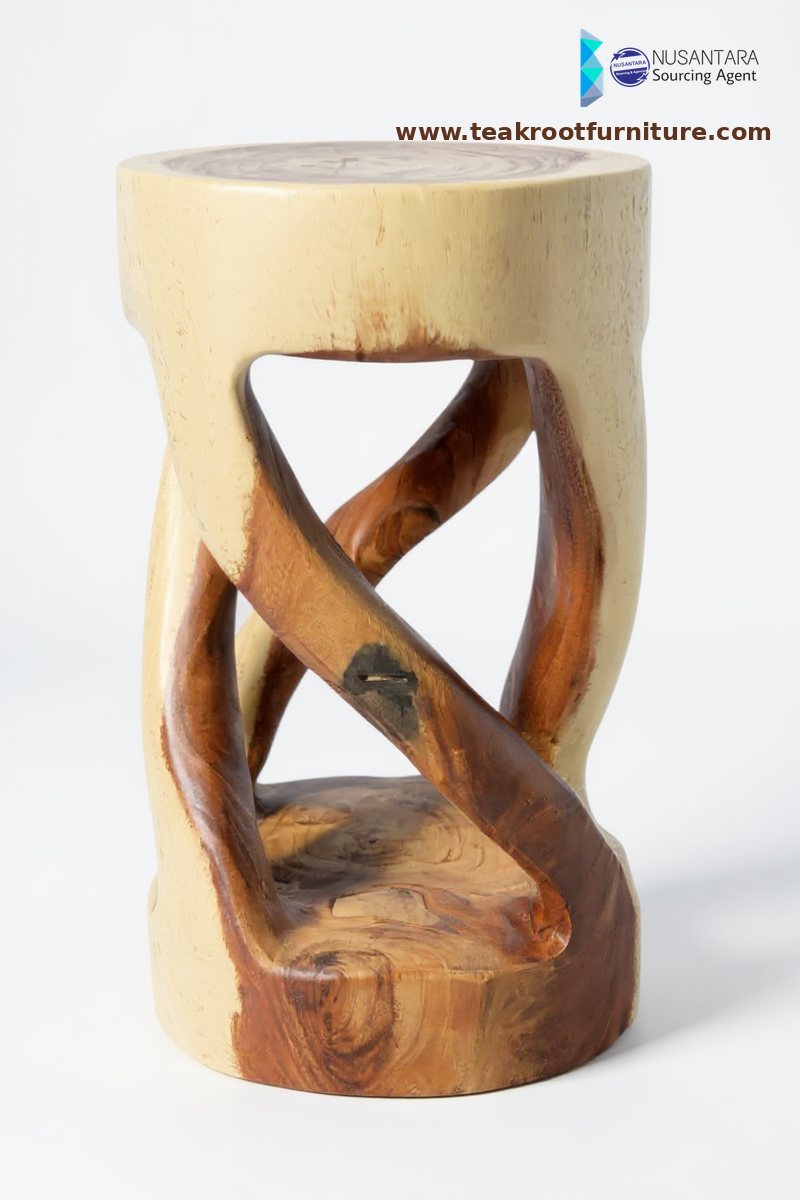
Importers are rarely surprised by the price of a teak root base. They are surprised by the second invoice — the one for moving it. A finished 120 cm dining table takes up the volume of a small wardrobe; strip the top off and the same root travels as a dense, stackable block that fills a fraction of the space. That gap is why a growing share of what we load in Jepara leaves as teak root table bases only, with the glass, stone or engineered top cut close to the customer instead of half a world away.
This article is written for the person who signs the purchase order: the load figures we actually work from, how a base should be specified against its top, and the duty and timber paperwork that changed between October 2025 and October 2026. Every figure is attributed; where the answer depends on your tariff code, we say so rather than guess.
Why base-only containers win the freight argument
A 20 ft dry container holds roughly 33 CBM of nominal volume, of which about 28 CBM is usable once pallets, cartons and loading gaps are allowed for; a 40 ft holds roughly 67 CBM nominal (CBM Calculator, 2026; Maple Sourcing, 2026). Ocean freight is charged against that space regardless of how you fill it. Fill it with air above a glass top and you pay for the air.
Shipping bases only changes four things at once:
- Volume falls, weight barely moves. You remove the bulky, fragile element and keep the dense one — the trade a container likes.
- Damage claims drop. Tempered glass moving 10,000 km in a crate is a claim waiting to happen. A root base in a carton is not.
- The margin moves to your side of the border. A local glass or stone workshop cuts the top at local labour cost, in days rather than months.
- One base profile, several price points. The same root can carry a 12 mm glass top for a contract hotel and a 20 mm stone top for retail — one run, two markets.
What you give up is the catalogue photo: importers who sell to designers order one or two complete tables for photography and the rest as bases.
The load maths: bases versus complete tables
The figures below are our own 2026 production and loading averages from the workshop in Jepara, Central Java — not a broker estimate. Treat them as a planning range and check them against your own drawings: the root is organic, so no two bases cube out identically.
| Item | Volume each (CBM) | Pieces per 20'FCL (≈28 CBM usable) | Packing note |
|---|---|---|---|
| Dining base, 80–100 cm top | 0.25–0.35 | 80–100 | Single-face carton, stacked two high |
| Dining base, 120–150 cm top | 0.35–0.55 | 50–75 | Loaded upside down to protect the top rim |
| Low coffee table base | 0.15–0.30 | 90–140 | Nests into voids left by taller pieces |
| Console or side base | 0.20–0.40 | 70–110 | Slim footprint, good void filler |
| Complete table, 120 cm + 12 mm glass | 0.90–1.20 | 23–30 | Glass crated separately, base in carton |
A mixed 20'FCL usually beats a single-SKU container, because low coffee table bases fill the voids taller dining bases leave behind. If you ship complete tables with glass, budget for crating and breakage rather than freight.
Ready to price a container? Send us your item list and quantities, and we will confirm what fits in one load, the FOB Semarang price and a realistic lead time.
Send your item list for a quote →
Matching a base to the top you will fit
Most first orders that go wrong do not go wrong in production. They go wrong at the drawing stage, where a base is ordered for a top that no local glass shop will cut. Five answers settle almost every case:
- Top material and thickness. Glass, stone, engineered quartz or solid timber each distribute load differently. A 20 mm granite top weighs roughly twice what 12 mm toughened glass of the same diameter does, and that weight has to land on the base's contact ring, not on its outer tips.
- Top diameter and shape. As a working rule the base footprint should be no more than about 60–70% of the top diameter, and the overhang on any open side should stay within roughly a hand's width. More overhang looks better in a showroom and feels worse at dinner.
- Finished height. Around 75 cm is standard for a dining table, 40–45 cm for a coffee table. Tell us your top thickness, and we set the base height so the finished piece lands where your client specified.
- Indoor or covered outdoor, and levelling. Outdoor use needs a different finish schedule and a levelling plan; on stone or polished tile, unprotected root tips leave marks, so we fit adjustable feet or felt pads on request.
If you are specifying glass, specify toughened glass rather than annealed. UK guidance points to thermally toughened safety glass certified to BS EN 12150 for table tops thicker than 6 mm (Glass Helper, 2025), and the market norm for a dining top is 10–12 mm (Flowyline, 2025). Your glazier confirms what is available locally; our job is to make sure the base's contact ring matches the panel you can actually buy.
Duty and compliance: what changed since October 2025
This is the part of the cost sheet that has moved most in the past twelve months, and the part most quotation comparisons leave out.
European Union
The EU Deforestation Regulation (EUDR) applies from 30 December 2026 for large and medium operators, and from 30 June 2027 for micro and small enterprises — a second one-year delay confirmed during 2025–2026 (European Commission; EY Tax News, January 2026). The older EU Timber Regulation governs until then. After that date an operator placing wood products on the EU market must file a due diligence statement including the geolocation of the plots where the timber was harvested — a heavier duty than most importers expect, and now the most common reason a European first order stalls. A 2026 investigation into Indonesian timber supply chains led several European timber firms to cut ties with suppliers linked to deforestation (Mongabay, April 2026). Our bases ship with Indonesian SVLK legality verification; if your compliance team needs harvest data in EUDR format, ask at enquiry stage, not the week the container is booked.
United States
The US–Indonesia Agreement on Reciprocal Trade finalised in February 2026 keeps a 19% reciprocal tariff on Indonesian goods (USTR fact sheet, February 2026). Separately, Section 232 wood measures from 14 October 2025 added 25% to certain upholstered wooden furniture, kitchen cabinets and vanities, stepping up to 30% on 1 January 2026 (Wiley, October 2025; RVIA, January 2026). Non-upholstered wooden tables sit outside that upholstery list, but exclusion lists and stacking rules move: one tariff engine showed a total 10.00% duty on HTS 9403.60.80 from Indonesia on 6 October 2026 (Airlift, October 2026), well below the headline reciprocal figure. We do not present either number as final. Ask your broker for the total rate on your exact HTS line in writing, and file the Lacey Act plant declaration.
Australia and New Zealand
Australia eliminated all remaining tariffs on Indonesian imports when IA-CEPA entered into force on 5 July 2020 (DFAT; Australian Border Force), so duty is rarely an Australian buyer's problem — 10% GST still applies. What delays shipments there is biosecurity: pallets, crates and dunnage must be ISPM 15 treated and stamped (Australian Department of Agriculture). We ship treated timber packing with single-face cartons.
| Market | Duty to plan for | Tax at import | Timber paperwork | Date to diarise |
|---|---|---|---|---|
| EU (Rotterdam, Antwerp, Genoa, Hamburg) | Low MFN duty on wooden furniture, code-dependent — check TARIC | VAT 19–22% by member state | EUDR due diligence statement + plot geolocation; SVLK legality | 30 Dec 2026 (large/medium operators) |
| United States | 19% reciprocal rate (Feb 2026 agreement); Section 232 list excludes most tables — confirm | State sales tax at resale | Lacey Act plant declaration | Section 232 step-up to 30% on listed goods, 1 Jan 2026 |
| Australia | 0% under IA-CEPA (in force 5 July 2020) | GST 10% | ISPM 15 treatment and stamp on pallets, crates, dunnage | Every shipment — biosecurity inspection is routine |
What lands on top of the FOB price
Duty and VAT are assessed on CIF value — goods plus freight plus insurance — not on the FOB invoice, so a higher freight rate raises your tax bill too. Freight in mid-October 2026 was not cheap: Drewry's World Container Index put the composite at $4,485 per 40 ft container, Shanghai–Rotterdam at $3,522 and Shanghai–Los Angeles at $7,884 (Drewry World Container Index, 15 October 2026). Semarang rates track the same market with a lag, and we quote them per booking.
| Cost line | Charged by | Weight on a 20'FCL of bases |
|---|---|---|
| Goods, FOB Semarang | Us | 100 (index base) |
| Ocean freight | Carrier or forwarder | Roughly 10–20% of goods value on a dense load — ask for a live rate |
| Import duty | Destination customs | 0% (Australia) to a US stack in the high single digits or higher; EU low single digits |
| VAT or GST | Tax authority | 19–22% EU, 10% Australia — usually recoverable for a VAT-registered business |
| Terminal handling and delivery | Forwarder or haulier | A few percent — worth its own line in your costing |
| Demurrage or detention | Terminal or carrier | Zero if documents are clean, hundreds per day if they are not |
Clean documents are the cheapest insurance in this trade, which is why we photograph every load against the packing list before the truck leaves Jepara.
Sending an enquiry that comes back comparable
Most quotations cannot be compared because the enquiries behind them were not comparable. Send the seven items below, and you will get a quote you can price line by line against another supplier:
- Each item with its top size, top material and finished height.
- Quantity per item, not a total.
- Finish (natural, bleach or named), indoor or covered outdoor use, and any packing instruction.
- Destination port or city.
- Bases only, or bases with glass tops.
- The date goods must be on the water.
Our terms are fixed: MOQ one 20'FCL mixed, FOB Semarang, capacity 4×40'FCL per month, and a first order runs about 12 weeks from deposit to loading. Payment is 50% deposit with the balance before shipment. A mixed container is the safer first test — you learn our quality across several shapes without committing a full load to one item.
Inside the Jepara workshops that cut the bases
To understand why the lead time is twelve weeks rather than four, it helps to know what the material is. The bases come from the root mass of old teak trees, mainly from plantations and farmland cleared for replanting across Central Java. The wood arrives irregular, wet and full of voids. It is cleaned of stone and soil, cut to a stable plane, then dried — and drying is where the calendar actually lives. In the wet season a thick root section sits in the kiln and in the shade far longer than a plank of the same species would, because a root that dries too fast splits along its own grain and the base is scrap.
After drying, the shaping is hand work. Jepara has been Indonesia's carving town for centuries, and the skills in these workshops — reading a root to find its best silhouette, holding a profile across a batch so a buyer's range looks like one collection — are learned by hand, not by machine. Finishing, sanding between coats and final inspection hold most of the labour hours. That is the honest reason a teak root base is not priced like a moulded panel: every piece is a decision.
If you want to import teak root furniture from Indonesia and see this for yourself, you are welcome to visit. Buyers who come to Jepara before their first order generally order with more confidence, and we have shipped over 300 containers from this address since 2016.
Frequently Asked Questions
Does EUDR apply to a teak root base shipped to Rotterdam?
From 30 December 2026 it applies to large and medium operators placing wood products on the EU market; the EU Timber Regulation covers the period before that. Your side files a due diligence statement including plot geolocation. We supply SVLK legality documents with every shipment and can attach harvest information at enquiry stage so your compliance team can build the file in advance.
My US broker says 10% duty and my forwarder says 19%. Which is correct?
Both figures are real and measure different things. The February 2026 US–Indonesia agreement sets a 19% reciprocal rate; a tariff engine showed 10.00% total on HTS 9403.60.80 from Indonesia on 6 October 2026, reflecting base rate and exclusion rules. The only safe answer is the one your broker puts in writing for your exact HTS code.
Do our pallets need fumigation for Australia?
Any solid-wood packaging — pallets, crates, dunnage — must be ISPM 15 treated and carry the stamp, and Australian biosecurity inspects routinely. We ship treated timber packing and keep the treatment marks on file. Confirm current conditions with your broker, as Australia updates them from time to time.
Can we mix dining bases and coffee table bases in one 20'FCL?
Yes, and it is usually the better first order. Low coffee table bases fill the voids between taller dining bases, so a mixed load often carries more pieces than a single-shape container. Our MOQ is one 20'FCL mixed, which is designed for exactly this test.
How long from purchase order to a loaded container?
Around 12 weeks for a first order, from deposit to loading, because of drying and finishing. Repeat orders are shorter. Tell us your installation date in the enquiry rather than a shipping date — it tells us how much slack the drying schedule has.
Talk to us about your project
If you are costing a table programme — a hotel, a retail range, a distributor's first container — send the item list with top sizes and quantities. We will tell you what fits in one load, the FOB Semarang price and a realistic loading date, and flag anything in your specification that a local glazier or stonemason will struggle to match. One email is usually enough to start.
Send your item list for a quote →
Packing, loading and shipping
Each base is wrapped and corner-protected, then packed in a single-face carton with the item code and dimensions written on the outside. We build a stack plan before loading so tall dining bases form the walls of the load and low coffee table or console bases fill the voids between them — that is what keeps the piece count per container up. Cartons are checked one by one against the packing list, and the load plan goes to your broker so arrival paperwork can be prepared while the vessel is still at sea.
Where does the container actually leave from?
The factory sits in Jepara, on the north coast of Central Java, about two hours by road from the port of Semarang. Containers are trucked to Semarang, where the goods are checked against the packing list again before the container is lifted onto the vessel. FOB Semarang is our standard term, so your forwarder takes control from the terminal gate.
Our office and factory stand at the same address on every document we issue: Jl. RA Rukmini KM.02 Pekalongan RT.02/V, Tahunan, Jepara 59428, Central Java, Indonesia.
MOQ 1×20'FCL mixed · capacity 4×40'FCL per month · 300+ containers shipped since 2016 · export@teakrootfurniture.com
Email: export@teakrootfurniture.com | WhatsApp +62 852 0600 7878 | Office & Factory: Jepara, Central Java, Indonesia.
Written by
Mr. August Praymunor — Overseas Marketing Director
CV. Nusantara Sourcing Agent · manufacturer and exporter of teak root furniture in Jepara, Central Java, Indonesia. We have shipped over 300 containers since 2016, loading 4×40’FCL per month for importers, hotel groups and interior contractors in Europe and North America. Every figure in this article comes from the sources noted in the text or from our own shipping records.
export@teakrootfurniture.com · WhatsApp +62 852 0600 7878 · LinkedIn · Jl. RA Rukmini KM.02 Pekalongan RT.02/V, Tahunan, Jepara 59428, Central Java, Indonesia
See also
- Choosing an Indonesian Teak Root Furniture Supplier: A Buyer's Checklist
- How to Choose a Teak Root Furniture Manufacturer in Indonesia
- Teak Root Furniture for Spain: Sourcing for Hospitality and Retail
- Our teak root furniture range
Modellseiten — Preis, CBM und Containerladung
Eine Seite pro Modell: Größe, Packvolumen, FOB-Preis Semarang und wie viele in einen 20-Fuß-Container passen.
- Mawar Dining Table dia 200 cm — USD 650 · 2.43 CBM
- Oval root dining table 200 cm — USD 365 · 1.50 CBM
- Cabak Dining Table dia 150 cm — USD 340 · 1.80 CBM
0 comments:
Post a Comment