


Six of every ten pieces of furniture sold in Germany in the first half of 2026 came from outside the country — up from 44% in 2019 — while the revenue of German furniture manufacturers fell 2.7% to about €7.7 billion across 374 establishments (Verband der Deutschen Möbelindustrie, September 2026). Read those two numbers together, and you understand the market our German customers are buying into: the shelf space exists, domestic production is contracting, and the pressure sits almost entirely on price, differentiation and paperwork that has to be right the first time.
Summary: Made in Jepara, Indonesia. FOB Semarang, one 20ft container with mixed models. On our own packing sheets, a 100 cm round root dining table cartoned takes up a little over one cubic metre, so that package lands somewhere around 45 55 cbm one 40'HC, not a 20'.

Six of every ten pieces of furniture sold in Germany in the first half of 2026 came from outside the country, up from 44% in 2019, while German manufacturers' revenue fell 2.7% to about EUR 7.7 billion across 374 establishments (VDM, September 2026). The shelf space exists and domestic production is contracting — which leaves price, differentiation and paperwork. That is the market we supply from Jepara: mixed 20-foot containers, FOB Semarang.
This guide is for importers, wholesalers, contract furnishers and specifiers in Germany buying teak root dining tables, coffee tables with glass tops, consoles, stools and table bases from Indonesia. It deals with what decides whether a container makes money: the customs line that carries 0% duty, the 19% import VAT you finance before reclaiming it, the EUDR deadline on 30 December 2026, LUCID registration, and what twelve weeks of production in Jepara, Central Java look like from your side of the desk.
What German buyers are walking into in the fourth quarter of 2026
The German furniture trade is not in a soft patch; it is in a structural squeeze. Domestic sales fell 4.1% to roughly €5 billion in the first half of 2026, exports held flat at €2.7 billion, and the export ratio crept up to 35.2% (VDM, September 2026). The segment closest to our own product — living, dining and bedroom furniture plus furniture parts — lost 5% and finished the half-year at €2.3 billion. Four in ten manufacturers told the association they plan short-time work in the third quarter. For the full year, the VDM expects a decline of around 3%.
Meanwhile, the import share keeps climbing. Furniture imports themselves dropped 4.3% in the same period, but China and Poland alone still supplied 60% of everything Germany bought abroad. That is the competitive reality on the shelf: two very large, very industrial sources, both able to ship flat-pack volumes at prices no handcrafted workshop will ever match.
There is also a policy risk worth writing into your contracts. In September 2026 the VDM's managing director, Jan Kurth, asked the EU to open a discussion on general safeguard duties, arguing that Chinese production and exports are state-directed and subsidised. Whether or not that produces measures, the practical lesson is simple: if you quote a German retailer for delivery in the second half of 2027, put a duty-change clause in the contract.
Where does that leave solid teak root? Not competing with a Polish flat-pack line, and not trying to. A root dining table is a single piece of wood with a shape that exists once. German buyers pay for that difference in the contract and hospitality segments, and in specialist retail where the customer is deliberately looking for something that is not on every third webpage.
Where teak root actually fits: hotel fit-outs and the solid-wood shelf
Germany has the third-largest hotel construction pipeline in Europe. At the close of the second quarter of 2026 it stood at 146 projects and 24,821 rooms, and Hamburg alone accounted for 25 projects and 4,789 rooms (Lodging Econometrics, Q2 2026). Across Europe, 307 new hotels with 39,798 rooms are forecast to open in 2026, followed by 303 hotels and 42,729 rooms in 2027 and 304 hotels and 43,099 rooms in 2028.
Those dates matter to a furniture supplier because fit-out happens in the last four to six months before opening. A hotel opening in Hamburg in the spring of 2027 is specifying loose furniture in the autumn of 2026 — which is now.
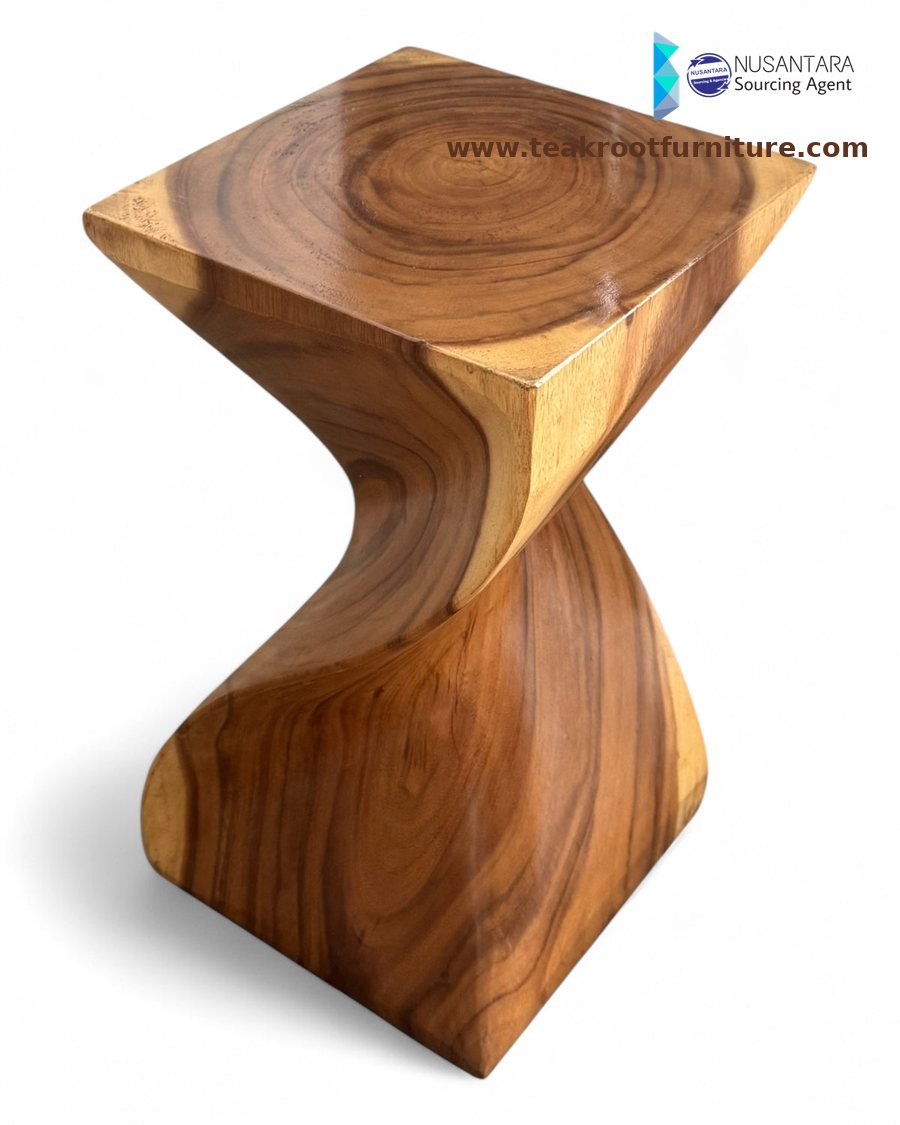
Run the arithmetic on a mid-size project and the order sizes become obvious. A 120-key hotel with one breakfast room, a lobby and a terrace typically needs something like 24 round dining tables in the 100–120 cm range, a dozen consoles for the buffet and corridors, eight low coffee tables for the lobby, and forty stools spread across bar, terrace and back-of-house. On our own packing sheets, a 100 cm round root dining table cartoned takes up a little over one cubic metre, so that package lands somewhere around 45–55 cbm — one 40'HC, not a 20'. The packing list we send with every quotation carries the exact figure per SKU so you can plan the load before you commit.
The design argument is easier in Germany than almost anywhere else. The trade press has spent 2026 talking about solid wood with visible grain, round and organic shapes, and tables where the base is part of the design rather than a steel frame hidden underneath. A root coffee table with a glass top, a live-edge console, or a sculptural stool fits that language without translation. What German specifiers will not accept is surprise: the tolerance on a diameter, the finish and its sheen level, and whether the second container will look like the first. That belongs in the specification sheet before anyone signs.
The landed-cost maths worth running before you negotiate
Start with the good news, because it is genuinely good: wooden furniture classified under CN 9403 60 — other wooden furniture — carries a 0% ad valorem duty at the EU border (German customs classification guides, September 2026). Teak root dining tables, consoles, coffee tables and table bases normally sit in that heading. Seating with a backrest moves to heading 9401 instead, so mixed orders should be classified line by line rather than as one lump.
The 19% German import VAT is not a cost if you are VAT-registered; it is a cash-flow item. You pay it at clearance on the customs value plus freight and insurance, and reclaim it in your return. On a €30,000 CIF shipment that is roughly €5,700 tied up for a few weeks. For an importer running four containers a quarter, that timing difference is worth more attention than the duty rate ever will be.
What actually decides your margin is freight, terminal handling, inland delivery and the cost of a damaged top. The table below is an arithmetic example, not a quotation — replace every line with your own forwarder's numbers before you negotiate a retail price.
| Line | Example basis (20'FCL, mixed) | What to watch |
|---|---|---|
| Goods | FOB Semarang, €18,000 | Confirm finish level and packing are inside the price |
| Ocean freight | €2,400 (assumed) | Quote per sailing, not per year; rates on this lane move |
| Insurance | 0.3–0.6% of CIF | Cheap against the cost of one cracked table top |
| Duty | 0% on 9403 60 | Classification decides; 9401 seating is treated separately |
| Terminal and handling | €450 (assumed) | Add demurrage if documents arrive late |
| Inland delivery | €600 (assumed) | Hamburg to Munich costs more than Hamburg to Hannover |
| Import VAT | 19% on CIF + duty | Recoverable, but financed by you first |
Two habits separate importers who make this work from those who do not. First, they price per cubic metre rather than per unit, because freight is bought in volume and a bulky root table that looks cheap per piece can be expensive per container. Second, they add a damage allowance of a few per cent on the first shipment and then watch it fall as packing improves. If your supplier cannot tell you the packed volume and gross weight per SKU before the order, the quotation is not finished.
Ready to price a container? Send us your item list and quantities, and we will confirm what fits in one load, the FOB Semarang price and a realistic lead time.
Send your item list for a quote →
Documents that keep a German container moving
Customs clearance in Germany is rarely the bottleneck; incomplete paperwork is. This is what a forwarder needs before the vessel berths in Hamburg or Bremerhaven.
- EORI number for the importer. Without it, nothing is declared.
- Import declaration, filed electronically by your forwarder. You do not file it, but you are liable for what it says.
- Commercial invoice, packing list and bill of lading, with the goods description matching the tariff line, not just the marketing name.
- Origin statement consistent across invoice and declaration. At 0% duty an EUR.1 is not what protects you; inconsistency is what triggers the query.
- ISPM 15 for any solid-wood packing, crates or pallets. We pack in single-face carton, which avoids the issue entirely — but if your forwarder insists on a wooden crate, the wood must carry the heat-treatment stamp.
- LUCID registration with the Zentrale Stelle Verpackungsregister. As the importer placing packaged goods on the German market, you are the one who must be registered before the first delivery arrives, not after.
- GPSR responsible person. Since 13 December 2024, consumer products sold in the EU need an economic operator established in the EU who answers for safety. For a German importer that is usually you.
- SVLK legality documents from Indonesia, plus whatever your EUDR due-diligence file will require from 30 December 2026 — see below, because these two are not the same thing.
Two 2026 deadlines that change what you must collect from us
One operational point matters more than the rest: the compliance calendar for wood furniture in Germany changed twice this year, and both changes land on the importer.
| Date | What changes | What to do now |
|---|---|---|
| 12 August 2026 | EU Packaging and Packaging Waste Regulation applies, replacing the old directive | Check carton labelling and material data with your supplier; keep LUCID quantities current |
| 30 December 2026 | EUDR applies to large and medium operators placing wood products, including furniture, on the EU market | Build the due-diligence file before your Christmas shipments, not after |
| 30 June 2027 | EUDR applies to micro and small operators (those already covered by the EU Timber Regulation face 30 December 2026) | If you are small, use the extra six months to test one supplier's data |
| 19–22 January 2027 | imm cologne, the reconceptualised trade-only edition, opens in Cologne | Production ordered in October is what you can show on the stand |
The EUDR is the one people underestimate. Wooden furniture sits inside its scope, and the regulation asks operators to prove the wood did not come from land deforested after 31 December 2020: plot-level geolocation, harvest dates, species and quantity, tied to a due-diligence statement filed before the goods go on the market.
Indonesian SVLK certification is a legality system. It is not an EUDR due-diligence statement, and treating one as the other is the mistake I see most often in enquiries from first-time importers. What we can do is give you the species, volume, origin and legality documentation that a due-diligence file is built from, shipment by shipment. Tell us at quotation stage what your file must contain — retrofitting data onto a container that is already at sea is where projects lose weeks.
One more piece of calendar context. The EU–Indonesia CEPA was presented to the Council in June 2026, with signing targeted for late September or early October 2026, ratification estimated at roughly 90 days at best, and implementation expected in early 2027 (AHK Indonesia, August 2026). Indonesia expects immediate zero-tariff access for 90.4% of tariff lines, and furniture is named among the sectors that gain. For teak root specifically the duty is already zero, so the practical benefit is procedural rather than a price cut — and note that the EU's GSP scheme for Indonesia expires at the end of 2026, which is precisely the gap CEPA is meant to close.
Which gateway into Germany fits your delivery address
Most German importers default to Hamburg out of habit. It is usually right, but not always, and the difference shows up in inland cost rather than ocean freight.
| Gateway | Best for | Practical note |
|---|---|---|
| Hamburg | Hamburg, Bremen, Hannover, Berlin, Leipzig, southern Germany via rail | Deepest service choice from Asia; the 7-day average vessel waiting time was around 1.7 days in late July 2026 (Kuehne+Nagel port update) |
| Bremerhaven | Bremen, Lower Saxony, North Rhine-Westphalia | Fewer direct calls; strong for consolidated and short-sea onward moves |
| Wilhelmshaven | Very large vessels, alliance hub calls | Deep water, thinner feeder network; check inland connections first |
| Rotterdam or Antwerp, then inland | Ruhr area, Rhineland, Baden-Württemberg | Often cheaper inland by barge, but you clear customs in the port of entry and add a day or two |
On the ocean leg, carriers publish 20–35 days port-to-port from Asia to northern Europe, and in our experience Semarang to Hamburg berth runs closer to five weeks once the feeder connection is included. Load port performance is not the problem: Semarang's 7-day average vessel waiting time was around 1.13 days at the end of July 2026, shorter than Hamburg's. What eats schedule is the week before loading, when a container waits for one unfinished console.
Making a first container safe
Nobody sensible sends a full 40'HC to a supplier they have never met. A first order should be small enough to survive a mistake, and specific enough that both sides know what "correct" means.
- Start mixed. Our minimum is one 20'FCL, mixed across models. That lets a German buyer test dining tables, a console and stools in the same load instead of gambling on a single SKU.
- Write the tolerance down. Expect variation in grain, colour and silhouette. What must be fixed is diameter, height, top thickness, moisture content and finish sheen. Put numbers on all five.
- Approve a sample or a photo set. For a first order, a physical sample of the finish on the actual species is worth more than a catalogue image.
- Pay 50% deposit, balance before shipment. That is our standard term, and it is not negotiable on a first order, because the wood is bought, and the workshop slot reserved at deposit stage.
- Inspect before the doors close. Load photos, a packing list checked carton by carton, a third-party inspection if you want one. You are also welcome to visit the workshop — buyers who have stood in the drying shed specify more precisely afterwards.
- Agree the claim route in advance. Who pays for a cracked top, what evidence is needed, and how the replacement travels. It is a five-minute conversation before the order and a month-long argument after.
Lead time on a first order is twelve weeks, and that figure assumes specifications are frozen in week one. Every week of indecision about finish moves the loading date, not the other way round.
Where these pieces come from
Jepara sits on the north coast of Central Java, Indonesia, a carving town that has supplied wooden furniture to European traders for centuries. Teak root arrives there as a by-product: the root mass left after plantation thinning and replanting, material that would otherwise be burned or left to rot. It is dense, irregular and almost impossible to machine predictably — which is exactly why the finished piece does not look like anything else on a German shop floor.
The work is seasonal in ways a European buyer does not see. Root sections are slow to dry in tropical humidity, and a piece that reaches the finishing line too wet will move in a German winter. Our answer is time and a moisture meter, not a kiln schedule that sounds impressive in a brochure. The carving and the welding of bases is still hand work, done by families who have been at it for generations — which is also why capacity has a ceiling and why we load four 40'FCL a month rather than twenty. Since 2016 we have shipped more than 300 containers from this workshop to importers, hotel groups and interior contractors in Europe and North America.
Frequently Asked Questions
Do German importers pay customs duty on teak root tables?
Wooden furniture under CN 9403 60 enters the EU at 0% ad valorem duty, and most teak root tables, consoles and table bases fall there. Seating with a backrest is classified under 9401 and should be declared separately. Import VAT of 19% still applies and is recoverable if you are VAT-registered.
When does the EUDR apply to my furniture imports from Indonesia?
From 30 December 2026 for large and medium operators, and from 30 June 2027 for micro and small operators — except small operators already covered by the EU Timber Regulation, who face 30 December 2026. Wooden furniture is in scope, so the due-diligence file including plot geolocation and harvest data should be built before your last 2026 shipments.
Can one 20'FCL mix dining tables, consoles and stools?
Yes. Our minimum order is one 20'FCL mixed, which is how most German buyers start: a few dining tables, two or three consoles, coffee tables and stools in the same container, so the range can be tested without committing to a full 40'HC of one model.
How long from order to goods arriving in Hamburg?
Twelve weeks production for a first order once specifications are frozen, then roughly five weeks at sea including the feeder, plus clearance and inland delivery. If a piece has to be on a stand at imm cologne on 19 January 2027, the production order needs to be confirmed in the first half of October 2026.
Talk to us about your project
Send your item list with sizes, quantities and the finish you have in mind. We will come back with what fits in one container, the FOB Semarang price per line, a packed volume for each SKU and a loading date we can hold. If you are specifying a hotel or a restaurant project, include the opening date — it decides more about the schedule than anything else on the list.
Send your item list for a quote →
Packing, loading and shipping
Every order is wrapped in protective material, stacked to a load plan and staged before the container arrives. We pack in single-face carton, which keeps the volume down and avoids solid-wood packing that would need ISPM 15 treatment. Each carton is marked against the packing list, and the completed list travels with the container so that what you unpack matches what you ordered.
Where does the container actually leave from? The container is filled at our workshop in Jepara, on the north coast of Central Java, Indonesia, checked carton by carton against the packing list, and then driven about two hours to the port of Semarang. FOB Semarang is our standard term: your freight forwarder takes over from the terminal gate, and we send the load plan and photographs before the truck leaves.
Our office and factory stand at the same address on every document we issue: Jl. RA Rukmini KM.02 Pekalongan RT.02/V, Tahunan, Jepara 59428, Central Java, Indonesia.
MOQ 1×20'FCL mixed · 4×40'FCL per month · 300+ containers shipped since 2016 · export@teakrootfurniture.com
Written by
Mr. August Praymunor — Overseas Marketing Director
CV. Nusantara Sourcing Agent · manufacturer and exporter of teak root furniture in Jepara, Central Java, Indonesia. We have shipped over 300 containers since 2016, loading 4×40’FCL per month for importers, hotel groups and interior contractors in Europe and North America. Every figure in this article comes from the sources noted in the text or from our own shipping records.
export@teakrootfurniture.com · WhatsApp +62 852 0600 7878 · LinkedIn · Jl. RA Rukmini KM.02 Pekalongan RT.02/V, Tahunan, Jepara 59428, Central Java, Indonesia
See also
- Teak Root Accent and Bedside Tables: Bulk Supply for Buyers
- Teak Root Bar Tables and Bistro Sets for Hospitality and Retail
- Teak Root Stools and Seating: Wholesale Supply for Furniture Buyers
- Our teak root furniture range
Deutsche Seite : Teakholz Möbel - Hersteller & Exporteur in Jepara, Indonesien - Großhandelspreise, Bedingungen und Katalog auf Deutsch.
Model pages — price, CBM and container load
One page per model: size, packed volume, FOB Semarang price and how many fit in a 20ft container.
- Mawar Dining Table dia 200 cm — USD 650 · 2.43 CBM
- Oval root dining table 200 cm — USD 365 · 1.50 CBM
- Cabak Dining Table dia 150 cm — USD 340 · 1.80 CBM
0 comments:
Post a Comment