


Queensland is on track to deliver only about 24% of the hotel rooms it needs for the 2032 Brisbane Olympics — a shortfall of roughly 11,100 rooms. That gap is why Australian buyers are quoting furniture earlier than usual. We ship teak root furniture from Jepara in mixed 20-foot containers, FOB Semarang, about 12 weeks, with ISPM 15 packing and photo approval before loading.
Summary: Made in Jepara, Indonesia. FOB Semarang, one 20ft container with mixed models. Our minimum is one mixed 20-foot container, with around 12 weeks lead time on a first order.

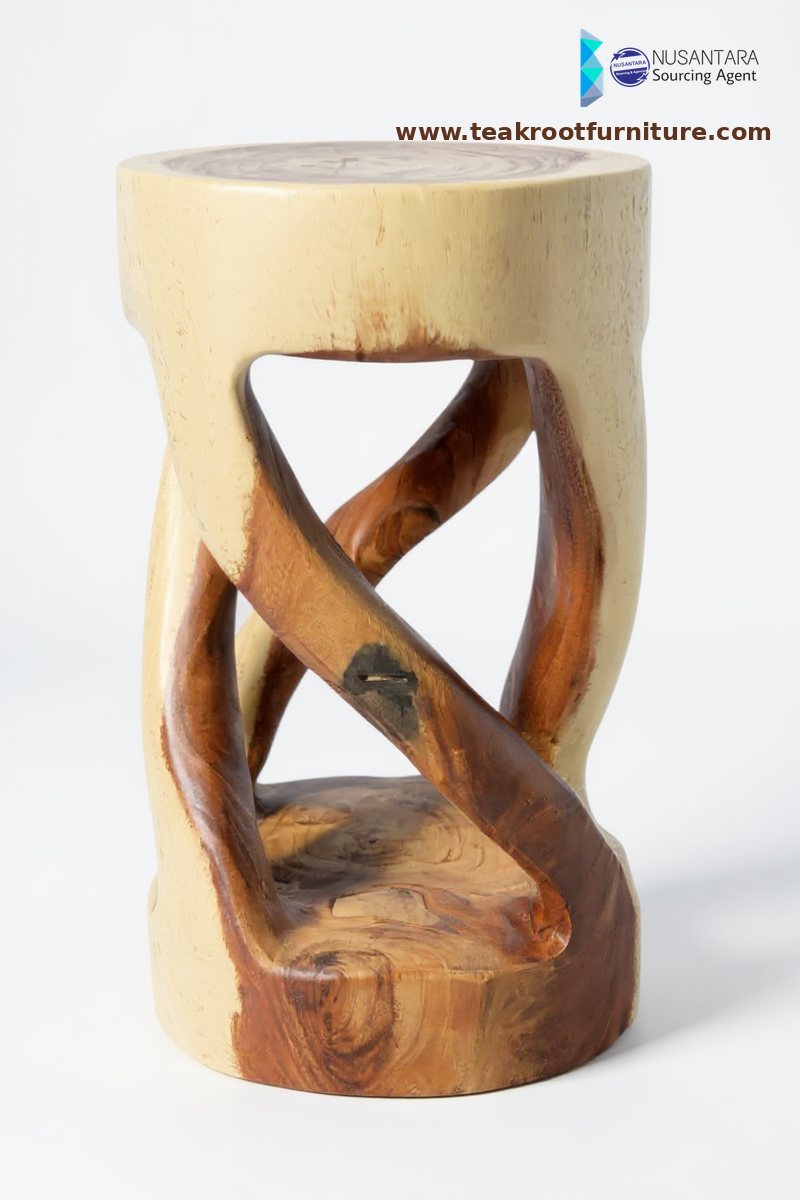
Queensland is on track to deliver only about 24% of the new hotel rooms it needs for the 2032 Brisbane Olympics — a shortfall of roughly 11,100 rooms (Inside the Games, May 2026). For anyone importing furniture into Australia, that single number explains why the next six years will not look like the last six. A hotel that is short of rooms is a hotel that is buying beds, bars and breakfast areas — and that is where a category like teak root furniture earns its place.
This piece is written for the importer, retailer or project buyer who already likes what Indonesian teak root furniture looks like and now has to land it in Sydney or Brisbane on schedule and on budget. It works through what Australian buyers actually ask us: the duty and GST position, the biosecurity file that decides whether a container clears or sits, which ports suit which market, and how to structure a first order that will not unravel in week ten.
A word on where we sit. CV. Nusantara Sourcing Agent has made and exported teak root furniture from Jepara, Central Java, Indonesia since 2016, loading around four 40-foot containers a month and more than 300 containers in total for importers, hotel groups and interior contractors. If you are learning how to import teak root furniture from Indonesia, this is the working file we keep on the Australian route.
What Australia is specifying right now
The demand story in Australia is a hotel story with an events tail. CBRE recorded 2,034 hotel rooms delivered in 2025 and the year to date in 2026, with 5,143 rooms under construction nationally (CBRE, Hotels Australia — Overview & Outlook 2026). That is steady, repeatable work for a furniture supplier. The accelerator is south-east Queensland: 30 new hotels (3,838 rooms) are already open or on track for the 2032 Games (Time Out, March 2025), and the wider state pipeline is not keeping pace — hence the projected 11,100-room shortfall.
Why that matters to a furniture buyer: hotels buy in packages. A new 120-room property does not order one dining table; it orders the restaurant, the lobby, the bar, the suites and the terrace at once, then reorders as it refurbishes every seven to ten years. Teak root suits that rhythm because every piece is unique in the showroom but repeatable on the floor plan — the same build, the same finish, the same packing, container after container.
The tourism numbers behind the build-out are strong. International arrivals reached 9.16 million, or 98% of 2019 levels, with average visitor spend up 31% to around A$6,795 (CBRE, 2026), and Tourism Research Australia forecasts 10.9 million arrivals and A$46 billion in visitor spend. That translates into more beds, more cafés and more short-stay apartments to fit out.
The design direction helps a natural-timber category. Australian 2026 trend reports keep landing on the same words — biophilic, tactile, organic, honest materials — with timber specified for its grain rather than hidden under lacquer (Style Sourcebook, February 2026; King Living, December 2025). At the domestic end, downsizing and apartment living are pushing demand toward compact, multipurpose pieces. In practice, that is where our range maps onto the market:
- teak root dining tables — hotel restaurants, resorts and large family homes;
- teak root coffee tables with a glass top — lobby lounges, suites and short-stay apartments where the glass protects the grain;
- teak root console and side tables — corridors, lobby flanks and bedheads;
- teak root stools and benches — bars, breakfast areas and poolside;
- teak root table bases, planters and sculptures — the statement pieces that photograph well and sell the scheme.
The landed-cost maths worth running before you negotiate
Australia is one of the better markets in the world to import into — provided you use the trade agreement you are entitled to. Under the Australian Border Force tariff, the general rate for other wooden furniture under HS 9403.60 is 5%. But goods that qualify as Indonesian-originating enter Free, because IA-CEPA, in force since 5 July 2020, eliminated all remaining Australian tariffs on Indonesian imports (DFAT). That two-point gap is where money leaks: a supplier quotes “no duty” without the paperwork, and the container is assessed at 5% at the border.
On top of duty comes GST. Australia charges GST at 10% on the value of the taxable importation — the customs value plus freight, insurance and any duty (Australian Border Force). If you are GST-registered you recover it, so treat it as cash flow rather than cost. The lines that actually move your margin are freight, insurance, terminal handling and — more than anyone admits — packing and finish quality.
| Line | Basis | What to watch |
|---|---|---|
| Goods | FOB Semarang | Confirm finish and packing are included |
| Ocean freight | 1 × 20'FCL to Port Botany / Melbourne / Brisbane | Rates move; quote per sailing, not per year |
| Insurance | 0.3–0.6% of CIF value | Cheap cover for breakable glass tops |
| Terminal & biosecurity | Destination port charges | Ask the broker for the all-in clearing quote |
| Duty | 5% general; 0% under IA-CEPA | 0% needs a valid proof of origin |
| GST | 10% of the taxable importation | Recoverable if GST-registered |
The practical rule: negotiate on FOB Semarang, so you know exactly what is yours and what is the factory’s, and insist on the same Incoterm from every supplier you approach. Mixed Incoterms make quotations impossible to compare, and the cheapest number is usually the one with the least included.
Where you land the box matters too. Australia is wide, and the port you choose should follow your customers, not your forwarder’s convenience.
| Gateway | Best for | Note |
|---|---|---|
| Port Botany (Sydney) | NSW retail, hotel and design trade | Australia’s largest container port; deepest buyer market |
| Melbourne | Victoria, Tasmania links, national distributors | Large furniture and homewares wholesale base |
| Brisbane | Queensland hotel build-out and the 2032 pipeline | Closest east-coast gateway to the Games programme |
| Fremantle (Perth) | Western Australia, resort and hospitality fit-outs | Often served by transhipment — plan for longer transit |
| Adelaide | South Australia, project and hospitality work | Smaller gateway; confirm sailing frequency first |
Transit from Semarang to the east-coast ports typically runs around three to four weeks port to port, depending on the sailing and any transhipment; confirm the exact routing with your forwarder, because a two-week swing changes when you should place a reorder.
Ready to price a container? Send us your item list and quantities, and we will confirm what fits in one load, the FOB Semarang price and a realistic lead time.
Send your item list for a quote →
DATA SHEET - FROM OUR FOB 2026 PRICE LIST
Models that leave the factory most often (FOB Semarang, Melbourne / Sydney / Fremantle)
| Model | CBM/pc | FOB | Max pcs in one 20ft |
|---|---|---|---|
| Cabak Dining Table dia 100 cm | 0.75 | USD 195 | ~32 pcs |
| Cabak Dining Table dia 120 cm | 1.08 | USD 265 | ~22 pcs |
| Cabak Dining Table dia 150 cm | 1.8 | USD 340 | ~13 pcs |
| Mawar Dining Table dia 120 cm | 1.08 | USD 265 | ~22 pcs |
| Mawar Dining Table dia 150 cm | 1.69 | USD 340 | ~14 pcs |
| Mawar Dining Table dia 200 cm | 2.43 | USD 650 | ~9 pcs |
Max pcs = if the container carries that model only, using 24 CBM of usable space.
A worked mixed load - 24 pieces, 22.78 CBM, FOB USD 5,310
| Item | Qty | CBM | FOB |
|---|---|---|---|
| Cabak Dining 120 cm | 8 | 8.64 | USD 2,120 |
| Mawar Dining 150 cm | 6 | 10.14 | USD 2,040 |
| Izpo Coffee Table 100 cm | 10 | 4.00 | USD 1,150 |
Border cost for this load
| Goods, FOB Semarang | USD 5,310 |
| Ocean freight (example rate) | USD 1,700 |
| Insurance 0.5% | USD 35 |
| CIF value | USD 7,045 |
| Duty: 0% with IA-CEPA, otherwise about 5% | USD 0 |
| GST 10% | USD 705 |
| Landed, before broker and port fees | USD 7,750 |
Freight is an example rate, quoted per sailing. Duty assumes a valid Certificate of Origin (IA-CEPA); without it the general rate of about 5% applies. Broker, DAFF and port charges are set at destination and are not included. All product figures come from our FOB 2026 price list.
Biosecurity: what actually holds an Australian container
Tariffs are arithmetic; biosecurity is where first-time importers lose weeks. All timber and wooden-article imports into Australia sit under the conditions published in the Department of Agriculture, Fisheries and Forestry’s BICON system (DAFF). Manufactured teak root furniture is generally lower risk than raw timber, but it still carries obligations that have nothing to do with the furniture itself.
- ISPM-15 packaging. Any solid-wood pallets, crates or dunnage must be heat-treated or methyl-bromide fumigated to ISPM-15 and carry the IPPC mark. This one detail delays more containers than any tariff line, and it is invisible until the box is opened.
- The BMSB season. Australia’s brown marmorated stink bug measures apply from 1 September 2026 to 30 April 2027 to targeted goods shipped from 38 target-risk countries (DAFF). Indonesia is not on that list, which makes the direct Semarang route an advantage — but a container transhipped through a target-risk port can still be pulled in, so keep the seal number and timestamped photos that prove when and where the box was loaded.
- Treatment on arrival, if required. Depending on the product and how it was prepared, DAFF may require treatment by an approved provider before release. A supplier who has shipped to Australia before prepares for this in the packing note, not at the wharf.
- Legality documentation. Indonesia’s SVLK timber-legality system is legally required for Indonesian timber exports, and the V-Legal licence is recognised under the EU–Indonesia FLEGT agreement. Keep it on file; it answers the “where did this wood come from” question in a single document.
Then the paperwork an Australian customs broker will actually ask for: a commercial invoice, a packing list, the bill of lading, a packing declaration covering the timber packaging, and — if you want the 0% IA-CEPA rate — a valid proof of origin (a certificate of origin or an exporter’s declaration). Send your broker’s exact list to the supplier before production starts, not when the container is already at the gate.
Bark and soil: the detail that decides whether you need fumigation
Most delays on wooden furniture at the Australian border come from two things that travel with the furniture rather than from it: bark and soil. Both are treated as biosecurity risk material, and both are inspected before the goods are released. We ship teak root furniture bark-free and cleaned: the root surfaces are wire-brushed, sanded and finished, and no soil, bark pockets or loose fibres are left in the crevices. That is a production decision, not a clerical one, and it is the reason our containers normally clear without a methyl-bromide treatment.
- Bark-free and soil-free. Ask any Indonesian supplier to state this in writing before production. A root piece that still carries bark can be ordered to treatment — or re-exported — at your cost.
- ISPM-15 applies to the crate, not the chair. Pallets, crates and dunnage need the IPPC mark; the furniture itself is a manufactured article, and a clean, bark-free article is lower risk than raw timber.
- Keep the evidence. We photograph the loading, the IPPC stamps and the seal number. If DAFF asks when and where the container was packed, those photographs answer in one email.
- Phytosanitary certificate on request. If your broker wants one, we apply for it through the Indonesian quarantine authority before the vessel sails — ask at quotation stage, not at the wharf.
Making the first order safe
A cautious first order is not a small order — it is a mixed one. Our minimum is a single 20-foot container with mixed items, which lets an Australian buyer test a teak root dining table alongside a root console, a couple of root coffee tables with glass tops and a run of root stools before committing to a full programme. Our terms are 50% deposit with the balance before shipment, quoted FOB Semarang, with around 12 weeks lead time on a first order.
Three habits separate comfortable importers from stressed ones:
- Ask for photographs of the finished goods and of the loaded container before it sails. A container loaded to a plan is far easier to reconcile on arrival.
- Fix the finish in writing. Raw, oiled, matte and gloss behave differently in Australian light and in coastal humidity, and “natural” means different things to different workshops.
- Agree the packing. Our standard is single-face carton, and glass tops are packed separately — if you need triple-wall or crates, say so in the RFQ, because it changes both cost and how the container stacks.
When you compare suppliers, compare like with like: the same products, sizes, quantities and finish, on the same Incoterm, with the same packing. A vague enquiry returns a vague price you cannot compare against anyone else.
Where these pieces come from
Jepara, on the north coast of Central Java, is Indonesia’s carving town, and it is where our workshop sits. The teak roots we use come from old plantation stumps and fallow land rather than felled forest — each piece is a by-product of land already cleared for other use. Every root is cleaned, seasoned and inspected before a carver decides what it wants to become: the base of a teak root dining table, the body of a root coffee table with a glass top, a root stool, a root planter or a standing sculpture.
Honestly, the hardest part is not the carving. It is the drying. When the rainy season arrives, green wood cannot move into the workshop on the schedule a buyer has in mind, because forcing it through the kiln cracks the grain. We build the calendar around the weather instead of against it, and that is one reason we quote 12 weeks rather than promise four. Legal timber paperwork is the second discipline — every batch is documented for SVLK in Jepara, Indonesia, and that discipline is exactly what makes an Australian buyer’s biosecurity file straightforward.
We ship from FOB Semarang, run roughly four 40-foot containers a month, and have loaded more than 300 containers since 2016. The volume is not the point. The point is that a hotel group in Queensland can reorder the same teak root console two seasons later and get the same thing.
Frequently Asked Questions
Do I pay duty on teak root furniture imported from Indonesia?
Under the Australian Border Force tariff, the general rate for other wooden furniture (HS 9403.60) is 5%. However, goods that qualify as Indonesian-originating enter Free under IA-CEPA, in force since 5 July 2020. To claim 0% you need a valid proof of origin — a certificate of origin or an exporter’s declaration — so ask for it with your quotation. On top of duty, GST of 10% applies to the taxable importation and is recoverable if you are GST-registered. Confirm the exact HS code with your broker.
What biosecurity paperwork will DAFF want for a furniture container?
Conditions are set out in DAFF’s BICON system. In practice, expect a commercial invoice, a packing list, the bill of lading and a packing declaration confirming your solid-wood packaging is ISPM-15 compliant and IPPC-marked. Depending on the product, DAFF may also require treatment by an approved provider before release. Send your broker’s exact list to us before production starts, so the packing is right the first time.
Does Australia’s BMSB season affect shipments from Indonesia?
Australia’s brown marmorated stink bug measures run from 1 September 2026 to 30 April 2027 and apply to targeted goods from 38 nominated target-risk countries. Indonesia is not one of them, so a direct Semarang booking is usually outside the scope. The exception is transhipment: a container routed through a target-risk port can be caught, so keep the seal number and timestamped loading photos that document where and when the box was sealed.
Which Australian ports do you ship to, and what is the Incoterm?
We quote FOB Semarang, and buyers clear through Port Botany (Sydney), Melbourne, Brisbane, Fremantle or Adelaide. Transit typically runs around three to four weeks port to port, depending on the sailing and any transhipment. CIF can be quoted on request, but keeping FOB lets you compare factories on identical terms and control your own freight. Our minimum is one mixed 20-foot container, with around 12 weeks lead time on a first order.
Talk to us about your project
Tell us which pieces you need, how many, and where in Australia they are going. We will tell you what fits in a container, what it costs FOB Semarang, and what the timeline really looks like.
Or write directly to export@teakrootfurniture.com · WhatsApp +62 852 0600 7878 · Mr. August Praymunor (10:00–16:00 Jakarta time, GMT+7)
Packing, loading and shipping
Every order is packed with protective wrapping, stacked to a load plan and staged before it leaves the factory. We list each piece so that what arrives matches what was ordered, and we can supply a container load plan for your customs broker.
Container loading in Jepara — packed, checked against the packing list and staged before dispatch.
Where does the container actually leave from?
Loading happens at our yard in Jepara, on Java’s north coast. From there the truck run to Semarang takes about two hours; the vessel is booked out of Semarang as the port of loading, and all export documents are issued from that same address.
We have handled this route repeatedly for Australian buyers, so the paperwork and timings are routine for us.
Our office and factory stand at the same address on every document we issue: Jl. RA Rukmini KM.02 Pekalongan RT.02/V, Tahunan, Jepara 59428, Central Java, Indonesia.
MOQ 1×20'FCL mixed · 4×40'FCL per month · 300+ containers shipped since 2016 · export@teakrootfurniture.com
Written by
Mr. August Praymunor — Overseas Marketing Director
CV. Nusantara Sourcing Agent · manufacturer and exporter of teak root furniture in Jepara, Central Java, Indonesia. We have shipped over 300 containers since 2016, loading 4×40’FCL per month for importers, hotel groups and interior contractors in Europe and North America. Every figure in this article comes from the sources noted in the text or from our own shipping records.
export@teakrootfurniture.com · WhatsApp +62 852 0600 7878 · LinkedIn · Jl. RA Rukmini KM.02 Pekalongan RT.02/V, Tahunan, Jepara 59428, Central Java, Indonesia
Shipping the same range to New Zealand
Australian and New Zealand importers face nearly the same rules, with three differences worth knowing before you quote a landed cost: the biosecurity authority is MPI rather than DAFF, the preferential certificate is the AANZFTA form rather than IA-CEPA, and GST is 15 persen rather than 10 persen. Bark-free production, ISPM-15 packing, the 50 persen deposit and the 12-week lead time are identical for both markets.
Teak root furniture for New Zealand importers → — the New Zealand version of this guide, including the MPI entry process and transitional-facility devanning.
See also
- Teak Root Furniture Wholesale for US Importers and Designers
- Why French Buyers Choose Indonesian Teak Root Furniture
- Teak Root Furniture for the German Market: What Importers Need to Know
- Our teak root furniture range
Model pages — price, CBM and container load
One page per model: size, packed volume, FOB Semarang price and how many fit in a 20ft container.
- Mawar Dining Table dia 200 cm — USD 650 · 2.43 CBM
- Oval root dining table 200 cm — USD 365 · 1.50 CBM
- Cabak Dining Table dia 150 cm — USD 340 · 1.80 CBM
0 comments:
Post a Comment