


Qatar's hotel pipeline fell from 35 projects and 8,526 rooms at Q3 2023 to 11 projects and 2,170 rooms by Q4 2025, so the money has moved to refurbishment of stock delivered between 2019 and 2022, restaurant fit-outs, serviced apartments and villas in Lusail and Al Waab. Those buyers order in smaller, repeatable lots rather than 300-room single-spec tenders \u2014 which is what a mixed 20-foot container is built for. FOB Semarang, about 12 weeks on a first order.
Summary: Made in Jepara, Indonesia. FOB Semarang, one 20ft container with mixed models. The figure that should decide the deal is landed cost per piece, not FOB per container: on sixty pieces, the gap between the low and high case above is about USD 18 a piece, and that is the number your retail or contract price has to absorb.

Qatar's hotel pipeline has been thinning for three years, and that single fact should decide how you buy furniture for the country. Lodging Econometrics counted 35 hotel projects and 8,526 rooms in Qatar's total pipeline at Q3 2023. By Q4 2025 the same measure was down to 11 projects and 2,170 rooms. The build-out that followed the 2022 World Cup is finished. The replacement cycle has begun.
That changes the shape of a furniture order. Fewer towers mean fewer 300-room single-spec tenders. What is expanding instead is refurbishment of stock delivered between 2019 and 2022, restaurant fit-out, serviced apartments, private villas in Lusail and Al Waab, and retail display. Those buyers order in tens, not thousands — exactly the volume one mixed 20-foot container serves. The market got smaller and more interesting at the same time.
Qatar's hotel pipeline is thinning — the money moved to refits, F&B and villas
A falling count does not mean a collapsing market; it means a maturing one. Qatar's hotel and serviced-apartment stock still reached roughly 42,000 keys by mid-2026, and that stock has to be refreshed whether or not a new tower opens. Qatar Tourism reported 5.1 million international visitors in 2025, up 3.7% year on year, against a national target of 6 million a year by 2030. Hotels chasing that gap compete on how the lobby and the restaurant feel, and they replace loose furniture long before they replace a building.
| Lodging Econometrics report | What the figure counts | Qatar projects | Rooms |
|---|---|---|---|
| Q3 2023 | Total pipeline | 35 | 8,526 |
| Q1 2025 | Under construction only | 20 | 4,476 |
| Q2 2025 | Total pipeline | 16 | 3,473 |
| Q4 2025 | Total pipeline | 11 | 2,170 |
Two construction programmes outside those hotel figures matter just as much. The first is energy: North Field West will add about 16 million tonnes a year of LNG capacity, and its engineering contract — a "major" award above EUR 1 billion — was recorded in Q1 2026 (Technip Energies, February 2026). Work on that scale generates site offices, camp accommodation and canteens: furniture demand that never appears in a hotel census. The second is the events calendar. The Formula 1 Qatar Grand Prix runs 27–29 November 2026 at Lusail International Circuit (Visit Qatar), with Web Summit Qatar next on 31 January–3 February 2027. Both trigger short-notice work on lounges, suites and restaurants — orders that arrive with a deadline already attached.
What Doha's specifiers are asking for in 2026
The design language in the Gulf has moved from polished towards grown. Wimberly Interiors' 2026 forecast describes biophilic cues, natural materials and breathable finishes being written into the architectural fabric rather than added as decoration, and Doha's newer schemes read exactly that way. What buyers want, in practical terms:
- Teak root dining table for hotel restaurants and villa dining rooms — typically 240–300 cm, one slab or two book-matched pieces, seating eight to ten.
- Teak root coffee table with glass top for lobbies and lounges, where glass keeps the sculptural base visible and gives a flat surface for service.
- Teak root console at 120 cm for corridors and suite entries, a width that clears a housekeeping cart.
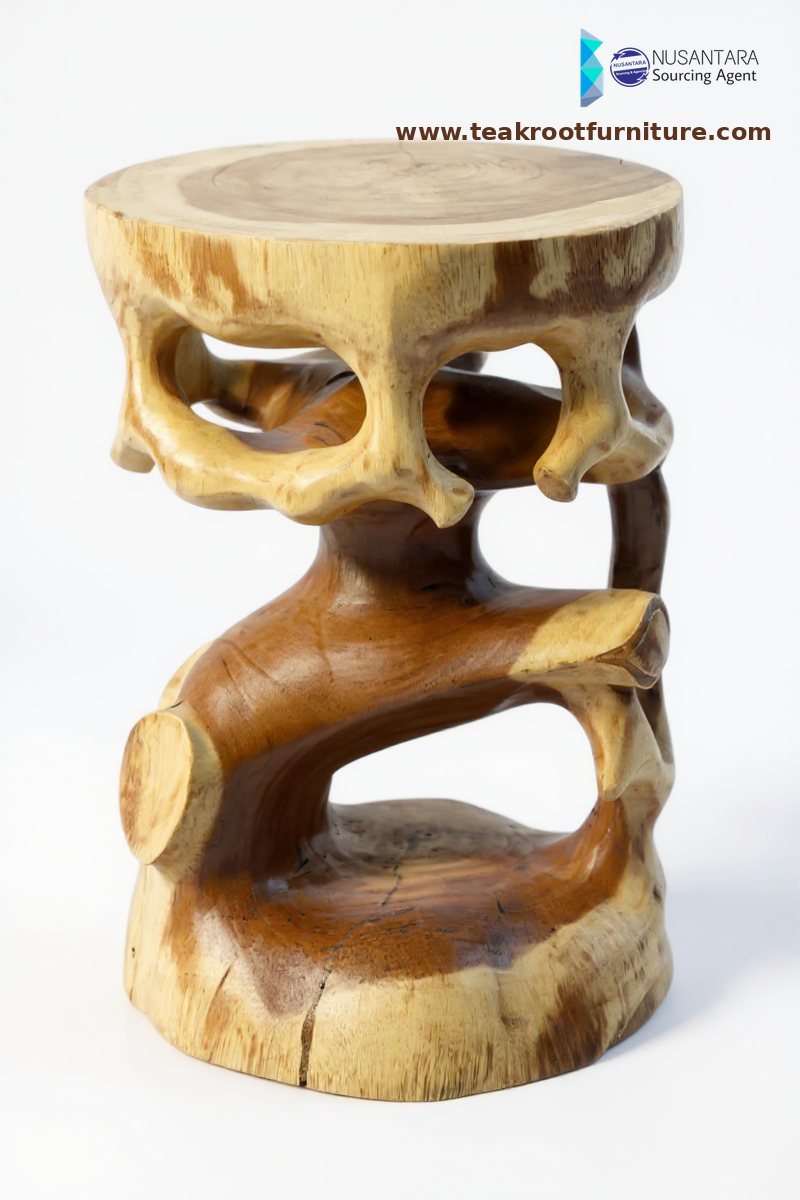
- Teak root stool and bench for restaurant overflow, spa reception and shaded terraces.
- Table base only, for buyers who cut stone or glass tops locally in Doha — it removes the freight and breakage risk on the top.
- Teak root planter and sculpture as lobby focal points, often the pieces designers photograph and reuse in marketing.
Two technical points come up in every serious conversation. The first is moisture: Doha interiors run at 22 °C with heavy air conditioning, and a root that leaves Indonesia at 12–15% moisture content will move or open a joint once it equilibrates. We kiln dry Gulf-bound orders to 8–10%; ask any supplier what figure they dry to, because "air dried" is not an answer. The second is consistency. A contract buyer cannot order forty identical root tables, but can order a matched family — pieces cut from the same root cluster, photographed individually and tagged, so the designer assigns this table to the presidential suite and that one to the pool bar.
Ready to price a container? Send us your item list and quantities, and we will confirm what fits in one load, the FOB Semarang price and a realistic lead time.
Send your item list for a quote →
The landed-cost maths worth running before you negotiate
Qatar applies a 5% ad valorem duty on the cost, insurance and freight value of general cargo under the GCC Unified Customs Law (US International Trade Administration, 2025; Invest Qatar). It is charged on CIF, not on FOB — the oldest mistake in the book is to build a price model on the invoice value and forget that freight and insurance are inside the duty base. On the tax side, Qatar still had no VAT in 2026; PwC's 2026 summary lists the expected rate at 5% under the GCC framework, and tax advisory trackers reported in September 2026 that no implementation date had been set. So model duty as a real cost and VAT as a later cash-flow question, not the reverse.
| Line | Basis | USD |
|---|---|---|
| Goods, 20'FCL mixed | FOB Semarang, illustrative | 12,000 |
| Ocean freight to Hamad Port | Forwarder quote, 2026 rates | 1,600–2,400 |
| Marine insurance | 0.5% of goods value | 60 |
| CIF value (duty base) | Goods + freight + insurance | 13,660–14,460 |
| Customs duty | 5% of CIF | 683–723 |
| Clearance, terminal handling, delivery order | Clearing agent, typical | 250–400 |
| Inland haulage to a Doha warehouse | Hamad Port to city | 120–200 |
| Landed cost | Uplift over FOB of 22.6–31.5% | 14,713–15,783 |
Put those numbers to work. Squeezing 3% off FOB saves USD 360 on this load; getting the HS line wrong, or sailing with crates that were never ISPM 15 stamped, costs more than that in a week of storage. The figure that should decide the deal is landed cost per piece, not FOB per container: on sixty pieces, the gap between the low and high case above is about USD 18 a piece, and that is the number your retail or contract price has to absorb.
Documents that actually hold a Qatar container
Most delays we see are documentary, not physical. The sequence that works:
- An importer of record with a valid import licence. Qatari law requires importers to be licensed; an overseas supplier cannot act as importer of record for you (US International Trade Administration, 2024).
- Commercial invoice, packing list, bill of lading and certificate of origin that agree on description, quantity and HS code, line by line. Discrepancy between invoice and packing list is the single most common reason a container sits.
- Arabic labelling. Goods entering Qatar must carry Arabic, or Arabic and English, labelling; Arabic stickers are accepted. For furniture this usually means a carton label and a care label, not a plate on the piece.
- ISPM 15 stamp on every crate and pallet, plus a phytosanitary certificate from the Indonesian plant quarantine service for the wood product itself. These are two different documents and buyers regularly assume one covers the other.
- A classification check against the revised Integrated Customs Tariff, which entered into force on 1 January 2026 with amended classifications and HS descriptions (EY Global Tax News, July 2026). If your broker is still working from a 2024 schedule, ask why.
- A view on conformity certification. Qatar operates a product conformity scheme for regulated categories; furniture has generally sat outside the mandatory list, but the list changes and the HS line decides. Confirm with your clearing agent before you assume exemption — not after the container is on the water.
One document nobody puts on a checklist: the carrier's free-time sheet. Free time at destination is set by the shipping line, not the port, and varies by box type. OOCL publishes Qatar-specific import free time, and Hapag-Lloyd's Qatar tariff has shown combined demurrage and detention allowances of up to 30 days on some equipment. Do not promise a hotel a delivery date before you know your free days — demurrage after a missed clearance is charged daily and is not negotiable.
Hamad Port in numbers, and what they mean for your sailing
Qatar's ports moved about 1.46 million TEU in 2025, with transhipment volumes through Hamad Port up 11% in the first half of that year, and Hamad ranked eighth worldwide in the 2025 Container Port Performance Index published by the World Bank and S&P Global. Installed capacity is far above current throughput — figures around 7.5 million TEU a year are quoted for the port — which is why Doha rarely suffers the berth queues that make Jebel Ali painful in peak season.
Published transit estimates for East Asia to Doha run 20–25 days, direct or with transhipment at Jebel Ali; quote platforms showed Semarang to Jebel Ali at about 23 days in 2026. Add clearance and inland delivery, and you are at three to four weeks. With 12 weeks of production on a first order, a container released in July lands in November — which is why F1 in late November is a July conversation, not a September one.
If you distribute onward into the GCC, the free zones are worth a look: businesses there hold 100% foreign ownership, a 20-year corporate tax holiday and zero customs duty on goods within the zone (Qatar Free Zones Authority), so stock can be re-exported without paying duty twice.
How to make the first order safe
A first container into Qatar should be boring, and the mechanism for that is a mixed load. Our minimum is one 20-foot container, mixed across products and sizes, priced FOB Semarang — a buyer can test dining tables, consoles and stools in one shipment instead of committing a 40-footer to a product nobody in Doha has seen.
What to put in the RFQ, so that two suppliers quote the same thing:
- Dimensions and quantity per SKU, with a tolerance for the natural variation of root timber (we work to ±3 cm on hand-shaped bases).
- Finish specified by behaviour, not by adjective: natural oil, matte lacquer, or wax, and whether the piece will sit outdoors under shade.
- Glass specification if you are buying tops — 10 mm tempered, edge polished, packed in a separate crate.
- Packing method, because it drives both damage rates and volume: single-face carton with corner protection is our standard, and it is what keeps landfall costs down.
- Destination port and the date you need stock on site, not the date you want to order.
A worked example. A 40-room boutique hotel in Doha typically needs about 15 dining tables for a 60-cover restaurant, 30 stools or benches, six coffee tables with glass tops for the lobby and lounge, and twenty consoles and side tables spread across suites and corridors. At roughly 0.9 m³ for a dining table, 0.15 m³ for a stool and 0.4 m³ for a coffee table, that scheme lands near 26 m³ — inside a single 20-foot container's usable volume, with room for a couple of planters. That is the arithmetic that makes a mixed container the sane first order rather than a compromise.
Payment on a first order is 50% deposit with the balance before shipment, and we photograph the load before the doors close. Buyers are welcome to inspect in Jepara or to appoint a third-party inspector — we would rather answer questions in the workshop than after the container arrives.
Where these pieces come from
Every piece here starts as a root ball left in the ground after a plantation teak tree is felled in Central Java. In Jepara, Indonesia — the carving town on Java's north coast that has supplied hardwood furniture for centuries — those roots are dug, washed and dried for six to eight weeks before anyone decides what they become. The root dictates the shape; a designer can specify a height and a footprint, but not the grain. That is the whole appeal, and also the reason a contract order has to be planned as a family rather than a repetition.
The rhythm of the workshop is set by the weather: the wet season from November to March slows air drying, so kiln capacity and cutting schedules are planned around it, and orders placed early in the year move faster than orders placed in the middle of it. Teak root is a by-product of legal plantation forestry, documented under Indonesia's timber legality assurance system, and we issue that paperwork per shipment because Qatari clearing agents ask for it consistently.
We have shipped more than 300 containers since 2016 at up to 4 × 40'FCL a month, mostly to importers, hotel groups and interior contractors in Europe and North America. Qatar is a newer market for us, which is why this article exists: if you import teak root furniture from Indonesia into the Gulf, a supplier who cannot answer these questions in writing before the order is not the supplier for a hotel deadline.
If the scope runs past Qatar into the wider Gulf, teak root furniture for Gulf hotels sets the duty, VAT and conformity rules out market by market, and the packing volume each market typically books.
DATA SHEET - FROM OUR FOB 2026 PRICE LIST
Models that leave the factory most often (FOB Semarang, delivery to Hamad Port)
| Model | CBM/pc | FOB | Max pcs in one 20ft |
|---|---|---|---|
| Cabak Dining Table dia 100 cm | 0.75 | USD 195 | ~32 pcs |
| Cabak Dining Table dia 120 cm | 1.08 | USD 265 | ~22 pcs |
| Cabak Dining Table dia 150 cm | 1.8 | USD 340 | ~13 pcs |
| Mawar Dining Table dia 120 cm | 1.08 | USD 265 | ~22 pcs |
| Mawar Dining Table dia 150 cm | 1.69 | USD 340 | ~14 pcs |
| Mawar Dining Table dia 200 cm | 2.43 | USD 650 | ~9 pcs |
Max pcs = if the container carries that model only, using 24 CBM of usable space.
A worked mixed load - 24 pieces, 22.78 CBM, FOB USD 5,310
| Item | Qty | CBM | FOB |
|---|---|---|---|
| Cabak Dining 120 cm | 8 | 8.64 | USD 2,120 |
| Mawar Dining 150 cm | 6 | 10.14 | USD 2,040 |
| Izpo Coffee Table 100 cm | 10 | 4.00 | USD 1,150 |
Border cost for this load into Qatar
| Goods, FOB Semarang | USD 5,310 |
| Ocean freight (example rate) | USD 1,500 |
| Insurance 0.5% | USD 34 |
| CIF value | USD 6,844 |
| Duty: per your tariff line (confirm with your broker) | not included |
| No federal VAT - state or local sales tax applies at destination | not included |
| Landed, before duty, broker and port fees | USD 6,844 |
Freight is an example rate, quoted per sailing. VAT (not yet applied) is the standard rate and is recoverable if you are registered. Duty depends on your tariff line and on the origin certificate; confirm both with your broker. Broker and port charges are set at destination and are not included. Product figures come from our FOB 2026 price list.
Frequently Asked Questions
Does Qatar charge VAT on imported furniture in 2026?
No. Qatar had not implemented VAT as of 2026; the 5% rate in the GCC framework is expected, but no date has been set. What you do pay is 5% customs duty on the CIF value, and that is not recoverable in the way a VAT would be.
Do teak root pieces need a certificate of conformity to clear Qatar customs?
Furniture has generally fallen outside Qatar's mandatory product conformity categories, but classification decides, and the list is revised. The documents that are always required for wood are the ISPM 15 stamp on packaging and a phytosanitary certificate for the product. Check your HS line with a clearing agent in Doha before production starts.
How long does it take from purchase order to stock in a Doha warehouse?
About four and a half months on a first order: 12 weeks production, three to four weeks on the water and at Hamad Port, then clearance and inland delivery. Repeat orders move faster because tooling, finishes and paperwork are already agreed.
Can one 20-foot container really furnish a 40-room hotel?
For loose furniture, usually yes. A scheme of roughly 15 dining tables, 30 stools or benches, six coffee tables, twenty consoles and a few planters comes to about 26 m³, which fits a 20'FCL. Bedroom case goods and upholstery are a different conversation and usually need a 40-footer.
Talk to us about your project
Send us your item list with dimensions and quantities, and we will come back within one working day with what fits in a single container, the FOB Semarang price and a lead time you can put in front of a hotel owner. If the project is still at design stage, send the drawings — better to flag a 300 cm slab that will not clear a service lift now than after fabrication.
Send your item list for a quote →
Packing, loading and shipping
Each piece is wrapped in bubble film, corner-protected and boxed in single-face carton; glass tops travel in their own crates with foam edging. Before loading we build a stack plan against the container's internal dimensions, weigh the load and photograph every stage against the packing list — a discrepancy found in Jepara costs an email, one found in Doha costs a week. You get the packing list and load plan to hand to your broker before the vessel sails.
Where does the container actually leave from?
From Jepara, on the north coast of Central Java, about two hours by road from the port of Semarang. The container is stuffed at our warehouse, checked against the packing list, sealed, trucked to Semarang and lifted onto the vessel there. FOB Semarang is our standard term, which is why the FOB price you are quoted is a port price and not a factory gate price.
Our office and factory stand at the same address on every document we issue: Jl. RA Rukmini KM.02 Pekalongan RT.02/V, Tahunan, Jepara 59428, Central Java, Indonesia.
MOQ 1 × 20'FCL mixed · up to 4 × 40'FCL per month · 300+ containers shipped since 2016 · export@teakrootfurniture.com
Written by
Mr. August Praymunor — Overseas Marketing Director
CV. Nusantara Sourcing Agent · manufacturer and exporter of teak root furniture in Jepara, Central Java, Indonesia. We have shipped over 300 containers since 2016, loading 4×40’FCL per month for importers, hotel groups and interior contractors in Europe and North America. Every figure in this article comes from the sources noted in the text or from our own shipping records.
export@teakrootfurniture.com · WhatsApp +62 852 0600 7878 · LinkedIn · Jl. RA Rukmini KM.02 Pekalongan RT.02/V, Tahunan, Jepara 59428, Central Java, Indonesia
See also
- Teak Root Furniture for the UAE: A Sourcing Guide for Importers
- Teak Root Tables for Oman: Import Duty & Buyer Guide
- Teak Root Table Bases for Glass and Stone Tops
- Our teak root furniture range
Model pages — price, CBM and container load
One page per model: size, packed volume, FOB Semarang price and how many fit in a 20ft container.
- Mawar Dining Table dia 200 cm — USD 650 · 2.43 CBM
- Oval root dining table 200 cm — USD 365 · 1.50 CBM
- Cabak Dining Table dia 150 cm — USD 340 · 1.80 CBM
0 comments:
Post a Comment