


Suar wood is the material most importers end up specifying for the pieces a teak root collection cannot carry on its own: matching dining tables, stools that stack, and planters that repeat across a hotel floor. Suar (Samanea saman) grows across Java, takes a wide, stable slab far more readily than root stock, and machines to consistent dimensions, which is why a container can be filled with one model instead of forty unique pieces.
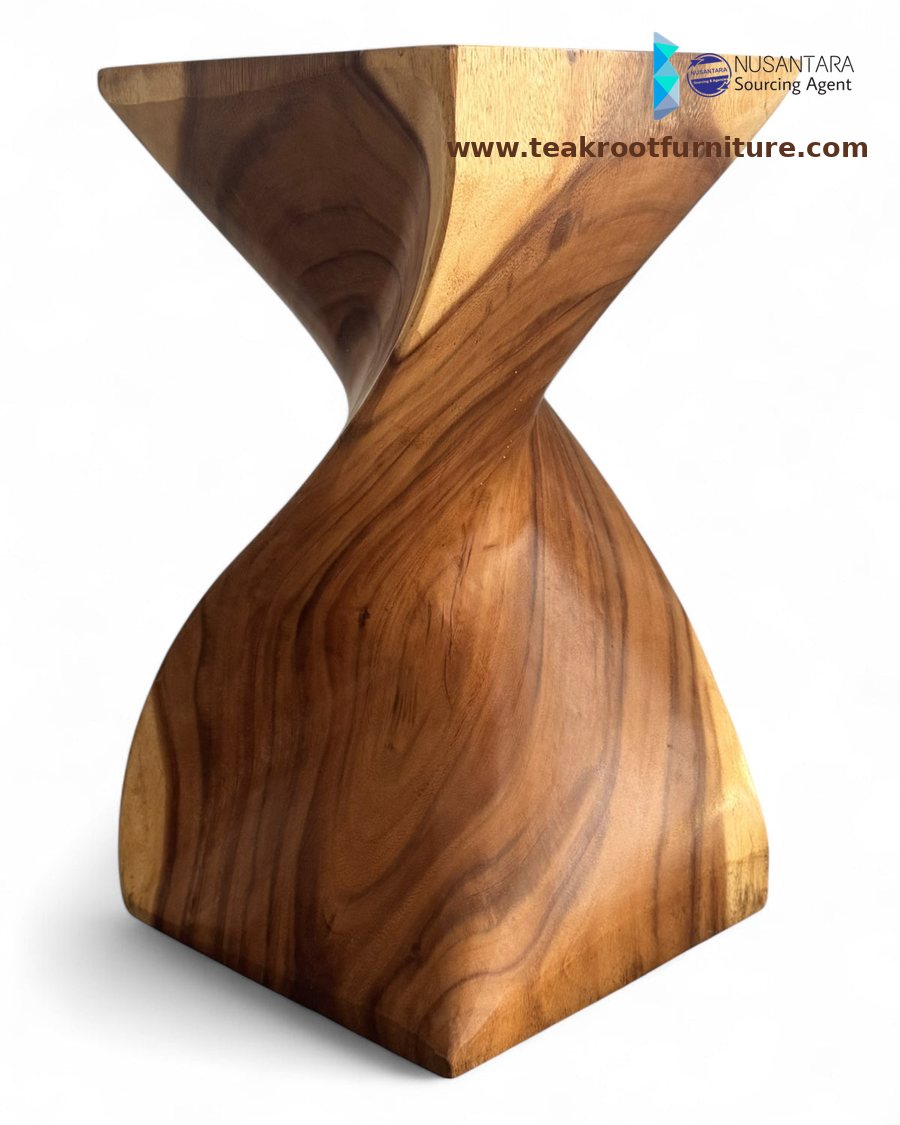
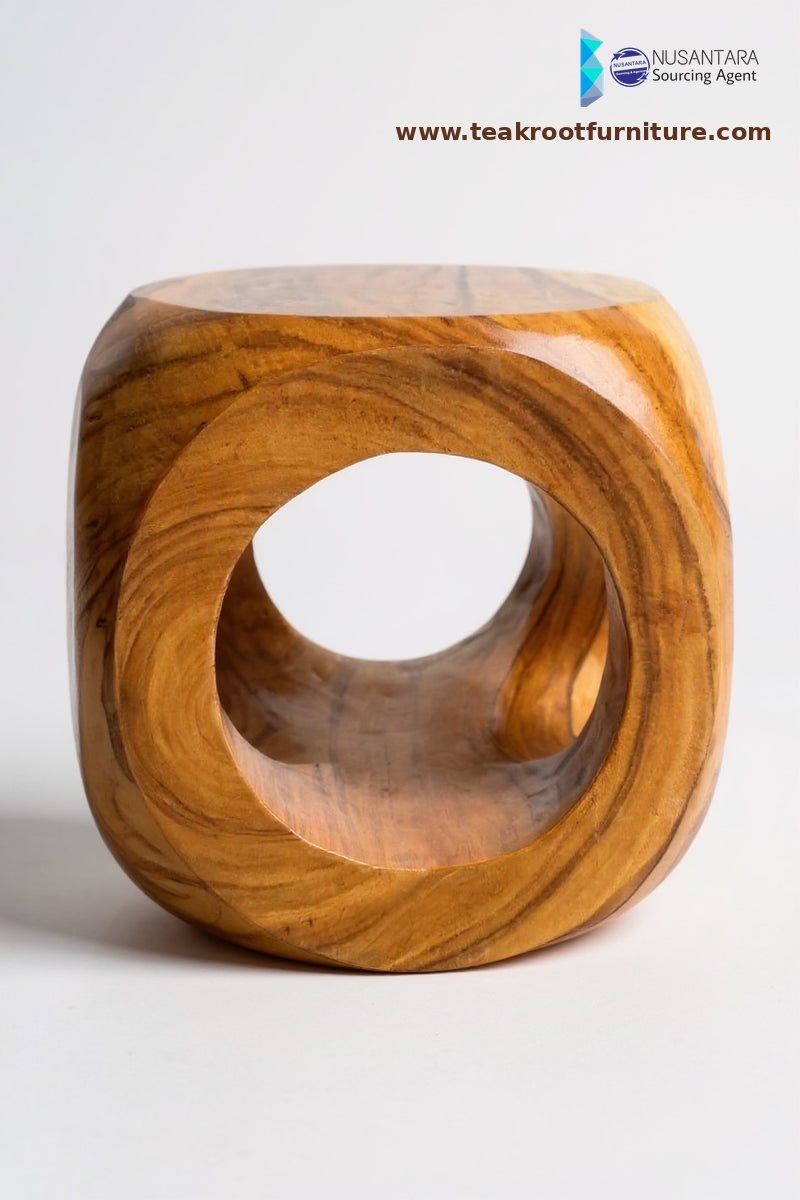
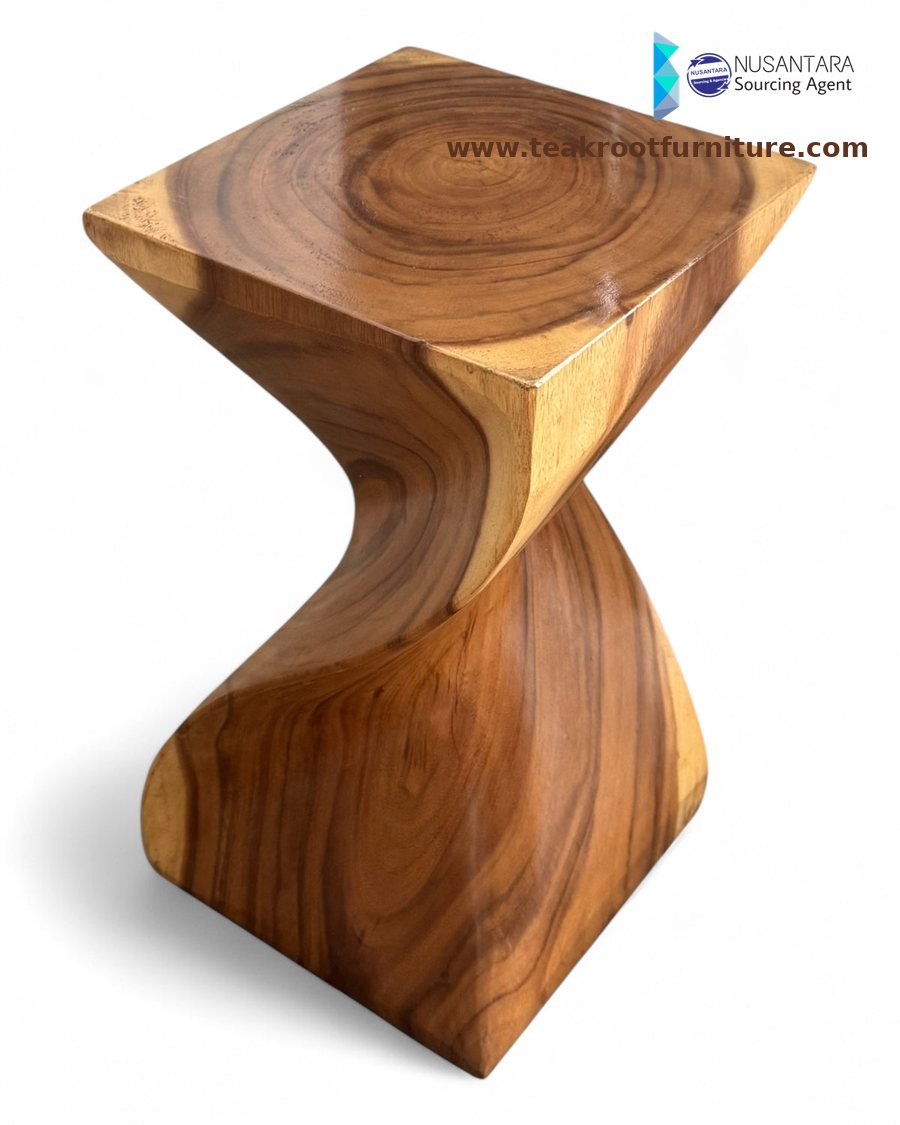
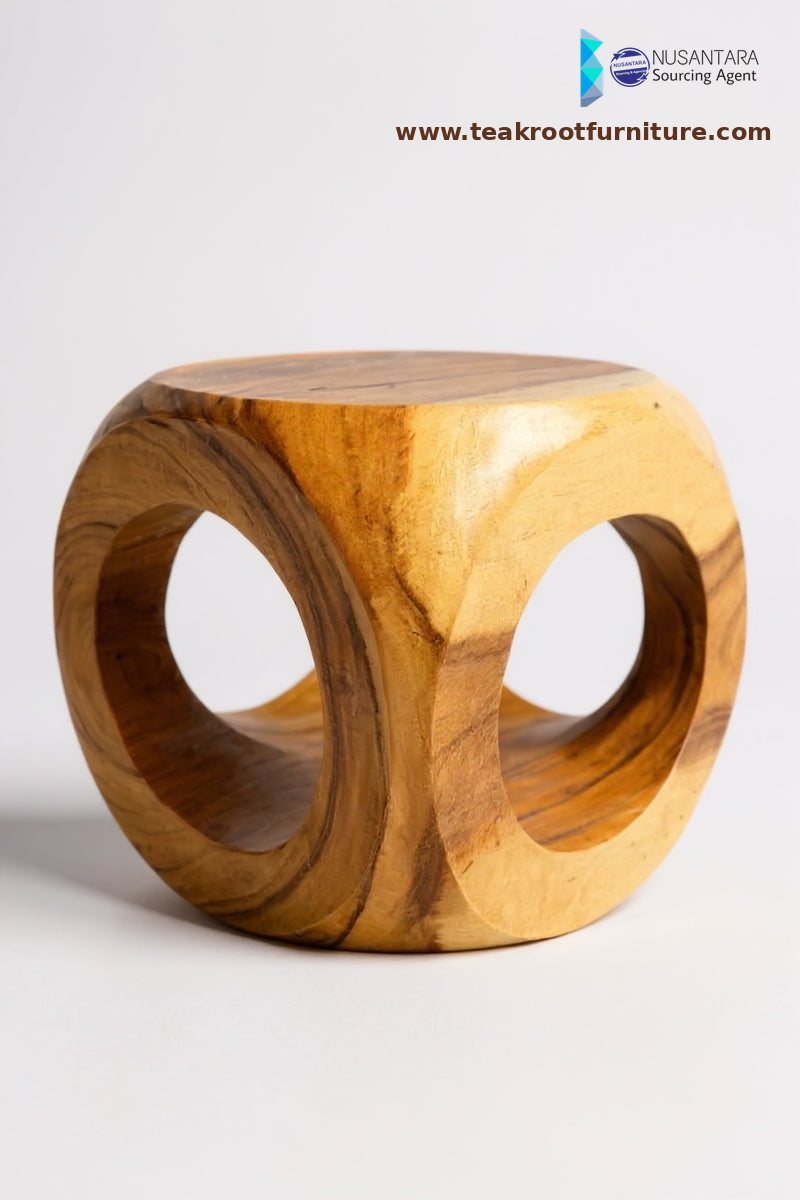
We manufacture suar wood dining tables, stools and planters in Jepara, Indonesia, and ship them FOB Semarang in mixed 20-foot containers. Round suar dining tables run from USD 195 to 340 per piece (100, 120 and 150 cm), stools from USD 38 to 55, and planters from USD 20 to 38 depending on diameter. Minimum order is one 20-foot container with mixed models, capacity is 4 x 40'FCL per month, and a first order takes about 12 weeks.
Last updated: 8 November 2026
What suar wood actually is, and why buyers confuse it with teak
Suar is Samanea saman, known in Indonesia as trembesi: a fast-growing shade tree with a wide trunk and an interlocking grain. It is not teak, and it is not teak root. Teak (Tectona grandis) is a different species with different density, colour and machining behaviour, and teak root furniture is made from the below-ground root mass, so every piece is one of a kind.
In the export trade the confusion is common because both are sold as "Indonesian hardwood". For a buyer the practical difference matters: suar gives you repeatable sizes and matched sets, while teak root gives you sculptural one-offs. Several of our importers run both in the same container, using suar for the dining and stool program and teak root for accent pieces.
Why dining tops are the natural home for suar
A dining top needs a flat, wide, stable surface. Root stock resists that, because the shape is the product. Suar sawn timber takes a round top from 100 to 150 cm in our current list without glue lines running through the centre, and takes a rectangular top when the project asks for one and the board is available.
Three things make it work in a commercial order:
- Repeatability. A hotel with 40 rooms can order 40 identical tables, not 40 variations of a theme.
- Machinability. Legs, aprons and tops are cut to dimension, so a repair or a second phase matches the first.
- Finishing control. The same sanding schedule and the same finish can be applied across the whole run.
Suar dining tables: sizes, freight and FOB prices
These are figures from our current price list, not estimates. All are FOB Semarang, per piece, before freight, insurance and import duty.
| Model | Top | Height | CBM/piece | FOB USD |
|---|---|---|---|---|
| Cabak dining table | 100 cm round | 75 cm | 0.75 | 195 |
| Cabak dining table | 120 cm round | 75 cm | 1.08 | 265 |
| Cabak dining table | 150 cm round | 75 cm | 1.80 | 340 |
Freight is where the model choice bites. A 20-foot container carries roughly 27 to 28 CBM of packed furniture, so the 150 cm table takes about 15 pieces to fill a box, while the 100 cm model takes closer to 36. If a buyer needs volume at a lower landed cost, the smaller top usually wins; if the project is a restaurant with large tables, the 150 cm model carries the design.
Stools: the item that pays for its own freight
Suar stools run USD 38 to 55 FOB at about 0.05 CBM each, which means one 20-foot container absorbs several hundred pieces without touching the dining program. That ratio is why stools are the first suar item most importers add: they fill the gaps around the tables, they are light to handle, and they can be nested in the load plan.
We produce them as solid one-piece seats or with a sculpted base, in two finishes: a light natural tone and a deeper brown. Because they are machined rather than root-shaped, a repeat order matches the first delivery.
Planters and pots: the accessory line that fills the container
Suar planters and flower pots run USD 20 to 38 FOB at 0.04 to 0.13 CBM. They are cut from the same boards as the table tops, so the colour and grain read as one family across a project. Interior planters are finished like furniture; exterior planters need a drainage hole, a liner and a finish that is re-oiled once a year.
For hotel and resort projects, planters are usually the piece that makes a container commercially viable: they bring the load factor up without adding much weight, and they let a buyer test a market with a small spend.
Suar against teak root: how to decide
| Question | Suar wood | Teak root |
|---|---|---|
| Best for | Matched dining sets, stools, planters, contract volumes | Statement tables, consoles, one-off accent pieces |
| Repeatability | Same model, same size, next order | Every piece differs by nature |
| Sizes | Round 100-150 cm, rectangular on request | Driven by the root, usually 90-200 cm |
| Price signal | Stools from USD 38, dining from USD 195 | Entry pieces from USD 28, statement tables to USD 650 |
| Container logic | Volume through stools and planters | Volume through coffee and side tables |
Drying, machining and finish
Suar moves while it dries, so the schedule matters more than the species. Our boards are kiln-dried before machining, then sanded and finished by hand. A closed-pore, matte finish suits interiors; a penetrating oil suits covered outdoor use. We agree the finish on a physical sample before production, and we keep that sample on file so the next order matches.
One honest caveat: suar is a natural material, so colour varies from board to board and the grain can include small knots and mineral streaks. If a project needs a single uniform colour, that has to be agreed up front and it costs more, because it means selecting boards.
Packing, documents and loading
Stools and planters travel in single-face cartons; table tops travel in cradles with corner protection, and legs are packed separately to keep the top flat. All packing timber is heat-treated and stamped to ISPM 15. Documents per shipment: commercial invoice, packing list, bill of lading, and a certificate of origin on request. We do not hold FSC or SVLK certification, so we do not describe our suar or teak as certified.
A worked container: what a suar order actually looks like
Buyers often ask for a container "mixed with everything". It is easier to decide with a real mix in front of you. Take a 20-foot container of about 27.6 CBM packed, a hotel project with 30 rooms and a restaurant:
- 12 dining tables at 120 cm × 1.08 CBM = 12.96 CBM, USD 3,180 FOB.
- 60 stools × 0.05 CBM = 3.00 CBM, USD 2,280 to 3,300 FOB depending on the model.
- 40 planters × 0.06 CBM average = 2.40 CBM, USD 800 to 1,520 FOB.
- Balance left roughly 9 CBM, which is where teak root coffee tables or consoles go, because those pieces are what make the project look designed rather than furnished.
That mix carries a suar wood table program, a seating program and an accessory program in one shipment, with one set of documents and one freight bill. It is also the reason we ask for the intended room list rather than a single model: the load plan decides whether the order is profitable, not the unit price.
Care and maintenance, in plain terms
Interior suar needs very little: dust, a damp cloth, and a re-oil every twelve to eighteen months if the surface looks dry. Avoid silicone polishes and avoid leaving standing water on a top. Outdoors, under a roof, re-oil once a year before the wet season; fully exposed, expect the timber to silver and plan for annual maintenance or a cover.
Planters need drainage. A pot without a hole becomes a water bowl, and no finish survives that. We drill drainage on request and can supply a liner.
What to send us for a quote
Three things shorten a quote from days to hours: the room list (what the piece is for), the sizes you need repeated, and the port you ship to. If you already have a reference photo, send it with the sizes marked — it is faster than a description, and it lets us tell you honestly whether the shape works in suar or whether it should be teak root.
Send those three things and you get back a load plan, the volume in CBM, the FOB Semarang price per model, and the lead time for that specific mix.
Frequently asked questions
Is suar wood the same as teak?
No. Suar is Samanea saman, a fast-growing Javanese hardwood also called trembesi; teak is Tectona grandis. They differ in density, grain and behaviour, and they are sold as separate programs.
Can suar be used outdoors?
Yes, with the right finish and hardware, and with re-oiling once a year. For a fully exposed site we usually recommend teak root or a covered position instead.
What is the minimum order?
One 20-foot container, mixed models allowed. There is no minimum per model, so a first order can be 10 dining tables, 60 stools and 40 planters.
How long does the first order take?
About 12 weeks from deposit, with 50 percent on order and the balance against the bill of lading copy.
Need a landed-cost estimate for suar? Send the models, sizes and quantities and we will confirm what fits in one container with the FOB Semarang price and a realistic timeline.
Send your item list for a quote →
See also
- Teak root and suar furniture range with FOB prices
- Suar wood table sizes, seats and CBM
- Suar wood vs teak: which one to choose
- Teak root dining tables for importers and retailers
- Teak root stools and seating wholesale
- Teak root coffee tables with glass tops
See the full catalogue and price list →
Written by
Mr. August Praymunor — Overseas Marketing Director
CV. Nusantara Sourcing Agent · manufacturer and exporter of teak root and suar wood furniture in Jepara, Central Java, Indonesia. We have shipped over 300 containers since 2016, loading 4×40’FCL per month for importers, hotel groups and interior contractors in Europe and North America.
export@teakrootfurniture.com · WhatsApp +62 852 0600 7878 · LinkedIn · Jl. RA Rukmini KM.02 Pekalongan RT.02/V, Tahunan, Jepara 59428, Central Java, Indonesia.
0 comments:
Post a Comment