


A 120 cm round table is the most quoted size in this trade and the one that disappoints most often. At four covers it works. At six, it gives each diner about 63 cm of table edge — enough on paper, tight once the chairs have arms and someone sits at the end. The buyer usually discovers this from a photograph, three months after the container left Semarang.
The arithmetic that prevents the mistake is short: seats, packed volume, and FOB per seat. This page is the sizing sheet our production office in Jepara, Central Java, Indonesia works from when a hotel group or a retail buyer asks what fits in one 20-foot container. FOB figures come from our price list of November 2026, volumes are packed carton volumes, and the container figures use what we actually load — 28 CBM in a 20-foot and 65 CBM in a 40-foot high cube, against a nominal 33.2 and 76.3 CBM (ISO container data).

The sizing sheet: seats first, then millimetres
Seat count follows the perimeter, not the diameter, which is why two tables of similar width can seat different numbers. The allowance we work to is 60 cm of table edge per cover at a dining table, 70 cm where chairs have arms or the setting includes a bread plate and two glasses. Divide the perimeter by that number and round down, never up.
The table below is our current dining range with the packed volume and FOB price from the same list, plus the number of pieces we would plan into a container after allowing for the air that round tops leave behind. The last two columns are planning figures, not straight division — the reason is in the next section but one.
| Model | Seats (60 cm rule) | Packed CBM | FOB USD | Per 20' | Per 40'HC |
|---|---|---|---|---|---|
| Round 100 cm | 4 | 0.75 | 195 | 31 | 73 |
| Round 120 cm | 4 (6 tight) | 1.08 | 265 | 22 | 51 |
| Round 150 cm | 6 | 1.80 | 340 | 13 | 30 |
| Round 200 cm | 8 | 2.43 | 650 | 9 | 22 |
| Oval 200 × 100 cm | 6–8 | 1.50 | 365 | 15 | 36 |
Read the 120 cm line twice. At four covers it costs USD 66 per seat in FOB terms; at six it costs USD 44 a seat and 63 cm of elbow room. That is why the size sells and why it generates complaints: it is specified for six and used by four. If the client genuinely needs six, move to 150 cm and say so before the order, not after.
The 200 cm round is a different animal. Its top weighs about 94 kg before the base is fitted, it takes two people to move, and it needs roughly 3.6 m of clear room to pull chairs out. In a resort lobby that works. In a 22 m² apartment it is furniture you cannot walk around.
Height is a specification, not a preference
Heights sell less visibly than diameters and cause more returns. The working numbers we build to:
- Dining tables: 75–78 cm. Below 74 cm a standard 45 cm chair seat leaves less than the 27–30 cm of clearance people expect under the apron.
- Coffee tables: 40–45 cm, paired with a sofa seat of 42–45 cm, so the gap stays in the 15–25 cm band.
- Console and side tables: 70–80 cm, so a lamp or a tray reads at hip height.
- Counter-height tables: 90 cm, with a 65 cm stool seat.
The most common error we see is not a wild number but a CAD number: a table drawn at 72 cm because the drawing was scaled from a photograph. Three centimetres does not sound like much; it is the difference between a chair sliding under the apron and a chair that catches it, and nobody in the showroom can say why the setting feels wrong. Send us the chair, or its seat height, and we set the table height from that.
Ready to price a container? Send the room count, the chair seat height and the sizes you are considering, and we will come back with what fits in one load, the FOB Semarang price and a realistic lead time.
Send your item list for a quote →
Why a table is mostly air: CBM, cartons and the 85 percent rule
CBM is calculated on the carton, not on the furniture: length × width × height in metres, and that is the number the freight forwarder charges against. A 150 cm round table is 1.80 CBM in our list, which corresponds to a carton of roughly 1.60 × 1.60 × 0.70 m — the top, the base and about 5 cm of foam and board on every side. The timber in that table is only 0.09 m³. The rest is protection and air, and the buyer pays freight on all of it.
The gap between nominal and usable volume is the second thing buyers underestimate. A 20-foot container holds 33.2 m³ by the ISO figure and a 40-foot high cube 76.3 m³, but no carton fills the corners, the door frame or the space above an uneven stack. We plan 28 CBM into a 20-foot and 65 CBM into a 40-foot high cube, which is 84–85 percent of nominal. A forwarder quoting you on 33 CBM for a 20-foot is quoting a number the terminal will not accept.
Round tops waste more than square ones because they do not nest. Between two rows of circular cartons there is a lens of empty space that nothing rectangular will fill. That is why we plan 85 percent of usable volume for round tables and fill the remainder with stools, planters and consoles — pieces that absorb the gaps and carry a better value per cubic metre than another table.
How many tables fit: a 30-room load plan, priced
Straight division flatters the plan. Twenty-eight cubic metres divided by 1.80 suggests fifteen 150 cm tables; at a realistic 85 percent packing factor it is thirteen, and a container forced to fifteen arrives with damaged edges. Below is a plan we actually quoted for a 30-room boutique hotel — nine larger tables for the dining room, smaller ones for terraces and suites, stools for the bar, planters for the entrance.
| Item | Qty | CBM each | Total CBM | FOB each | FOB total |
|---|---|---|---|---|---|
| Round dining table 150 cm | 9 | 1.80 | 16.20 | 340 | 3,060 |
| Round dining table 120 cm | 8 | 1.08 | 8.64 | 265 | 2,120 |
| Stools, mixed models | 40 | 0.05 | 2.00 | 42 | 1,680 |
| Planters, 40–60 cm | 20 | 0.06 | 1.20 | 30 | 600 |
| One 20-foot, mixed | — | — | 28.04 | — | 7,460 |
Two checks before this plan goes to production. First, weight: those tables, stools and planters come to about 1.9 t, against a cargo limit near 21.6 t for a 20-foot container. On this product volume always binds before weight, which is why a 6 cm top costs you money in the piece and in handling, not in freight. Second, the packing list: every line needs the model code, the finish and the quantity, because a mixed container is loaded in the order the list is written.

Thickness, weight and the cost per seat nobody calculates
Suar tops are normally 4–6 cm. Dried suar averages about 600 kg/m³ (The Wood Database), so the arithmetic is easy: a 150 cm round at 5 cm is 0.088 m³ of timber, about 53 kg; at 6 cm it is 64 kg. Neither threatens a container; both matter to the people who move the table.
Thickness is also where slab and glued tops part company. A single slab shows one continuous grain and cannot be repeated; a glued top is more stable, cheaper, and the only way to get a 240 cm width. Suar moves little in service — 2.0 percent radial and 3.4 percent tangential shrinkage from green to oven-dry (The Wood Database) — but a wide top fixed hard to a rigid base will still split at the joint, which is why the fixing method matters more than the thickness.
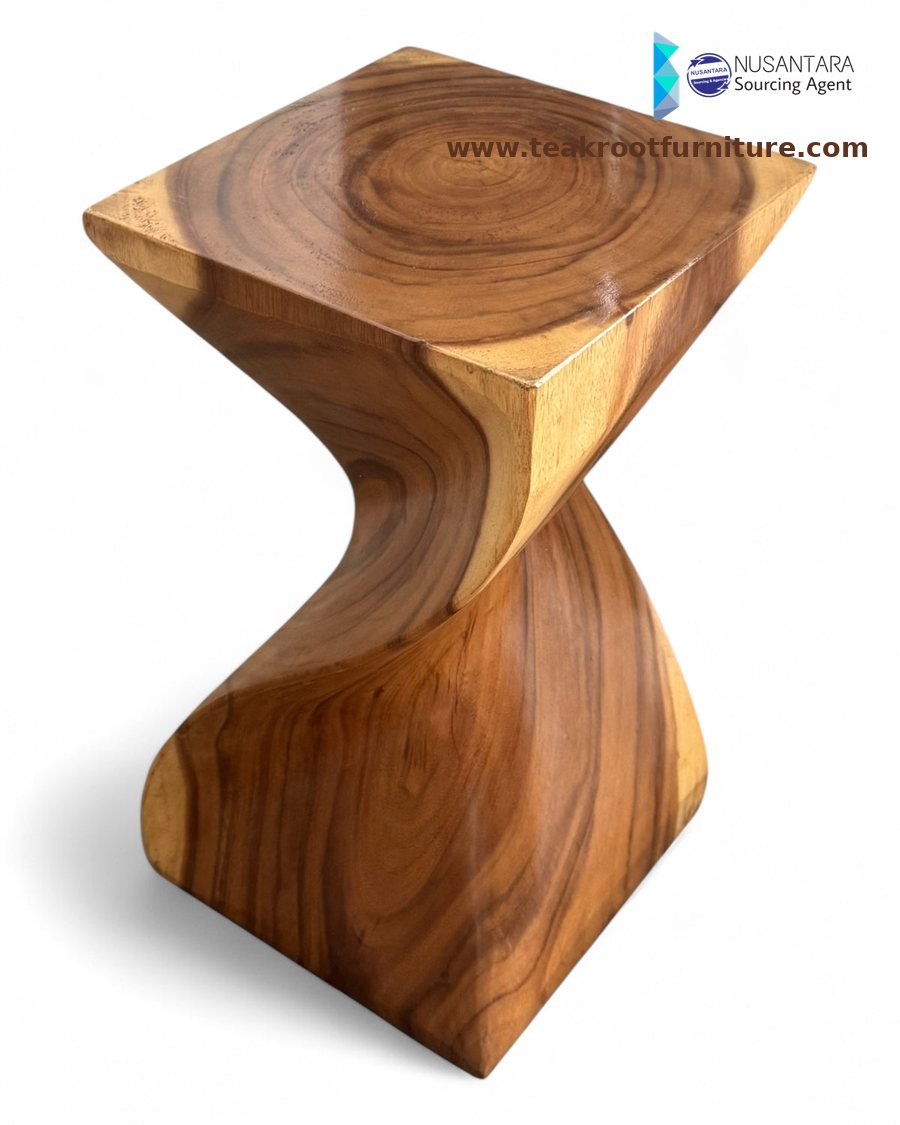
The number buyers rarely run is FOB per seat. At list prices: 100 cm is USD 49 a seat, 150 cm is USD 57, 120 cm is USD 66, and the 200 cm round is USD 81. The 120 cm is the worst of both worlds on paper — the highest price per cover in the range and the size most likely to be used by four people — yet it remains the default order. If your client list is couples and small families, the 100 cm is cheaper and easier to place; if it is groups, go to 150 cm and stop pretending the 120 cm seats six.
FOB is not the landed price: three borders, three numbers
FOB Semarang is where our responsibility ends and your cost calculation begins. Duty is charged on CIF (goods + freight + insurance), and VAT is charged on CIF plus duty, so a bulky table that costs little per cubic metre still carries a freight and tax multiplier. Using the same USD 340 table and an illustrative freight plus insurance of 25 percent of FOB — replace it with your forwarder's figure — the border looks like this:
| Destination | Duty | Local tax | Border cost on USD 340 |
|---|---|---|---|
| United States, HTS 9403.60.80 | Free | State sales tax at retail | ≈ USD 1.50 merchandise processing fee (0.3464%, floor and ceiling per entry apply); harbour fee on freight |
| Chile | 6% | 19% VAT | ≈ USD 111 |
| Uruguay | 16.2% | 22% VAT | ≈ USD 178 |
The US line is duty free for wooden furniture under HTS 9403.60.80 (USITC, 2026); the Chilean and Uruguayan rates are the published tariff and VAT on the same six-digit line, 9403.60, as recorded against each customs service in the ArancelLatam tariff table (verified September 2026). Port handling, clearance and inland haulage come on top and vary by terminal, which is why the honest comparison between two suppliers is landed cost per seat, not FOB per table.
Where suar comes from, and the two questions that decide quality
Suar is Albizia saman, the rain tree; in Java it is called trembesi. It grows 15–25 m tall with a crown up to 30 m across, and it was planted along roads and in villages around Kudus and Demak — the regencies next to Jepara — long before anyone thought of it as furniture timber. The logs are plantation and roadside trees, not forest trees, which is one reason the species is priced below teak root and well below teak.
Its working properties are the reason it suits big tops: average dried weight around 600 kg/m³, Janka hardness about 900 lbf, and low shrinkage, so a 240 cm top stays flat if it was dried properly and fixed with allowance for movement (The Wood Database). It is also softer than teak, which matters on a hotel dining table that meets cutlery and cleaning chemicals four times a day. A hardwax oil finish, renewed annually, is our standard recommendation for contract use.
Two questions separate the workshops that understand timber from the ones that only understand prices. Was the top kiln-dried before machining, and to what moisture content? For export, we work to 8–12 percent; a top machined at 18 percent will arrive in a European winter and shrink into a cup. How is the top fixed to the base? If it is screwed down hard with no slotted holes or buttons, the first dry season will find the weakest point in the grain.
Making the first order safe
A first order does not need to be a container of one model. Our minimum is one 20-foot container, mixed, with no minimum per model — which lets a buyer test four sizes, two finishes and a stool in the same shipment. Lead time on a first order runs about 12 weeks: drying and machining are the long part, and rushing the kiln is how tables arrive at 16 percent moisture. Payment is 50 percent deposit with the balance before shipment.
What makes the order safe is the paperwork before production: a spec sheet in millimetres with tolerances written down (±5 mm on tops, ±3 mm on height), the chair height you are pairing with, a finish sample approved by photograph or courier, and a packing list agreed line by line. Buyers are welcome to inspect in Jepara before loading; the factory and the office are at the same address on every document we issue.
Frequently asked questions
How many 120 cm suar tables fit in a 20-foot container?
Twenty-two, planned. Each is 1.08 CBM packed, and we load about 28 CBM into a 20-foot, then apply an 85 percent factor because round cartons do not nest. Straight division suggests 25 or 26.
Why is a 150 cm round table 1.80 CBM when the timber in it is only about 0.09 m³?
Because freight is charged on the carton. The packed carton is roughly 1.60 × 1.60 × 0.70 m — 5 cm of foam and board around a 150 cm top, plus the base stacked underneath. That is 1.79 m³, rounded to 1.80 in the price list, and it is the number your forwarder will use.
Can I mix 100, 120 and 150 cm tables with stools in one container?
Yes — that is the normal first order. A worked example is in the load plan above: 9 tables at 150 cm, 8 at 120 cm, 40 stools and 20 planters total 28.04 CBM and about USD 7,460 FOB. The constraint is volume, not weight; the shipment weighs under 2 t against a limit near 21.6 t.
Does a 6 cm top instead of 5 cm change my freight cost?
Barely. One extra centimetre of carton height on a 70 cm carton is about 1.4 percent more volume, or roughly USD 1–2 per table at typical freight rates. What it does change is weight — about 11 kg on a 150 cm top — and the FOB price, because it is more timber and more machining. Specify thickness for the look and the load, not to save freight.
Talk to us about your project
Send us the room schedule, the chair you are pairing with and the finishes you are considering. We will reply with the sizes that fit, the packed volume, the FOB Semarang price and a load plan you can forward to your broker — usually within one working day.
Send your item list for a quote →
Packing, loading and shipping

Each top is wrapped in foam and board, corners reinforced, and packed in a single-face carton with the base in its own carton beneath it. Tops ship flat, never on edge. We stack by model so the load plan and the packing list match, photograph every row as it goes in, and hand the forwarder a loading sequence that puts the pieces needed first at the door. Buyers who want their own inspector on site are welcome; we book the slot and provide the packing list in advance.
Where does the container actually leave from? It is loaded at our workshop in Jepara, on the north coast of Central Java, about 65–70 km and roughly two hours by road from the port of Semarang. Every piece is checked against the packing list before it goes on the truck, the container is sealed at the factory, and FOB Semarang is the term we quote as standard.
Our office and factory stand at the same address on every document we issue: Jl. RA Rukmini KM.02 Pekalongan RT.02/V, Tahunan, Jepara 59428, Central Java, Indonesia.
MOQ 1×20'FCL mixed · 4×40'FCL per month · 300+ containers shipped since 2016 · export@teakrootfurniture.com
Written by
Mr. August Praymunor — Overseas Marketing Director
CV. Nusantara Sourcing Agent · manufacturer and exporter of teak root and suar wood furniture in Jepara, Central Java, Indonesia, with over 300 containers shipped since 2016.
export@teakrootfurniture.com · WhatsApp +62 852 0600 7878 · LinkedIn
0 comments:
Post a Comment