


Boho is not a style you can order from a catalogue of shapes; it is a set of rules about material, scale and imperfection. For an importer that matters, because two suppliers can both claim "boho" and deliver ranges that do not sit together on the same shop floor: one low and organic, the other tall, glossy and sharply finished. This guide sets out the five markers that actually define boho furniture, the sub-styles buyers ask for by name, and what each one means when you have to write a purchase order.
Summary: Boho furniture is defined by five markers: natural materials used as structure, low and rounded proportions, visible handmade irregularity, a warm neutral palette, and layered texture. Teak root and suar wood from Jepara meet the first three directly. Minimum order is one mixed 20ft container, FOB Semarang, about 12 weeks.
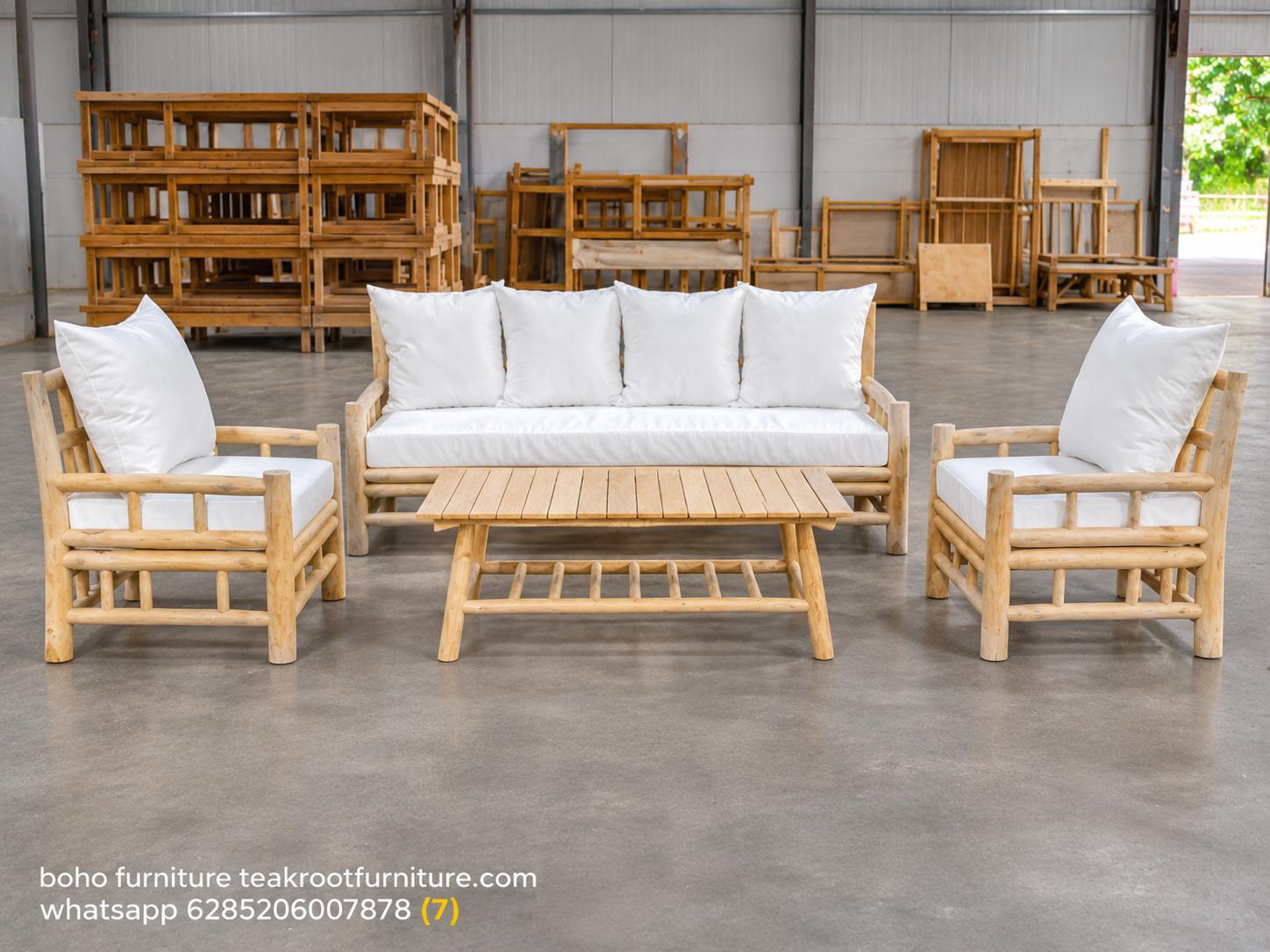
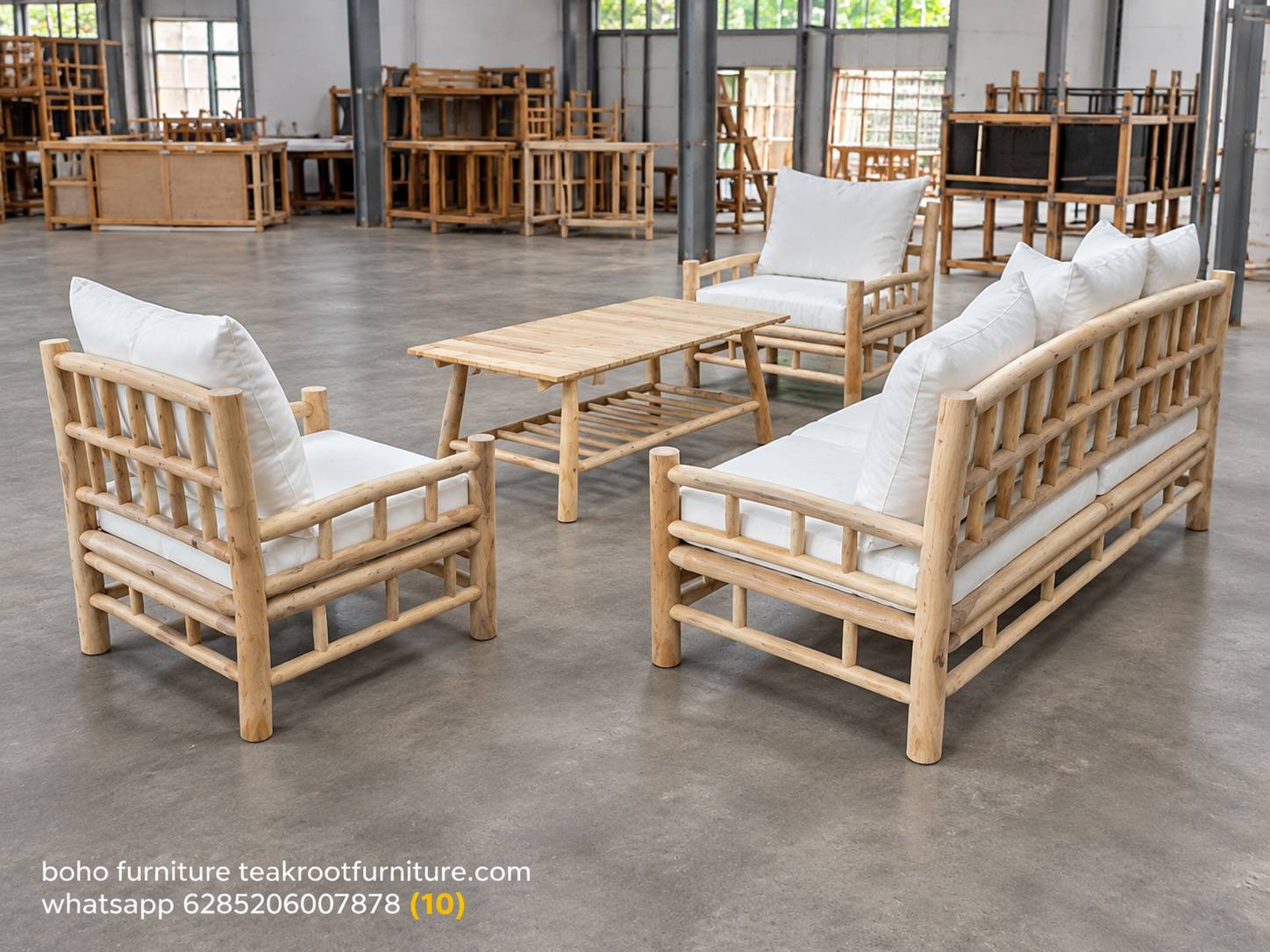
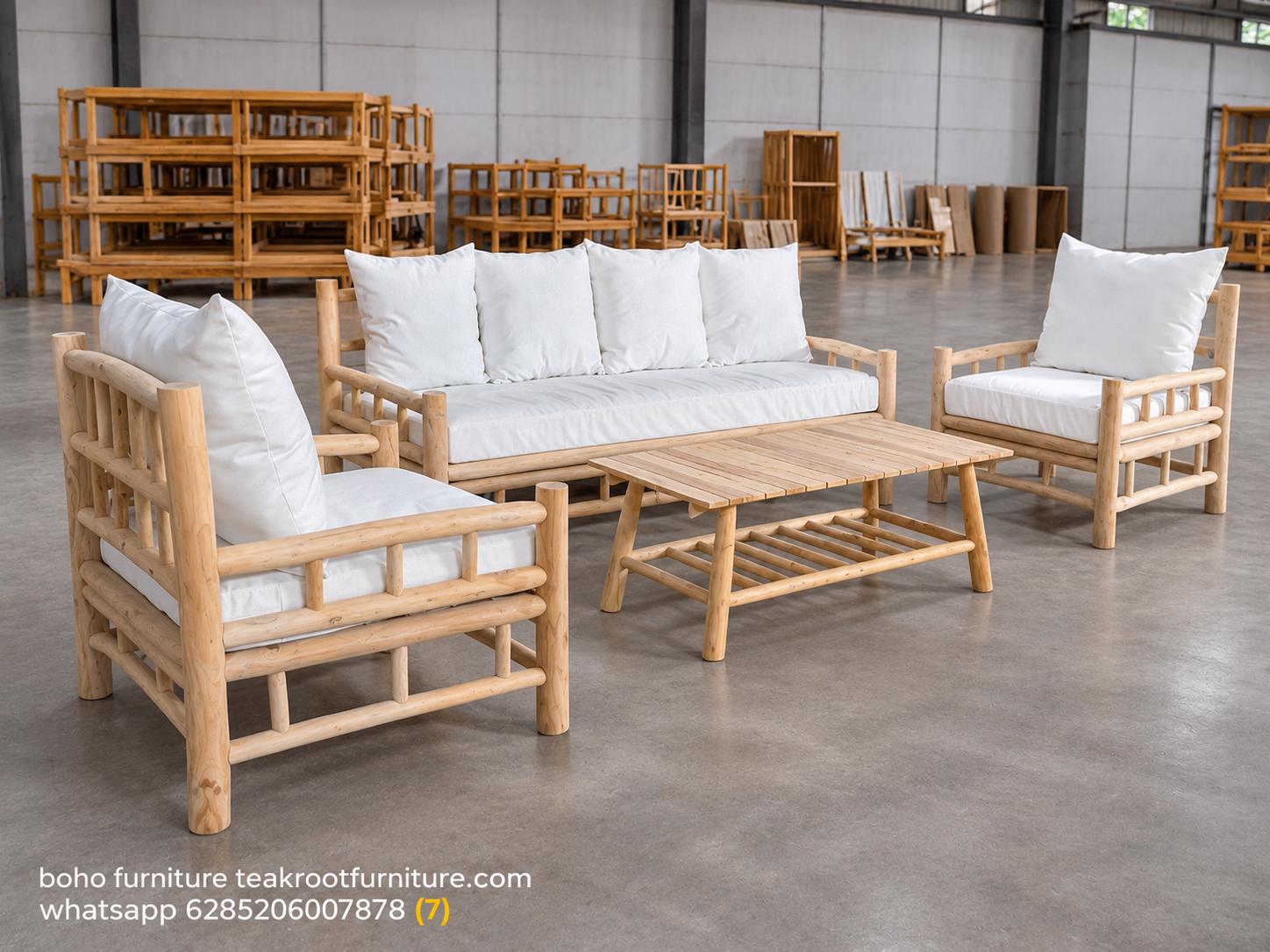
The five markers that make furniture read as boho
Trend language is loose; manufacturing is not. When a buyer says "boho", what they are usually recognising is the presence of five things at once. Strip any one of them out and the range drifts toward Scandinavian, industrial or coastal.
| Marker | What it looks like | What to write on the PO |
|---|---|---|
| Material as structure | Wood does the work: a root base, a slab top, a branch leg | Solid teak root or suar wood; no veneer, no MDF |
| Low, rounded proportion | Coffee tables at 30-40 cm, dining at 75 cm, no sharp boxy edges | Height, diameter and edge profile stated per model |
| Irregularity | No two pieces identical; grain, knots and root shape differ | Approve from photographs of the actual batch, not a swatch |
| Warm neutral palette | Natural, honey, walnut, black-wash, white-wash | Finish name recorded per line item |
| Layered texture | Wood next to glass, rope, linen, ceramic, rattan | Which models take a glass top, which stay solid |
The five sub-styles buyers ask for by name
Coastal boho is the lightest: bleached and white-washed finishes, glass tops, pale linen, rooms that look like a bach or a beach house. It is the dominant version in New Zealand, Australia and the Netherlands.
Boho-chic keeps the shapes but adds a darker, more polished finish: walnut and black-wash, brass or iron in the base, more contrast. This is the version that sells in city apartments and boutique hotels.
Rustic boho leans into the raw material — live edges, visible root structure, minimal sanding, oil rather than lacquer. It is the version we are naturally closest to, because the material is the design.
Japandi-boho is the quiet one: fewer pieces, lower contrast, straight-ish lines with one organic object per room. It is growing fastest in Northern Europe and Japan, and it needs tighter dimensional tolerance than the others.
Maximalist boho mixes everything — which is the easiest to sell a container of and the hardest for a retailer to repeat, because every piece is different by definition.
What boho means for an importer, in numbers
The practical consequence of "no two pieces identical" is that photography and measurement approval become part of production, not an afterthought. Our standard terms reflect that: one mixed 20-foot container minimum, FOB Semarang, 50% deposit with the balance before shipment, about 12 weeks on a first order, and every item photographed and measured before loading.
Two numbers matter more than any style word. One 20ft container carries roughly 24-26 CBM usable of its 28 CBM, and the CBM per piece decides how much of a range you can test. A stool at 0.038 CBM lets you ship hundreds; a 200 cm dining table at 2.43 CBM uses a tenth of the container on its own. Boho ranges are usually mixed for exactly that reason: stools, side tables and bowls fill the space around the statement pieces.
Send your item list for a quote →
Where boho and our own range overlap
Teak root is a by-product of plantation harvesting: the root mass is left when the tree is felled, and shaping it into a table base or a stool is a way of using material that would otherwise be burned. Suar wood covers the ranges that must repeat — the 120 cm dining tables and consoles a retailer needs in quantity. Most of our importers carry both lines in one container, which is also the cheapest way to look like a full-range boho supplier.
What we do not do is the soft furnishing: cushions, rugs, macramé. Buyers who need a complete room usually source textiles locally and take the wood from us.
Request a Quote and Price ListWholesale terms →
Frequently Asked Questions
What exactly is boho furniture?
Boho furniture is a styling convention rather than a manufacturing specification: solid natural materials, low and rounded proportions, visible handmade irregularity, warm neutral finishes and layered texture. The pieces are usually individual rather than matched, which is why photographs and measurements are approved batch by batch.
Is boho still in demand in 2026?
Yes, but it has moved from maximalist layering toward quieter versions - coastal boho and japandi-boho - where fewer pieces carry the look. In our own search data, "boho" appears far more often as a modifier (boho coffee table, boho dining table) than as a category on its own.
Can boho furniture mix with modern interiors?
That is the most common use now: one organic object in an otherwise plain room. A single root coffee table or a bleached console reads boho without turning the room into a themed set, and it is the easiest way for a retailer to sell the range to customers who are not committed to the style.
Which woods are authentic to boho furniture?
Teak, suar, mango, acacia and rattan are the materials buyers associate with it. We work teak root and suar wood; both are dense hardwoods suited to humid climates, and both are finished by hand rather than lacquered in a factory line.
0 comments:
Post a Comment